
Table of Contents
- Viscosity - the internal friction you cannot see
- Why every oil flows differently
- Temperature - the most sensitive dial on viscosity
- The bath of Maria - two thousand years of the water jacket
- Mixing - the art of moving without aerating
- From hopper to bottle neck
- What viscosity reveals about oil freshness
- Oil in motion - a summary
- Frequently Asked Questions
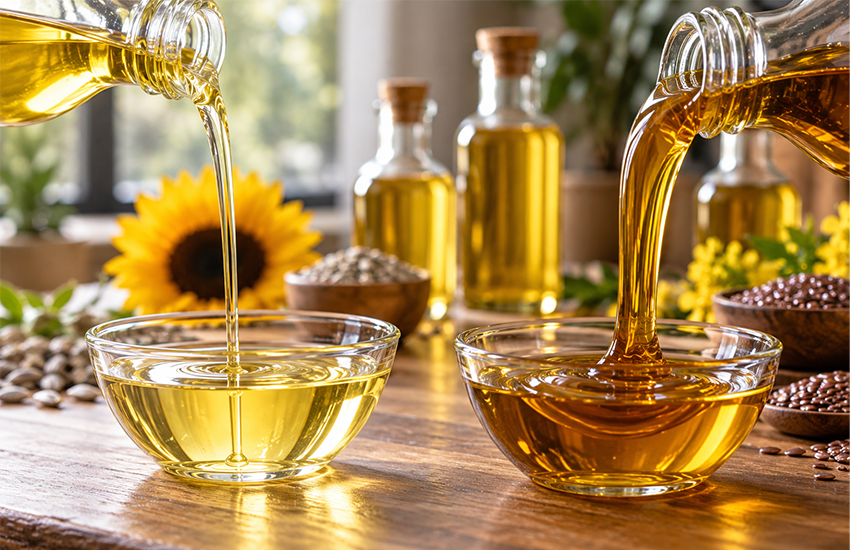
Pour the same linseed oil twice - once on a chilly autumn morning, once on a hot summer afternoon - and you will see two different liquids. In the morning the stream is thick and lazy, folding into a heavy ribbon and dripping from the rim of the jug for a long time. In summer the same oil runs fast in a thin, almost watery thread. Nothing has changed in the oil itself - not its composition, not its freshness, not the seeds it came from. What has changed is a single physical property that is mentioned surprisingly rarely in the press room, even though it accompanies every litre from the press outlet all the way to the bottle cap. That property is viscosity.
In this article we take a close look at oil viscosity. We explore where it comes from, why castor oil flows like syrup while linseed oil runs almost like water, what an alchemist from Alexandria nearly two thousand years ago has to do with it, and why a heated hopper with a mixer plays such an important role in a modern filling machine. It is a story of physics, chemistry and history that begins in a single triglyceride molecule and ends at a clean bottle neck.
Viscosity - the internal friction you cannot see
Put simply, viscosity is the resistance a liquid puts up when we try to set it in motion. When oil runs down the inside of a funnel, its layers do not all move at the same speed. The layer touching the wall barely moves, the next ones slide over each other faster and faster, and the centre of the stream moves fastest of all. Between those layers there is a kind of friction, and how strong it is depends on how firmly the liquid's molecules attract their neighbours and how easily they can slip past one another.
In water the molecules are small and nimble, so the layers glide with little resistance. In oil we are dealing with real giants. A single triglyceride molecule consists of three long fatty acid chains attached to a glycerol backbone - more than fifty carbon atoms in total. Such a molecule looks more like a splayed twig than a little ball. To move, it has to squeeze between its neighbours, snagging on them and briefly tangling with them. That is where the familiar sense of thickness and "oiliness" comes from.
Poiseuille, Stokes and units with a history
A curiosity for lovers of scientific history: the basic units of viscosity are named after two men, neither of whom worked with oil. The poise honours Jean Léonard Marie Poiseuille, a French physician who in the first half of the nineteenth century studied blood flow in capillaries. To understand circulation, he pushed water through glass tubes about as thin as a hair and measured how much liquid passed through in a given time. The law he formulated says that flow through a tube rises with the fourth power of its radius. A tube twice as wide therefore lets through not twice but sixteen times as much liquid. The same principle is at work today in every hose and every filling nozzle.
The second unit, the stokes, used for kinematic viscosity, comes from the Irish physicist George Gabriel Stokes. Among other things, Stokes described how fast a sphere sinks through a viscous liquid - and that law will come back later in this article when we turn to air bubbles. In laboratory practice, oil viscosity is most often given in millipascal-seconds (mPa·s), and one centipoise equals exactly one millipascal-second.
Oil, water and honey on a single scale
At 20°C water has a viscosity of about 1 mPa·s. Typical vegetable oils at the same temperature fall roughly between 40 and 90 mPa·s - so they are several dozen times more viscous than water. Linseed oil sits near the bottom of that range, rapeseed and sunflower oil roughly in the middle, olive oil closer to the top. Honey is in a different league altogether: depending on its water content and the type of sugars, anywhere from a few thousand to over ten thousand mPa·s. Castor oil, which we will come to shortly, reaches nearly 1,000 mPa·s at room temperature.
These numbers have a surprising consequence. Human senses are rather imprecise when it comes to viscosity. Linseed oil and olive oil differ in viscosity by almost a factor of two, yet poured onto a spoon they look very similar. The eye only starts to tell liquids apart clearly when they differ by a factor of several or more. A machine is far more sensitive - for a filler, even a difference of ten or fifteen percent means a different filling time, a different stream shape and a different behaviour of the drop at the tip of the nozzle.
Why every oil flows differently
If all vegetable oils are built from triglycerides, where do such large differences come from? The answer lies in the details of the fatty acid chains and in what else - besides the fat itself - is floating in the oil.
Chain length and the number of double bonds
Two features of a fatty acid have the greatest influence on viscosity. The first is chain length. The longer the chain, the more places where molecules can rub against each other and the greater the resistance to flow. Old rapeseed varieties, rich in erucic acid with 22 carbon atoms, are a good example. Their oil was noticeably thicker than oil from modern varieties, which are dominated by oleic acid with eighteen carbons.
The second feature is the number of double bonds. Each cis double bond puts a permanent kink in the chain. A straight, saturated chain can lie snugly against its neighbour like pencils in a pencil case. A chain with three kinks, as in alpha-linolenic acid, is more like a bent piece of wire - the molecules cannot get close to each other, interact more weakly and slip past one another more easily. That is why linseed oil, in which alpha-linolenic acid often makes up more than half of all fatty acids, flows more lightly than olive oil dominated by monounsaturated oleic acid.
The same geometry explains why fats rich in saturated fatty acids, such as cocoa butter or coconut oil, are solid at room temperature. Their straight chains can arrange themselves into ordered crystalline structures, and the liquid becomes a solid. Between runny linseed oil and hard cocoa butter there is no chasm, then - just a smooth scale on which every fat takes the place dictated by the shape of its molecules.
Castor oil - the exception that proves the rule
There is one vegetable oil that does not fit with the rest at all. Castor oil, pressed from the seeds of the castor plant, is roughly ten times more viscous than rapeseed oil. The secret lies in ricinoleic acid, which makes up around 90% of its fatty acids. Halfway along the chain of this acid sits a hydroxyl group - the same group that is responsible for hydrogen bonding in water and alcohols. Castor oil molecules do not just rub against each other, they literally attract one another and form fleeting bridges. The effect is like a crowd in which some people are holding hands - such a crowd moves much more slowly.
For this reason castor oil was for decades a prized lubricant for aero and racing engines. It kept a sufficiently thick lubricating film where many other oils failed. It is a good example of how viscosity is not a random trait but a direct record of molecular structure - one extra group of atoms in the chain is enough to make an oil behave like syrup.
Unrefined oil - a suspension, not a pure liquid
Oil straight from a screw press is not a uniform liquid but a suspension. Floating in it are fine particles of seed meal, traces of water, phospholipids, waxes, proteins and pigments. Some of them settle in the sedimentation tank, but even after clarification, cold-pressed oil contains far more accompanying compounds than refined oil. They are responsible for its taste, aroma and colour, but they also affect how the oil flows.
Every solid particle dispersed in a liquid increases its viscosity. Albert Einstein described this phenomenon in his 1905 doctoral thesis, showing that the viscosity of a dilute suspension rises in proportion to the volume occupied by the dispersed particles. He used the same work, incidentally, to estimate the size of sugar molecules dissolved in water. In press room practice this simply means that fresh, unclarified oil is always a little thicker than the same oil after a few days of settling, and that oil with visible sediment behaves differently in a filler than clarified oil.
Temperature - the most sensitive dial on viscosity
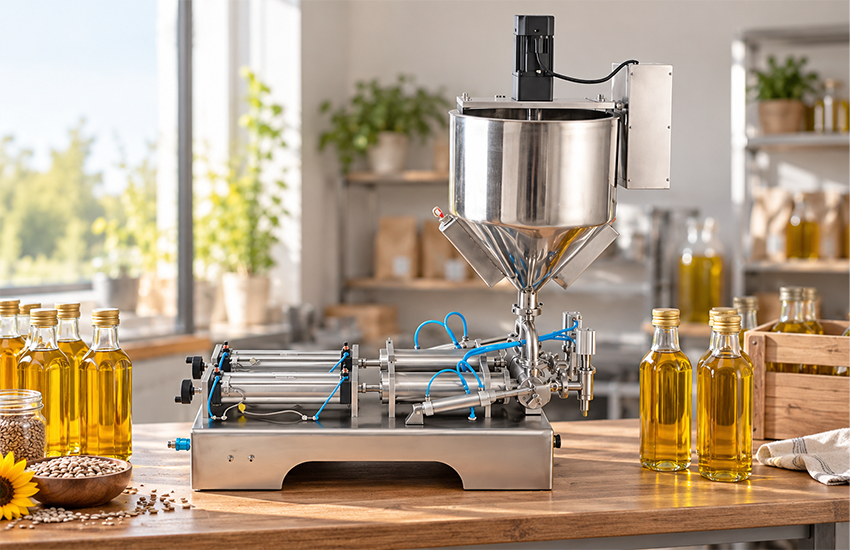
Of all the factors that affect oil viscosity, temperature acts most strongly. Just as importantly, it is the only factor that can easily be controlled during work. The fatty acid profile is set by the seeds, the amount of fine particles depends on the press and the settling tank, but the temperature of the oil in the hopper can be set with a dial.
Every fifteen degrees or so halves the resistance
As oil warms, triglyceride molecules vibrate and move more vigorously. They overcome their neighbours' resistance more easily, and viscosity drops markedly. For vegetable oils this relationship is very strong: between the temperature of a cool cellar and a warm room, viscosity falls by roughly half for every 15-20 degree rise. Rapeseed oil that flows lazily like thin syrup at 10°C has several times lower viscosity at 40°C.
Mathematically this is described by the equation proposed in 1930 by the British physicist Edward Andrade - the viscosity of a liquid falls exponentially as temperature rises. Such a relationship has an interesting property: the low-temperature range is the most sensitive. The difference between 10 and 20°C changes the oil's behaviour far more than the difference between 40 and 50°C. That is why a press room working through autumn and winter in an unheated building notices the oil's change of "character" much more clearly than in summer, when all production takes place at a similar, higher temperature.
Waxes, cloudiness and oils that set on the shelf
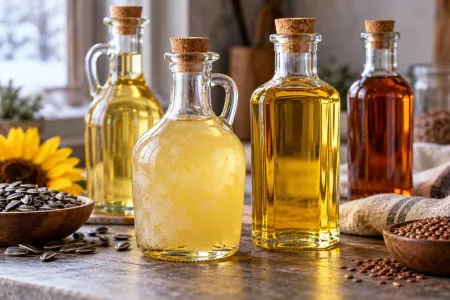
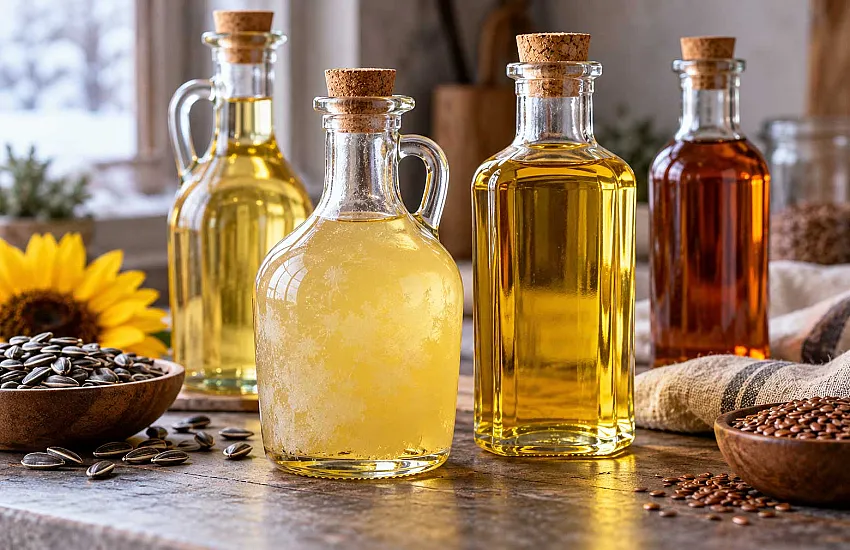
At low temperatures more happens than just a rise in viscosity. Unrefined sunflower oil contains waxes from the seed hulls. In warm oil they are dissolved and invisible, but once cooled below the mid-teens Celsius they begin to crystallise as fine needles. The oil turns hazy and opalescent, and in extreme cases a delicate, fluffy sediment appears at the bottom of the bottle. The process of removing these waxes is called winterisation - literally "wintering" the oil - and consists of chilling it and filtering out the crystals before winter in the storeroom does the job instead.
Olive oil in the fridge behaves in a similar way, forming whitish clusters of crystals of higher-melting triglycerides at a few degrees above zero. Coconut oil goes even further - at around 24-25°C it changes from solid to liquid. In an unheated room it can be a white, compact mass in the morning and a clear liquid by the afternoon. For anyone filling containers, the lesson is clear: without temperature control there is no repeatable work, because the product in the hopper changes from hour to hour.
Oil expands like the liquid in a thermometer
Temperature changes not only the viscosity of oil but also its volume. The coefficient of thermal expansion of vegetable oils is roughly 0.07% per degree. That sounds harmless, but a 20 degree difference already means about 1.4% of volume. A litre of oil measured out at 35°C will take up about 986 millilitres once cooled to 15°C - noticeably more headspace will appear under the cap. For the same reason, a bottle filled to the brim with cold oil and left on a sunny windowsill can push oil out from under the cap.
This shows that a stable temperature in the filler hopper translates directly into repeatable filling. A piston filler measures volume, not mass. If the oil in the hopper is at 15 degrees one moment and 30 the next, consecutive bottles, though filled "the same", will differ in fill level once they cool down. On a shop shelf, where bottles stand side by side, such differences are obvious at a glance.
The bath of Maria - two thousand years of the water jacket
If oil sometimes needs warming, the question is how to do it gently. The answer was found a very long time ago, and its trace survives in a name that cooks all over the world still use today.
The alchemist of Alexandria
The French term bain-marie, a water bath, is traditionally linked to Maria the Jewess, also known as Maria the Prophetess. She most likely lived in Alexandria in the first centuries AD and is regarded as one of the earliest alchemists known by name. Later writers credited her with inventing several pieces of laboratory apparatus, including a distillation device and precisely this vessel heated indirectly by water. For alchemists, who worked with delicate substances and had no thermometers, it was an excellent way to obtain gentle, predictable heat.
The name passed through medieval Latin, where it was balneum Mariae, into French, and from there into kitchens all over Europe. Today the water bath is used to melt chocolate, make hollandaise sauce or bake cheesecake, and in the food and cosmetics industries it appears as a water jacket surrounding a tank. The principle has stayed exactly the same as in the Alexandrian alchemist's workshop.
Why water heats more gently than a heating element
The secret of the water bath lies in three properties of water. First, it has a very high heat capacity - heating a kilogram of water by one degree takes about twice as much energy as heating a kilogram of oil. A layer of water therefore acts as a buffer that smooths out fluctuations in the heater's output. Second, the water in the jacket circulates constantly through convection and spreads heat across the whole surface of the tank instead of concentrating it at one point. Third, in an open system at atmospheric pressure, water cannot heat beyond its boiling point. It is a natural safety valve, used long before the thermostat was invented.
What is the risk of direct heating? A heating element pressed against the tank wall creates so-called hot spots, where the local oil temperature can be tens of degrees higher than the average across the whole volume. In such places fatty acids, especially polyunsaturated ones, oxidise much faster, and delicate aroma compounds evaporate or break down. For cold-pressed oil, whose value lies in preserving its natural flavour and composition, gentle and even heating through a water jacket is therefore essential.
It is worth sticking to one simple rule here: warming before filling is meant to lower viscosity, not to "cook" the oil. For most cold-pressed oils a temperature some ten to fifteen degrees above room temperature is quite enough, usually around 25-35°C. That is the threshold at which oil flows freely without significantly accelerating its oxidation.
Mixing - the art of moving without aerating
The second half of this story is about movement. Left alone in the hopper, oil starts to live a life of its own. Heavier particles slowly settle, warmer layers rise to the top, and zones with a different temperature from the centre form along the walls. A mixer restores uniformity - provided it runs at a sensible speed.
Stokes and the bubbles that refuse to rise
Back to George Stokes. His law says that the speed at which a sphere sinks through a liquid - or a bubble rises through it - is inversely proportional to viscosity and grows with the square of the sphere's diameter. Two practical curiosities follow from this simple relationship.
The first concerns sediment. In thick, cold oil, fine particles of seed meal sink very slowly and so stay suspended for a long time. In warmer, thinner oil they sink faster, and in a hopper without mixing the composition of the oil near the bottom and near the surface drifts further and further apart. The first bottles, filled from the lower part of the hopper, may then contain noticeably more suspended matter than the last. A gently turning mixer keeps everything uniform, so the first and last bottles of a batch look the same.
The second curiosity concerns air. A mixer turning too fast creates a vortex, draws in air and breaks it into tiny bubbles. In water such bubbles escape to the surface in a few seconds, but in oil, which is several dozen times more viscous, things are completely different. A bubble a tenth of a millimetre across rises through oil at just a few millimetres per minute - crossing a few dozen centimetres of hopper depth may take it more than an hour. In the meantime it reaches the filler, reduces the volume of oil actually dispensed and, worse still, brings oxygen with it. That is why oil follows one rule: mix slowly and continuously, not quickly and violently. Adjustable mixer speed is therefore not an extra but a tool for matching movement to the viscosity of a particular product.
Infused oils and liquids that change their mind
Pure vegetable oils are Newtonian liquids - their viscosity does not depend on how vigorously we stir them, only on temperature. Things are different with products that small press rooms increasingly make alongside plain oil. Seed pastes, nut creams, oils with chilli flakes, dried herbs or garlic, and blends of oil with honey behave as non-Newtonian liquids. Many of them are shear-thinning: at rest they are thick and almost solid, but under movement they become noticeably more fluid. We know this effect from ketchup, which refuses to leave the bottle until we give it a good shake.
For such products, continuous mixing does two jobs. First, it keeps the particles of added ingredients evenly distributed through the whole volume. Without mixing, chilli flakes will sink to the bottom and the first bottles will have almost no spice while the last will be fiercely hot. Second, the motion of the mixer keeps the product in its thinned state, in which it passes through the valves and nozzle of the filler much more easily. The same goes for oilseed pastes, in which oil has a natural tendency to separate from the solid mass. Anyone who has ever opened a jar of natural peanut butter with a layer of oil on top knows exactly what this means.
From hopper to bottle neck
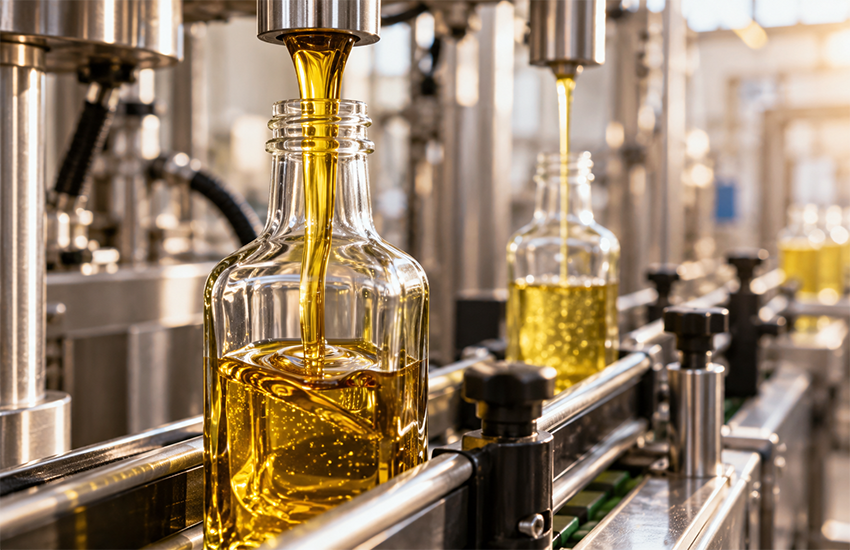
All of these phenomena meet in one place - the filling machine. This is where viscosity, temperature and uniformity decide whether oil reaches the bottle in an even portion, in a clean stream and without traces on the neck.
The thread, the drop and the clean neck
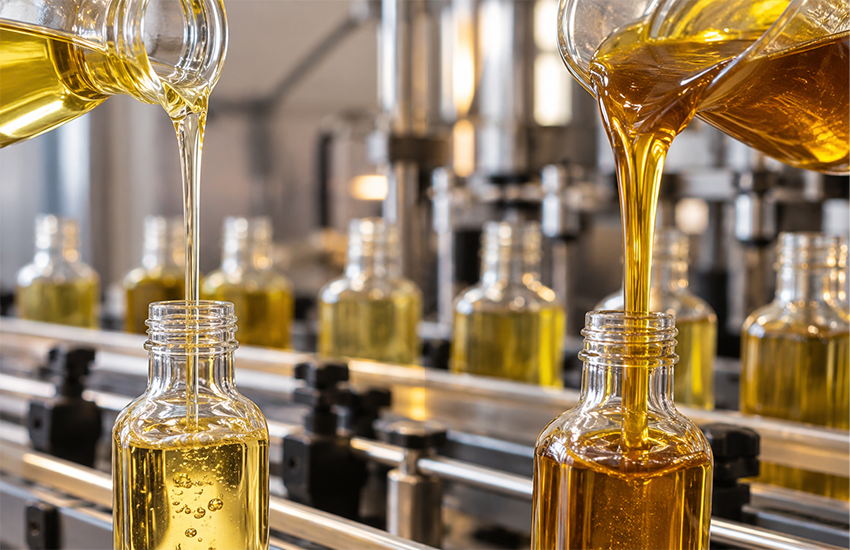
Anyone who has poured a thick liquid knows the stringing effect. When dispensing stops, a thin thread stretches between the nozzle and the bottle for a moment before it finally breaks - often right above the neck or over the label. The higher the viscosity, the longer the thread holds and the greater the chance of soiling the container. Surface tension adds to this. Oil has less than half the surface tension of water, so it readily spreads over glass and creeps up the thread of the neck. Hence the characteristic greasy rings that can sometimes be seen on the necks of oil bottles.
Warm oil largely solves this problem on its own. It breaks off sooner, with a shorter thread, and the drop left at the tip of the nozzle is smaller. The time to fill a single bottle also shortens, and the stream enters the container more calmly, without turbulence that could introduce air. Confectioners pouring liquid chocolate and beekeepers filling jars with honey apply the same principles with far thicker products. It is no coincidence that heated hoppers have been standard in both trades for decades.
A water-jacketed hopper with a mixer - physics in practice
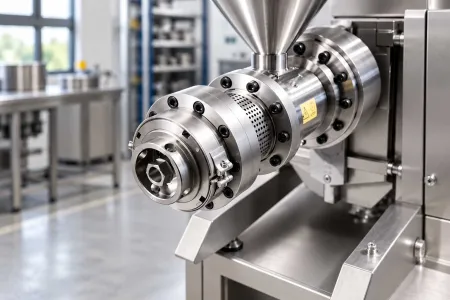
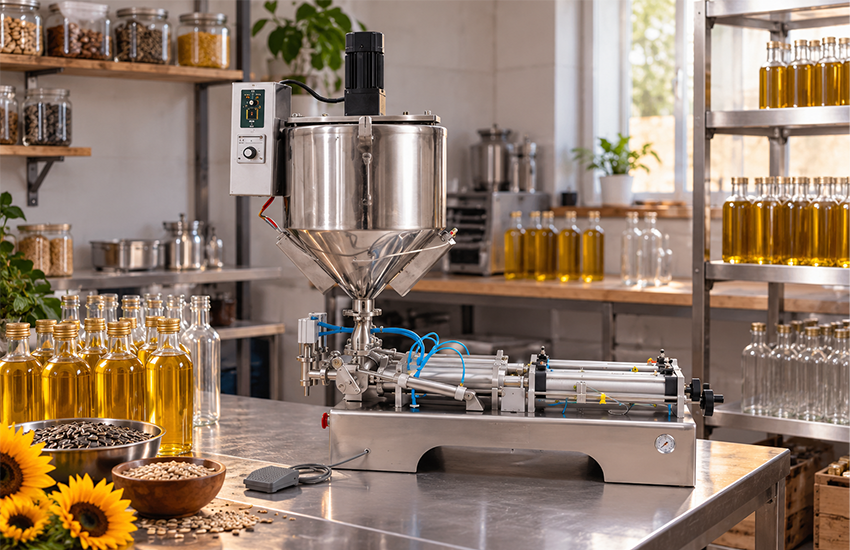
Everything discussed so far comes down to two needs: a stable, gentle temperature and calm, continuous movement. That is exactly the principle behind the single-head thick liquid and paste filler with heater and mixer for 30-500 ml. Its 30-litre stainless steel hopper has double walls with water between them - a modern, industrial version of Maria's bath. The heater warms the jacket, and the jacket passes heat evenly to the whole surface of the hopper, without hot spots that could locally overheat the oil.
Inside, an agitator turns at adjustable speed. What matters most, in light of what we know about bubbles and suspensions, is that the jacket temperature and the mixer speed are set independently. Linseed oil can be held at a slightly raised temperature with very slow mixing, while a seed paste or chilli oil can be stirred harder so the additions do not sink to the bottom. The manufacturer gives a heating range of up to 300°C, which makes the machine suitable for chocolate, honey or thick cosmetic creams, but recommends a maximum product temperature of 70°C - and for cold-pressed oils, as we have seen, only the very bottom of that scale makes sense. Piston dosing then measures out each portion from oil of the same temperature and the same consistency.
A capacity of 30 litres means the oil stays in the hopper long enough for its temperature to even out across the whole volume, yet briefly enough not to expose it to hours of heating. Smooth stainless steel surfaces make cleaning easy, which matters when products are changed often - the scent of black cumin oil can be remarkably persistent. For press rooms bottling larger batches, the same water-jacketed hopper and mixer are available in a two-head filler with heater and mixer, which fills two containers per cycle. Either machine also handles the other products a small press room may add alongside its oils: creams, pastes, sauces and honey.
What viscosity reveals about oil freshness
Viscosity does not stay constant over the life of an oil. It changes with age and storage conditions, and watching that change can say a good deal about the history of a particular bottle.
The oil that turns into varnish
The most spectacular example is linseed oil. Left in a thin layer in the air, it takes up oxygen, and its polyunsaturated chains link together into ever larger networks. Viscosity rises until the oil finally turns into a flexible, solid film. Oil painting, developed by the Netherlandish masters as early as the fifteenth century, rests on this phenomenon, as does traditional wood finishing. Painters also know stand oil - linseed oil heated for a long time at high temperature without access to air, which thickens through polymerisation to the consistency of honey.
On a much smaller scale, similar processes take place in every edible oil. Oxidation and molecular cross-linking slowly increase viscosity. It is most visible in frying oil, which after repeated use becomes dark, thick and sticky. In fresh cold-pressed oil the changes are slight, but this observation is a good reminder of why oil in a filler hopper should be warmed gently and no longer than necessary, and why mixing should not aerate it. Heat and oxygen are exactly the same factors that turn linseed oil into a layer of paint on canvas.
A home viscosity test - a funnel and a stopwatch
Laboratories measure viscosity with viscometers. One of the classics is the falling-ball viscometer, designed in the 1930s by the German chemist Fritz Höppler. It measures how long a ball takes to sink through an inclined tube filled with the liquid under test, exactly in line with Stokes' law. The paint and varnish industry, meanwhile, has long used flow cups - vessels with a calibrated hole in the bottom, timed as a set volume of liquid runs out.
Such a cup is easy to improvise in a press room. All you need is a small funnel with a narrow spout, a fixed portion of oil - 100 ml, for instance - and a stopwatch. By timing the outflow of the same oil at different temperatures, you can draw your own viscosity curve in half an hour and see with your own eyes how much a few degrees change the liquid's behaviour. Comparing different oils the same way - linseed, rapeseed, pumpkin seed or hemp - makes it easy to see how the fatty acid profile translates into fluidity. It is a simple experiment, but it builds an intuition that no table can give, and it shows perfectly why setting the hopper temperature on a filling machine makes real sense.
Oil in motion - a summary
Viscosity is like an oil's invisible character. It records the structure of the molecules, the presence of fine particles and waxes, the temperature of the room and even the age of the oil. Linseed oil flows lightly because its chains are bent by double bonds. Castor oil flows like syrup because its molecules hold hands. Sunflower oil turns cloudy in winter because waxes from the seed hulls crystallise in it. And every one of them roughly halves or doubles its fluidity with every fifteen degrees or so.
For a press room filling bottles, the lesson is simple. Oil should be treated as a living, changeable liquid, not as water. Gentle heat from a water jacket, known since the days of the Alexandrian alchemists, and the calm motion of a mixer ensure that every bottle receives oil of the same temperature, the same fluidity and the same content - from the first in the batch to the last.
Frequently Asked Questions
Does warming cold-pressed oil before filling damage it?
The term "cold-pressed" describes how the oil is pressed - the conditions inside the press while oil is extracted from the seeds. Gently warming oil before filling, to around 25-35°C and only for as long as it takes to fill the bottles, does not significantly change its composition. The key is for heating to be even, without hot spots, and for the oil not to sit warm for many hours. That is exactly why a water-jacketed hopper is best suited to the job.
Why do sunflower oil and olive oil turn cloudy in the cold?
The cloudiness is caused by crystallisation. In unrefined sunflower oil, waxes from the seed hulls crystallise; in olive oil, it is triglycerides with a higher melting point. This is a physical phenomenon, not a sign of spoilage. Once warmed to room temperature the oil usually regains its clarity, although the waxes in sunflower oil may need more time and a slightly higher temperature.
Which vegetable oil is the most viscous and which the least?
The most viscous of the common vegetable oils is castor oil, about ten times thicker than rapeseed oil, thanks to the hydroxyl groups in ricinoleic acid. Among the least viscous are oils rich in polyunsaturated fatty acids, especially linseed oil. Oils rich in saturated fatty acids, such as coconut oil, stop being liquids altogether at low temperatures.
Is a mixer needed for clear, clarified oil?
With clarified oil without additions, a mixer matters less than with pastes or herb-infused oils, but it is still useful. Slow mixing evens out the temperature throughout the hopper and prevents warmer and cooler layers from forming, and in oil with a small amount of suspended matter it keeps that matter evenly distributed. The most important thing is for the speed to be low enough not to draw in air.
What temperature should the water jacket be set to when filling oil?
For most cold-pressed oils, 25-35°C is enough - some ten to fifteen degrees above a cool room. Coconut oil has to be taken above its melting point, so a slightly higher value is usually set. The simple funnel and stopwatch test is a good way to find the temperature at which a given oil already flows freely, so you never go beyond it without need. The heated fillers on our site have a recommended maximum product temperature of 70°C, which leaves plenty of headroom for thicker products such as honey or pastes.
Does oil viscosity affect filling accuracy?
Yes, in several ways. Viscosity determines the filling time and the length of the thread that breaks above the bottle. Temperature changes the volume of oil by about 0.07% per degree, so oil measured out warm will take up less space in the bottle once it cools. On top of that, tiny air bubbles, which take a long time to rise in viscous oil, reduce the amount actually dispensed. A stable temperature and gentle mixing keep all of these effects in check.
Can a filler with a water-jacketed hopper be used for products other than oil?
Yes. A water-jacketed hopper with a mixer is designed for products whose properties change with temperature or standing time - honey, chocolate, creams, pastes, sauces, jams, as well as cosmetics and gels. For a press room, this means being able to fill oils, seed pastes and creams on the same machine, without needing separate equipment for each product.