
Table of Contents
- The Seed as a Chronicle of the Season
- Cool Nights, More Omega - Temperature and Fatty Acid Composition
- Heat, Drought and Seeds That Never Filled Out
- Green Seeds - Frost You Can See in the Oil
- A Wet Harvest and Seeds That Started to Sprout
- The Moment of Harvest - the Decision That Closes the Vintage
- The Vintage in Less Obvious Crops
- Variety, Field and Year - Three Layers of Flavour
- How to Read the Vintage in Seed Before Pressing
- Unpredictability as a Virtue
- Frequently Asked Questions
Winemakers have talked about vintages for centuries. The same vineyard, the same vines, the same cellar and the same hands on the barrels - and yet a wine from one summer tastes completely different from the next. Nobody finds this surprising, because everyone understands that a grape records the weather: sunshine, rain, cool nights, scorching August afternoons.
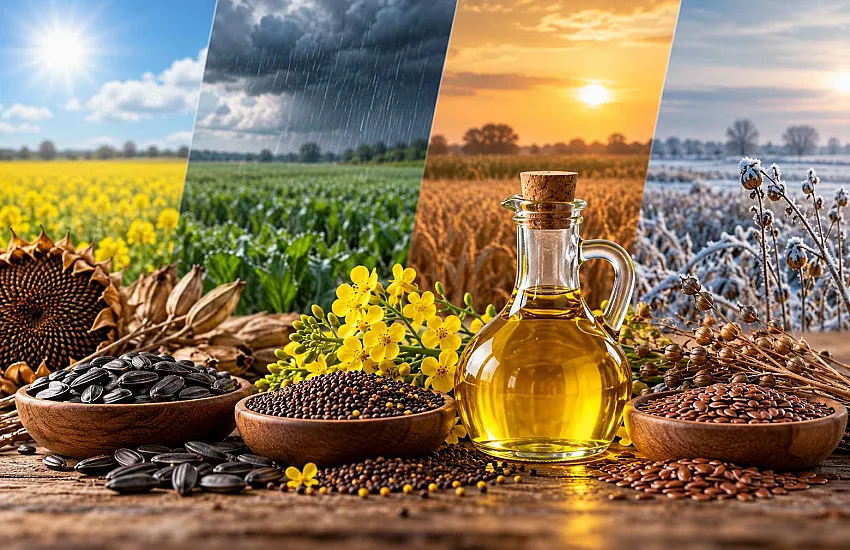
In the world of cold-pressed oil, vintages are rarely mentioned. Yet a seed of rapeseed, sunflower or flax is just as sensitive a record of the season as a bunch of grapes. Anyone who has pressed oil for a few years from seed grown on the same land sooner or later notices it. One year gives a paler oil, another a distinctly greenish one. One summer the seed releases its oil willingly, the next it resists - even though the press, the nozzle and the settings have not changed.
This is neither coincidence nor a quirk of the machine. It is the weather that was at work in the field months earlier. In this article we look at how temperature, rainfall, drought, frost and the timing of harvest are written into the seed - and how they come back to us in a bottle of oil.
The Seed as a Chronicle of the Season
An oilseed plant does not build up its oil throughout the whole growing season. The decisive phase happens in a relatively short window - seed filling, which begins after flowering and usually lasts a few weeks. During this time the developing seed's cells run a full enzymatic production line, turning sugars supplied by the leaves into fatty acids and then into oil molecules.
This window matters because it is when the seed's oil content and composition are decided. May weather has almost no influence on it, and neither does the weather in the week after harvest. What counts is what happened during those few weeks of filling. For winter rapeseed in northern and central Europe this usually falls between late May and July, for sunflower in August, and for flax in midsummer.
That is why two years that look similar in the meteorological statistics can deliver completely different raw material. It is enough for a heatwave to land squarely on the seed-filling period in one year, and to arrive a week later in another, when most of the oil has already been built.
Leaves as the Factory, Seeds as the Warehouse
To understand how weather affects oil, it helps to remember a simple division of labour inside the plant. The leaves - and, in rapeseed, the green pods as well - carry out photosynthesis and produce sugars. The seeds take those sugars and convert them into oil and protein. Anything that limits the leaves - drought, heat, disease, hail, premature drying - also limits the flow of material into the seeds.
A stressed plant behaves like a farmer in a hard year. It does not give up on its seeds, because they are the purpose of its entire life, but it changes what it packs into them. Less oil, more protein, smaller seeds, sometimes more hull relative to kernel. These changes can later be felt at the press - in yield, in how the mass behaves in the barrel, in the look of the press cake.
Cool Nights, More Omega - Temperature and Fatty Acid Composition
The most fascinating example of weather written into oil concerns the proportions of fatty acids. This is not a subtle difference visible only in a laboratory. In some years and in some plants, oil composition can shift dramatically.
The Sunflower as a Thermometer
Conventional oilseed sunflower produces an oil dominated by linoleic acid, a polyunsaturated omega-6 fatty acid. The second major component is monounsaturated oleic acid. The ratio between the two, however, is not fixed. Research carried out in different parts of the world has shown that it depends heavily on temperature during seed filling - and especially on night-time temperature.
When nights are cool, more oleic acid in the sunflower seed is converted into linoleic acid. Oil from a cooler season or a cooler region is therefore richer in polyunsaturated fatty acids. When nights are warm, this conversion slows and more oleic acid remains in the oil. The difference between sunflower oil from a cool northern summer and oil from a hot southern one can be so large that they resemble two different products.
The mechanism behind this is elegant. The conversion of oleic acid into linoleic acid is carried out by an enzyme called a desaturase, which adds another double bond to the fatty acid chain. It needs oxygen to work. At lower temperatures more oxygen dissolves in the tissue, and the enzyme itself is more active and more stable. A cool night gives the desaturase good working conditions. A warm night makes them worse.
Biologically, this makes perfect sense. Oils richer in polyunsaturated fatty acids stay liquid at lower temperatures. A plant ripening in cool conditions prepares an energy reserve for its embryo that will not solidify in cold soil during germination. The seed quite literally measures the ambient temperature and adjusts the composition of its oil accordingly.
Flax, Camelina and the Cool North
A similar effect is seen in flax. The content of alpha-linolenic acid - the omega-3 for which linseed oil is best known - tends to be higher in cooler years and regions. It is no accident that countries with cool climates, such as Canada, Poland, the Baltic states and Scandinavia, have long been known for linseed oil with a high content of this acid.
Camelina, an ancient oilseed grown across northern and eastern Europe for thousands of years, is just as interesting in this respect. It is exceptionally tolerant of cold and poor soils, and its oil contains a good share of omega-3 fatty acids. Its long tradition in the cooler parts of Europe is no coincidence - it thrives where summers are not too hot.
When Genetics Overrides the Weather
Against this background, the story of high-oleic sunflower is particularly interesting. In the 1970s, breeders in the Soviet Union obtained a variety in which a mutation almost switched off the desaturase in the seed. Oil from such sunflowers contains a great deal of oleic acid and little linoleic acid, and - crucially - this ratio depends far less on the weather. Cool nights do not turn it into an omega-6-rich oil, because the enzyme that would do so simply does not work at full capacity.
Similar high-oleic varieties were later developed in rapeseed. For anyone pressing oil, this carries an important lesson. The vintage effect is strongest in traditional varieties, in which the plant has kept its natural ability to respond to temperature. Oil from such seeds is livelier, more variable, more dependent on the season - and for that very reason more interesting.
Heat, Drought and Seeds That Never Filled Out
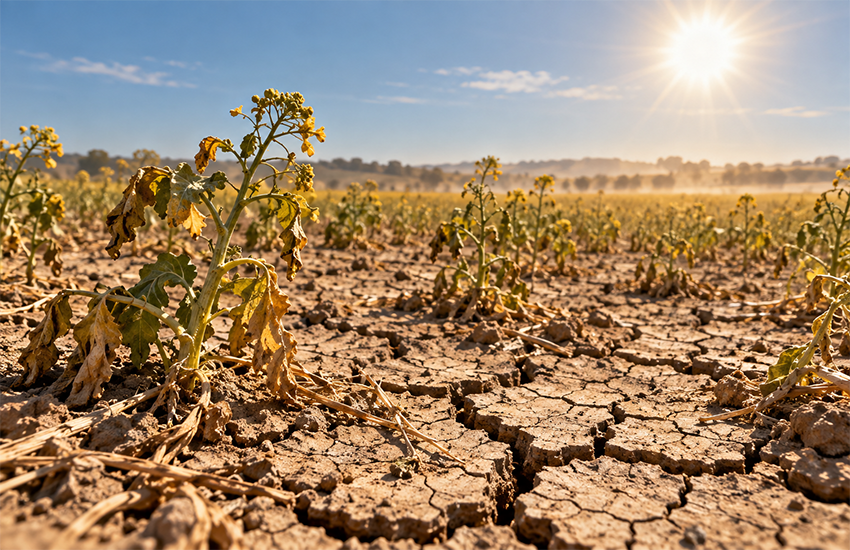
Temperature affects not only what kind of oil is formed, but also how much of it. Winter rapeseed tolerates heat poorly during flowering and seed filling. When temperatures climb above thirty degrees Celsius and the soil dries out, the leaves and pods begin to limit photosynthesis to save water. The flow of sugars into the seeds weakens, and the filling period shortens as the plant hurries towards maturity.
The result is visible to the naked eye - seeds tend to be smaller, and in the laboratory their oil content turns out lower than in a good year. At the same time the protein share often rises. Oilseed crops have long shown this inverse relationship: when there is less oil, there is usually more protein. The plant builds protein in an earlier phase of seed development and lays down most of its oil later, so a shortened ripening period hits the oil first.
In sunflower, drought has another effect too. Seeds are smaller, and the hull makes up a larger share of their weight. At the press the raw material behaves differently - more fibre, less oil in the kernel, a different resistance of the mass in the barrel. Experienced press operators can recognise a dry year by the sound of the machine and the look of the cake coming out of it.
Small Seed, Large Surface
Small seeds from a dry year have one more feature that is rarely discussed. For the same weight, they carry a larger total area of hull relative to their interior. Rapeseed hulls are dark and rich in pigments and phenolic compounds. Oil pressed from very small seeds can therefore have a slightly different shade and a more pronounced, faintly bitter note. It is another trace of the weather that ends up in the bottle.
Green Seeds - Frost You Can See in the Oil
One of the most distinctive weather signatures in oil is its colour. Cold-pressed rapeseed oil is usually golden, sometimes with a light greenish tint. But there are years when the oil comes out of the press distinctly green. The cause is what growers call green seed.
An immature rapeseed seed is green because it contains chlorophyll, just like a leaf. As it ripens, the plant gradually breaks this pigment down and the seeds turn brown or black. This breakdown is an enzymatic process that needs time and the right temperature. If ripening is cut short abruptly - by an early frost, a sudden drought or overly rapid desiccation of the plant - the enzymes do not finish their work. The seed dries, but the chlorophyll stays in it, like a pressed leaf that never had the chance to turn yellow.
In the press, chlorophyll passes into the oil along with the fat. The oil turns greenish, and its flavour can become grassier and sharper. There is another side to this as well. Chlorophyll in oil acts as a photosensitiser - under light it transfers energy to oxygen and accelerates the oxidation of fats. Oil from a large proportion of green seed is therefore especially sensitive to light and needs a dark bottle and a cool place all the more.
In Canada, where canola is grown on an enormous scale, the share of distinctly green seed is one of the key grading factors for a crop lot. There is good reason for it - early autumn frosts on the prairies can turn a golden crop into a green one every few years.
How to Spot Green Seed Before Pressing
Green seed is easy to identify by crushing a few seeds on a sheet of white paper. A mature rapeseed seed has a yellow or yellowish interior. A seed that has retained its chlorophyll has a green, sometimes clearly olive interior. If a sample contains a few percent of such seeds, the oil will probably show a noticeably green tinge. It is a simple test worth doing on every new lot, especially after a season with early frosts or sudden drought during ripening.
A Wet Harvest and Seeds That Started to Sprout
The weather does not stop writing itself into the seed once the seed stops growing. The period between maturity and harvest matters just as much, and so does the time between harvest and pressing.
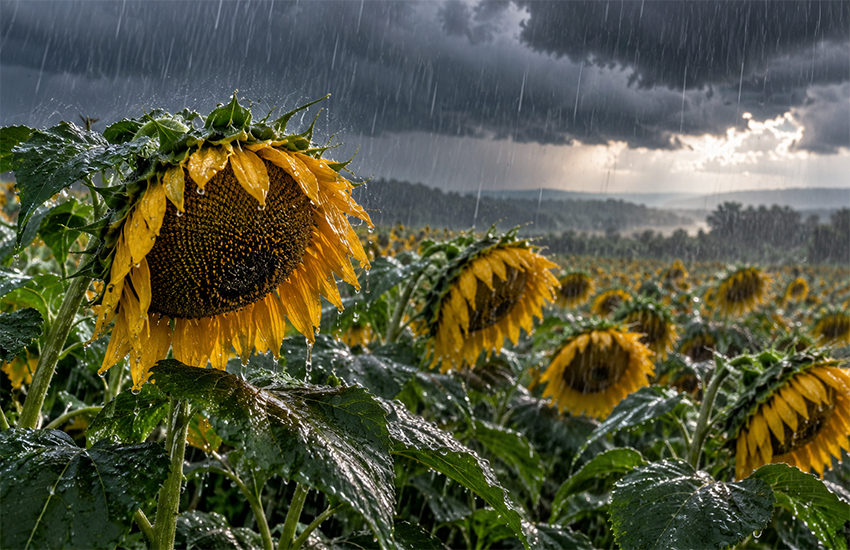
A mature seed is dormant. It holds little water, and the enzymes responsible for germination are switched off. But if prolonged rain arrives at harvest time and the crop stands wet day after day, the seeds begin to absorb moisture. In some of them the germination programme starts before they ever reach the combine. This is known as pre-harvest sprouting, familiar to cereal growers but affecting oilseeds as well.
For oil, sprouting has concrete consequences. The first step of germination is the activation of lipases - enzymes that break oil molecules down into glycerol and free fatty acids so the embryo can use them. If the process is interrupted by harvest and drying, the broken-down oil stays in the seed. Oil pressed from such raw material has a higher free fatty acid content, which affects its flavour and shortens its shelf life.
Pods That Shatter
Rapeseed has another weak point linked to harvest weather. Its pods, once fully ripe, become brittle and split open in strong wind, in hail, or even when a machine drives past. Seeds that have fallen to the ground and lain there for a few days in the damp, and are then gathered in with the rest of the crop, can show early signs of mould or sprouting. That is why a lot harvested after a stormy week tends to be less uniform than one brought in during calm, dry weather.
The Moment of Harvest - the Decision That Closes the Vintage
In winemaking it is said that the most important decision of the year is the day the grape harvest begins. Oilseed growing is no different. Harvesting too early means immature seed, with more chlorophyll, less oil and high moisture. Harvesting too late brings the risk of seed loss, rain, sprouting and mould.
The key parameter behind this decision is seed moisture. Rapeseed is usually harvested when the seeds hold somewhere between a few and a dozen or so percent water, and for safe storage and pressing it needs to come down further still, to around seven or eight percent. Sunflower has its own thresholds, flax its own. A difference of a few percentage points decides whether the seed goes straight into storage or needs further drying, and whether it can be pressed immediately or must wait.
Measuring in the Field, in the Trailer and in Storage
This is where a portable meter becomes so useful - one that lets you check seed moisture directly in the field before the combine goes in, again in the trailer, after drying and just before pressing. One such tool is the Dramiński GMM mini II moisture meter for oilseeds, calibrated specifically for fourteen oil-bearing raw materials, among them rapeseed, flax, shelled and unshelled sunflower, hull-less and shelled pumpkin seeds, hemp seed, sesame, soybeans, black cumin and milk thistle. Ordinary grain meters struggle with oilseeds, because their high oil content changes the electrical properties of the sample. This meter measures whole seeds using the capacitive method, with a 270 ml sample measured out using the included dispenser.
From the vintage perspective, one feature is especially valuable - a digital sensor built into the measuring chamber which, alongside moisture, displays the temperature of the seed and automatically takes it into account in the result. Seed harvested on a hot July afternoon, straight from a sun-baked trailer, is at a completely different temperature from the same seed after a night in storage. Without compensation, the same raw material would give two different readings. What is more, the temperature of the seed in a heap is valuable information in its own right - seed that begins to warm up unexpectedly is a sign that something is going wrong in the lot. The device fits in one hand, runs on two AA batteries, and its calibration curves can be updated via USB.
Measuring moisture is, in essence, reading the last chapter of the season's chronicle. It tells you whether the harvest was dry or wet, whether the seed was gathered at the optimal moment, and whether the raw material is ready to meet the press.
Drying - Go Gently with Heat
If seed has been harvested too wet, it needs further drying. For raw material destined for cold pressing, it is worth remembering that drying too hot and too fast can undo what the weather spent the whole summer carefully building. High temperatures accelerate the oxidation of delicate polyunsaturated fatty acids, can darken the seed and alter the oil's aroma. Gentle, unhurried drying, combined with regular moisture checks, keeps the character of the vintage intact.
The Vintage in Less Obvious Crops
Rapeseed, sunflower and flax are the crops whose response to weather is best understood, as they have been studied for decades. But the imprint of the season is just as clear in raw materials that reach the press less often - and in some of them the vintage effect can be dramatic.
Oil Pumpkin and the Warm Summer That Sometimes Never Comes
The oil pumpkin is a warmth-loving plant which, in central and northern European climates, always lives somewhat at the edge of its comfort zone. It needs a long, warm summer for the fruit to ripen fully and the seeds to fill with oil. In years with a cool, rainy August and an early autumn, the fruit often stays unripe and a good share of the seeds are flat and poorly filled, with a thin, underdeveloped interior. Pressers call them empty seeds - from the outside they look normal, but in the press they release surprisingly little oil.
Pumpkin also has a particular weakness linked to harvest. The seeds are scooped out of the fruit's flesh, washed and dried. Until dried they are very wet, and in a cool, damp autumn drying takes longer, increasing the risk of mould and off-flavours. Seeds from a warm, dry autumn dry quickly and evenly. Those from a wet one demand patience and careful moisture control before they go into the press. Either way the oil has its characteristic deep green colour, but its depth, aroma and intensity can vary noticeably from one vintage to the next.
Hemp and Uneven Ripening
Hemp seed has yet another trait that lets the weather leave a strong mark. Seeds on a single plant do not ripen at the same time. Those at the bottom of the flower head are ready earlier, those at the top later. In a warm, dry season the gap is smaller and most seeds reach maturity at around the same time. In a cool or rainy year the spread widens, and a single harvested lot contains both fully ripe, dark, marbled seeds and pale, greenish, immature ones.
For the oil, this matters in much the same way as green seed in rapeseed. Cold-pressed hemp oil is naturally greenish, but a share of immature seed can deepen that colour noticeably and give it a grassier, more vegetal character. Immature seeds also tend to hold more water and less oil, so a lot from a difficult year behaves differently in the press from one grown in a good season. With hemp, a close look at the sample and a moisture check before pressing pay off especially well.
Hail, Wind and Flattened Crops
Not every weather event works slowly and subtly. Sometimes a quarter of an hour is enough. A violent hailstorm during ripening can damage rapeseed pods and sunflower heads, opening the way to fungal disease. Strong wind and a downpour can flatten a crop - growers call it lodging - leaving the plants lying on the ground. Seeds in a lodged crop ripen unevenly, stay damp near the soil for longer and are more often affected by mould. Such a lot, even if it looks decent after harvest, can be inconsistent and deserves a particularly careful assessment - by smell, by the look of the seed interior and by moisture readings from several samples taken from different parts of the trailer.
Variety, Field and Year - Three Layers of Flavour
If you broke the flavour of a cold-pressed oil down into its components, you would find three layers. The first is genetics - the variety. Double-low rapeseed, traditional or high-oleic sunflower, brown- or golden-seeded flax - the variety sets the boundaries within which the oil's composition and flavour can fall.
The second layer is place - soil, field position, sun exposure, access to water. Rapeseed from heavy, fertile soils behaves differently from rapeseed grown on sandy ground. A field on a south-facing slope ripens faster than one in a hollow where cold air collects.
The third layer is the vintage itself - the weather of a particular season. It decides whether the variety and the place get to show their full potential, or are pushed in one direction by heat, drought, frost or rain. Of the three layers, it is the most variable and the least predictable.
Does Oil Have a Terroir?
Winemakers have a beautiful word for the combination of these three layers - terroir. In the world of cold-pressed oil the idea is only beginning to appear, but the principle is the same. Rapeseed from one farm, pressed every year on the same press, produces oils that share a common thread while differing from one another depending on the summer. People who press oil from their own seed often say they can recognise the year from the first taste - by whether the oil is nuttier or grassier, mellow or carrying a distinct peppery catch in the throat.
For olive oil, this relationship is well documented. Oil from early-harvested green olives is more pungent and bitter, full of phenolic compounds, while late-harvest oil is milder and more buttery. Seed oils obey the same laws, even if they are talked about less often. Perhaps it is time to start.
How to Read the Vintage in Seed Before Pressing
You do not need a laboratory to get a sense, before pressing, of what the season has brought. A careful eye, a sheet of paper and a few simple observations are enough.
Seed size and uniformity tell you how filling went. Small, uneven seeds with plenty of screenings point to a dry or hot ripening period. The colour of crushed seed interiors reveals whether the plants ripened calmly or were caught out by frost or sudden drought. The smell of a lot speaks about the harvest - a slightly musty, stale or sour odour is a sign that the seed has been through a damp spell. Moisture and temperature readings show whether the raw material is ready for pressing and whether storage is going safely.
It is also well worth keeping a simple pressing log. Noting for each lot where the seed came from, which year it was grown, its moisture, how the press behaved and how the oil tasted turns, after a few years, into an invaluable chronicle. It reveals patterns that a single season cannot show - for example, that after a cool June the linseed oil is noticeably more intense, or that after a hot July the rapeseed gives up its oil reluctantly.
Unpredictability as a Virtue
In industrial production of refined oils, differences between vintages are carefully smoothed out. The oil is refined, bleached, deodorised and blended so that every bottle tastes identical, regardless of the summer the field went through. It is an understandable approach, but it erases something that is most valuable in cold-pressed oil.
Cold-pressed oil, clarified naturally in a settling tank, keeps the trace of the season. Its colour, aroma, flavour and even the way it behaves in the cold are echoes of the weather that worked in the field a few months earlier. Variation between vintages is not a flaw to be hidden. It is proof that there is something genuine in the bottle - a piece of a particular summer, recorded in the seed by the plant and released by the press.
The next time oil from a new lot tastes a little different from the last one, before looking for a fault in the machine, try to remember what June was like. There is a good chance the answer lies in the field, not in the press.
Frequently Asked Questions
Does the weather during the growing season really affect the flavour of cold-pressed oil?
Yes, and noticeably so. Temperature, water availability, frost and harvest conditions affect the oil content of the seed, its fatty acid proportions, its chlorophyll content and the level of free fatty acids. All of these translate into the colour, flavour, aroma and shelf life of the oil. In cold-pressed oil, which is neither refined nor blended, differences between vintages are especially easy to detect.
Why is rapeseed oil sometimes green?
The green colour of rapeseed oil comes from chlorophyll retained in immature or prematurely desiccated seed. If rapeseed ripening is cut short by frost or sudden drought, the enzymes that break chlorophyll down do not have time to finish. Such oil has a grassier taste and is more sensitive to light, so it should be stored in a dark bottle in a cool place.
Does sunflower oil from different regions have a different composition?
Yes. In traditional sunflower varieties, the ratio of linoleic to oleic acid depends largely on temperature during seed filling, especially night-time temperature. In cooler conditions the oil contains more linoleic acid, in warmer conditions more oleic acid. High-oleic varieties are much less sensitive to these swings, because a mutation limits the activity of the enzyme responsible for the conversion.
How does drought affect seed intended for pressing?
Drought and heat during seed filling shorten ripening and limit the flow of sugars into the seed. The seeds are then usually smaller, contain less oil and more protein, and in sunflower the hull makes up a larger share of the seed weight. Such raw material behaves differently in the press than in a good year, and the oil may have a slightly different colour and a more pronounced aftertaste.
What is pre-harvest sprouting and how does it affect oil?
Pre-harvest sprouting is the start of germination before the crop is harvested, usually caused by prolonged rain at harvest time. Lipases are activated in the seed and begin breaking the oil down into free fatty acids. Oil pressed from such seed has higher acidity, poorer flavour and a shorter shelf life. Lots harvested after a wet harvest are therefore worth checking particularly carefully before pressing.
When is the best time to measure oilseed moisture?
Ideally at several stages - in the field before harvest to choose the right moment, after harvest and any drying, and again just before pressing, as seed moisture can change during storage. Oilseeds should be measured with a meter calibrated for these raw materials and equipped with automatic temperature compensation, because ordinary grain meters can give significantly inaccurate readings on oil-rich seed.
Can you press seed from different years and combine the lots?
Technically yes, but bear in mind that seed from different vintages may differ in moisture, oil content and composition, so it can behave differently in the press and produce oil with a different flavour. Many people who press oil from their own seed deliberately press lots separately to preserve the character of each season. Older seed, even when well stored, can also carry a higher level of free fatty acids, which affects the shelf life of the oil.