
Table of Contents
- Oil is a crowd, not soldiers in a line
- The birth of a crystal - what happens in the bottle as the temperature drops
- Waxes - invisible guests from the hull
- Olive oil in the fridge - the famous test that does not work
- From liquid to solid - the people who wanted to make oil set
- Heat from the press and cold in the bottle - temperature from the very start
- Flavour at low temperature - why cold oil smells of less
- Oil as fuel - the cold that stops engines
- A haze does not mean spoilage - how to read your oil's signals
- A home cold laboratory - experiments with oil
- What the cold teaches us about oil
- Frequently Asked Questions
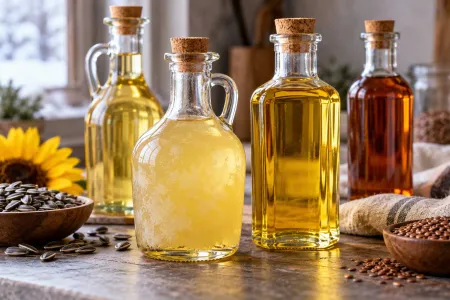
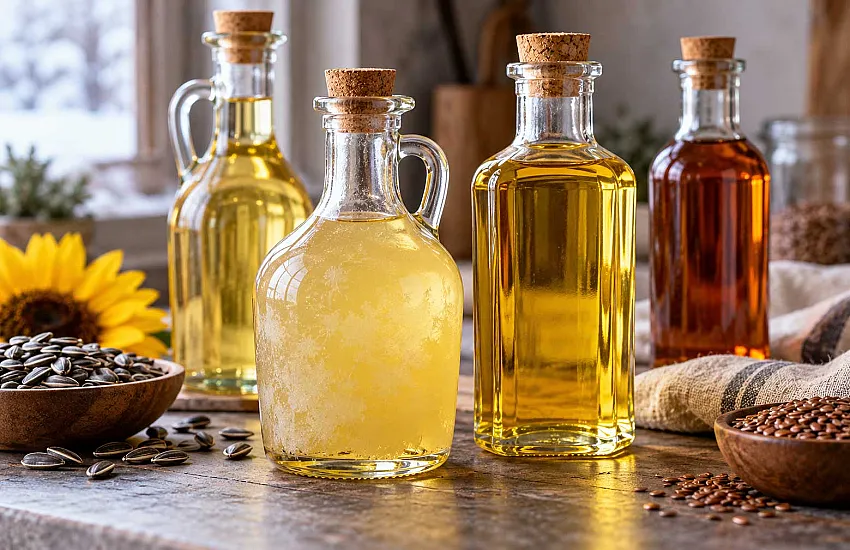
Anyone who keeps freshly pressed oil in the fridge or a cool pantry will sooner or later witness the same small drama. A bottle that was clear as amber yesterday looks today as if someone had stirred a drop of milk into it. Pale flakes have gathered at the bottom, and when you tilt the bottle the oil moves lazily, like thick syrup. The first thought can be an uneasy one - has the oil gone off? In the vast majority of cases the answer is no. What you are looking at is one of the most beautiful physical phenomena you can observe in your own kitchen - the crystallisation of fat.
Oil is not a single substance with a single freezing point, the way water turns to ice at zero degrees. It is a mixture of hundreds of different molecules, each with a temperament of its own. Some begin to set at the first hint of cooling, others stay liquid even in the freezer. Add to that tiny amounts of wax carried over from the seed hull, and a clear oil can turn into a hazy suspension. In this article we look at what happens to oil when the temperature drops - from the shape of its molecules, through the crystals forming in the bottle, to the long history of people who tried either to make oils solid or, just as stubbornly, to keep them liquid at all costs.
Oil is a crowd, not soldiers in a line
To understand why oil goes cloudy, you have to look inside it. The main component of every vegetable oil is a family of molecules called triacylglycerols - a glycerol backbone with three fatty acid chains attached. You can picture each one as a fork with three tines, where every tine can have a different length and a different shape. A single oil contains a huge number of such combinations, because each of the three tines can be a different fatty acid.
It is precisely this diversity that governs how oil behaves in the cold. A pure substance made of identical molecules has one sharp melting point. A mixture of hundreds of different triacylglycerols has instead a whole range of temperatures over which it gradually passes from liquid to solid. That is why oil does not freeze all at once. It first turns faintly hazy, then thickens, and only at a much lower temperature sets completely.
Straight chains and chains with a kink
The decisive factor is the shape of the fatty acids. Saturated fatty acids, such as palmitic and stearic acid, have chains as straight as matchsticks. Molecules like these pack together beautifully - tightly, in parallel, one beside the other, like pencils in a box. Tight packing means strong attraction between molecules, and that translates into a high melting point. Pure stearic acid melts at around 69 degrees Celsius, palmitic acid at around 63 degrees. This is why fats rich in saturated fatty acids, such as lard or cocoa butter, are solid at room temperature.
Unsaturated fatty acids look entirely different. At the site of each double bond their chain is permanently bent, as if someone had snapped a matchstick halfway along. Such bent molecules cannot line up neatly side by side. They leave gaps between them, attract each other more weakly and stay liquid far more easily. Oleic acid, with a single kink, melts at around 13-14 degrees Celsius. Linoleic acid, with two kinks, melts a few degrees below zero. And alpha-linolenic acid, abundant in flaxseed and camelina oil, with three kinks stays liquid even at around minus 11 degrees.
Every oil has its own character in the cold
From this simple principle follows the behaviour of individual oils. Flaxseed oil, dominated by alpha-linolenic acid, shrugs off the fridge and stays clear where other oils have long since clouded over. Even in the freezer it remains liquid for a long time or merely thickens. Oils from walnuts, hemp and pumpkin seeds, rich in polyunsaturated fatty acids, are similarly resistant to cold.
At the opposite extreme sits coconut oil. Its main component is lauric acid, a saturated fatty acid of medium chain length. As a result coconut oil solidifies at around 24 degrees Celsius, and in a typical northern or central European kitchen it spends most of the year as a firm white mass. Between these two extremes lies everything else - olive oil, rapeseed oil, sunflower, sesame and peanut oil - and each of them behaves a little differently when the temperature falls.
The birth of a crystal - what happens in the bottle as the temperature drops
Simply cooling oil below the melting point of some of its molecules is not enough for crystals to appear. The molecules first have to meet and arrange themselves in the right order, forming a tiny seed that physicists call a crystallisation nucleus. Only around such a nucleus can further layers start to grow.
Nuclei, supercooling and flakes at the bottom
Forming nuclei in a liquid takes patience. Oil can remain for some time in a supercooled state - colder than the melting point of its most stubborn components would suggest, yet still perfectly clear. A small trigger is all it takes to set things in motion. A microscopic particle of sediment, a scratch on the glass, a jolt as the bottle comes out of the fridge - any of these can become the point from which crystallisation begins.
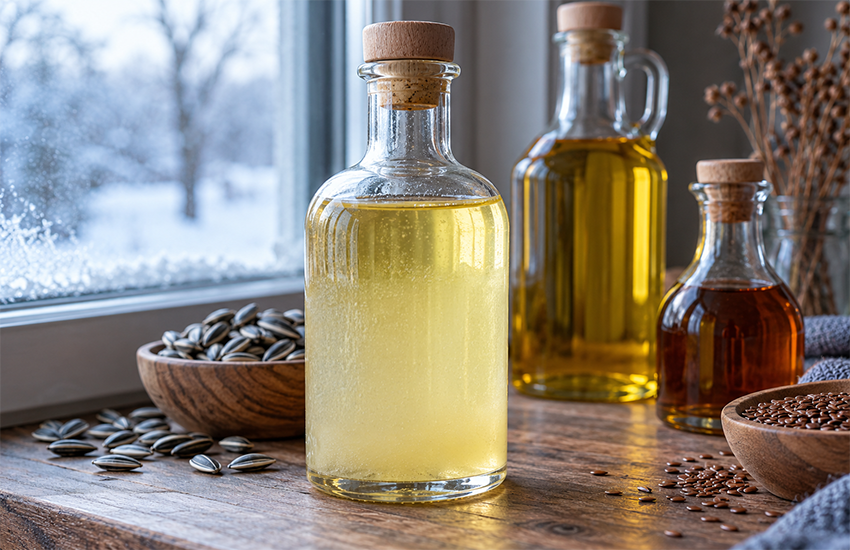
Once nuclei have formed, they grow by capturing matching molecules from their surroundings. First a delicate milky haze appears - thousands of microscopic crystals scattering the light. Over time the crystals join into larger clusters, forming the familiar pale flakes or fine granules that slowly sink to the bottom. In olive oil kept in the cold for a long time they can take the form of tiny beads resembling grains of semolina.
Three faces of the same fat
One of the most fascinating properties of fats is polymorphism. The same triacylglycerols can crystallise in several different forms, which differ in how the molecules are arranged and therefore in melting point, hardness and appearance. Chemists label the basic forms with the Greek letters alpha, beta prime and beta. The alpha form appears on rapid cooling, is the least ordered and the least stable. The beta form is the most stable, but its crystals grow slowly and can be large and coarse.
Every chocolatier tempering chocolate relies on this phenomenon. Cocoa butter can crystallise in as many as six forms, and only one of them, known as form five, gives chocolate that is glossy, firm and snaps cleanly when broken. It melts at around 34 degrees, just below body temperature - which is why good chocolate melts in the mouth rather than in the hand. When tempering goes wrong, a grey film appears on the surface of the bar, known as fat bloom. It is nothing other than fat crystals in the wrong form that have migrated to the surface.
In a bottle of oil at home, polymorphism shows itself more subtly, but it is there. Oil chilled quickly, for example in the freezer, usually forms a fine, uniform haze. The same oil cooled slowly, in a cellar or on a cold windowsill, has time to build larger, more distinct crystals that settle to the bottom faster.
Waxes - invisible guests from the hull
Not every kind of cloudiness comes from triacylglycerols. In many cold-pressed oils waxes play an important part - substances that are fully dissolved and invisible in warm oil, but come out of solution in the cold as a delicate whitish haze.
Where waxes in oil come from
Plant waxes are compounds built from long-chain fatty acids joined to long-chain alcohols. Their main job in nature is protection - they form a thin, water-repellent layer on the surface of leaves, fruit and seeds that keeps water in and outside moisture out. This is why cabbage leaves shed raindrops so easily and why an apple takes on a shine when polished.
In seeds, the largest amounts of wax sit in the hull and the seed coat. When seeds go into the press with their hulls on, some of these waxes pass into the oil. In warm oil they dissolve without a trace, but their melting point is very high - often above 70 degrees Celsius. As the oil cools and then goes into a cool place, the waxes are the first to come out of solution, before any other component has reacted at all.
Sunflower - the master of the waxy haze
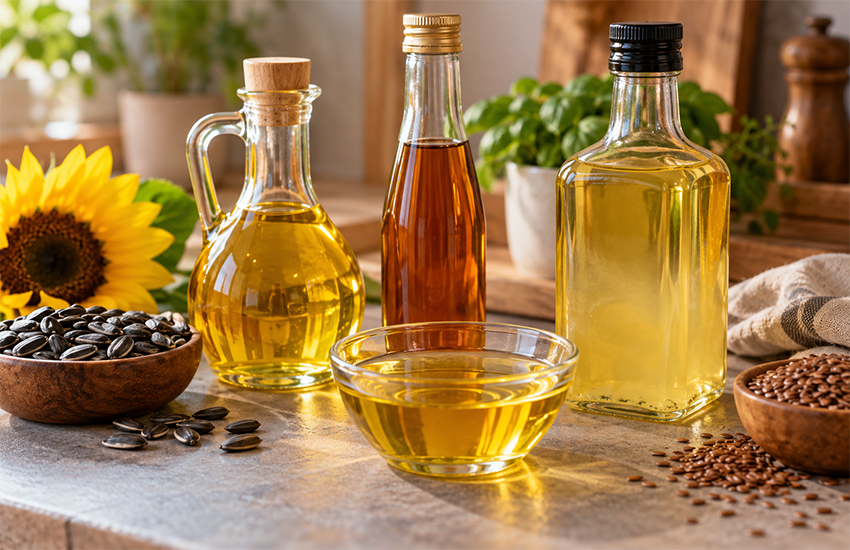
Sunflower oil is particularly well known for this. Sunflower hulls are rich in wax, and oil pressed from unhulled seeds can contain enough of it to cloud visibly in the fridge, even though the waxes make up only a fraction of a percent of its weight. Oil pressed from hulled kernels usually contains much less and stays clearer in the cold.
Waxy cloudiness looks a little different from the crystallisation of the fat itself. It is usually more uniform and silky, like smoke suspended in the liquid. It also appears at a higher temperature than triacylglycerol crystals - sometimes a cool pantry or a winter windowsill is enough. After warming to room temperature, waxes can stay suspended longer than fat crystals, because they need somewhat warmer surroundings to dissolve again.
Winterisation - the industry's answer to the haze
The oil industry uses a process called winterisation. Oil is cooled slowly to a few degrees above zero and held there for many hours, until the waxes and the highest-melting fractions of the fat crystallise, and the resulting crystals are then filtered out. Oil treated this way stays clear even in the fridge.
The name has a historical origin. In the nineteenth century in the United States, cottonseed oil was stored in tanks outdoors over the winter. In the low temperatures a solid fraction separated out, and the liquid oil drawn off above it worked better in salads because it did not cloud in a cold kitchen. Over time natural winterisation gave way to controlled cooling, but the name stuck. It is worth remembering, however, that oil cold-pressed at home does not undergo any such treatment - and it does not need to. A light haze in the cold is a natural feature of the product, not a flaw.
Olive oil in the fridge - the famous test that does not work
Many beliefs have grown up around how olive oil behaves in the cold. The best known is the so-called fridge test. According to this popular theory, genuine extra virgin olive oil should thicken and cloud when placed in the fridge, and if it stays liquid, it must have been cut with a cheaper oil.
The theory sounds logical, because olive oil does contain plenty of oleic acid along with saturated palmitic and stearic acids, so it usually thickens in the cold. The trouble is that the composition of olive oil varies a great deal with olive variety, climate, ripeness and harvest timing. Some genuine olive oils set quickly in the fridge, others stay liquid for many hours. Research carried out by the Olive Center at the University of California, Davis showed that the fridge test is unreliable and cannot reliably tell authentic olive oil from a blend.
This story is a useful lesson for anyone pressing their own oil. How oil behaves in the cold depends on its composition, and that changes with seed variety, growing conditions and even the weather in a given season. Rapeseed oil from one batch of seed may stay perfectly clear in a cool cellar, while oil from another batch turns slightly hazy. That is natural variation, not a sign of a problem.
From liquid to solid - the people who wanted to make oil set
For most of history people had two groups of fats at their disposal. Animal fats - lard, tallow, butter - were solid at room temperature. Vegetable oils stayed liquid. Each group had its uses, and for centuries nobody tried to make them trade places. All that changed in the nineteenth century.
An emperor's competition and the birth of margarine
In 1869 the French chemist Hippolyte Mège-Mouriès won a competition announced by Emperor Napoleon III. The aim was to create a durable, easy-to-store substitute for butter for the army and the poorer classes. Mège-Mouriès developed a product based on a fraction of beef fat, which he obtained by exploiting differences in melting points - separating the softer part of the tallow from the harder part. He named his invention margarine, from the Greek word for pearl, after the pearly sheen of margaric acid crystals.
The first margarine therefore had nothing to do with vegetable oils. It was the result of a clever use of crystallisation - the very same phenomenon we see today in a bottle of oil in the fridge.
Hydrogenation - straightening the chains chemically
The breakthrough came at the beginning of the twentieth century, when the German chemist Wilhelm Normann patented a method of hardening vegetable oils with hydrogen in the presence of a nickel catalyst. The process, called hydrogenation, added hydrogen atoms at the double bonds of the fatty acids. Bent unsaturated chains became straight like saturated ones, packed together better, and the oil turned into a solid fat.
From the point of view of physics it was a masterstroke - changing the shape of molecules turned a liquid oil into a semi-solid spread. From the point of view of health, however, partial hydrogenation turned out to produce so-called trans isomers - chains in which the double bond remains but loses its characteristic kink. Today we know that trans fats are harmful to health, and their content in food is strictly limited by law in the European Union and many other countries. The story shows how much the shape of a single molecule matters - and how valuable it is that cold-pressed oils keep their natural, bent chains intact.
Heat from the press and cold in the bottle - temperature from the very start
Melting point phenomena accompany oil from the moment it is pressed. Oil leaving a screw press is always warmer than the seeds that went into the hopper, because friction and pressure in the pressing chamber generate heat. In that state all of its components, waxes included, are perfectly dissolved. Only in the container and the bottle, as the oil cools, do they start to separate.
Coconut - an oil that sets before your eyes
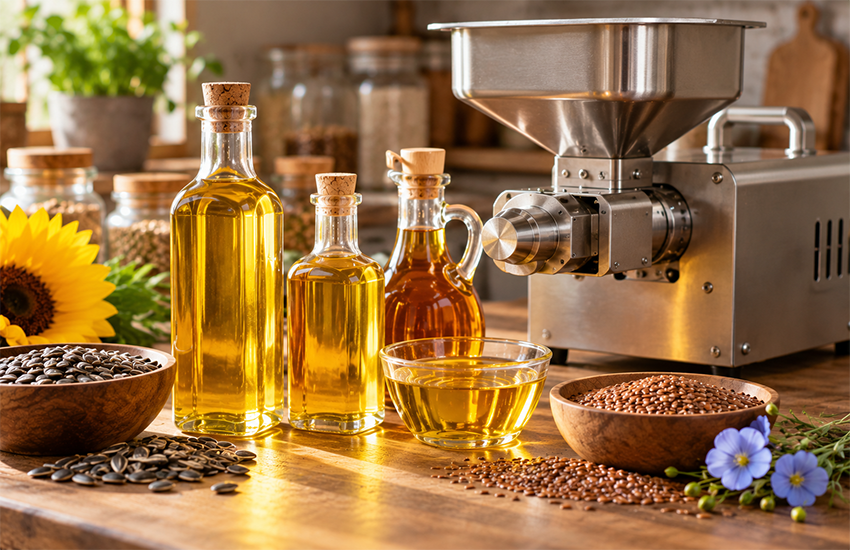
The most spectacular example is pressing desiccated coconut. Coconut fat is solid at room temperature, so extracting it calls for a press whose pressing chamber can be heated. That is exactly what the home oil press for cold and hot pressing with a capacity of 5-7.5 kg/h offers. Its 450 W heater with temperature control can bring the press head up to 200 degrees Celsius, while a 300 W motor drives the screw in a stainless steel body. As a result coconut oil flows from it as a clear, liquid stream.
The real show begins in the container. As the oil cools below about 24 degrees, the first milky streaks appear on its surface and along the walls of the vessel. Within a few dozen minutes the whole contents turn white and opaque, and after a few hours - as firm as butter. This is crystallisation in its purest form, and you can watch it from beginning to end in your own kitchen.
Seeds from a cold store room
Temperature matters on the other side of the press too, in the hopper. Seeds kept in an unheated shed or garage in winter can be barely above freezing. In such seeds part of the fat, especially in raw materials rich in saturated fatty acids, is more viscous and harder to release during pressing. It is worth bringing the sack into a warm room a few hours before work so that the seeds reach room temperature. On presses with an adjustable heater you can also warm the press head gently without crossing the cold-pressing threshold of an oil temperature of around 40 degrees. The press handles seeds with more than 15 percent oil and less than 10 percent moisture, and its compact size makes it easy to set up wherever the kitchen is warmest.
Cloudy oil straight from the press is not wax yet
It is worth distinguishing cold-induced cloudiness from the natural haze of freshly pressed oil. Oil straight from the press is often cloudy because it carries fine particles of seed tissue and traces of moisture. That haze disappears with settling and filtering, regardless of temperature. Cold-induced cloudiness behaves differently - it appears in clean, clear oil when the temperature drops and disappears when the oil warms up. A simple test tells them apart: if the haze clears after a quarter of an hour in a warm room, the cold was to blame.
Flavour at low temperature - why cold oil smells of less
Cold affects not only how oil looks but also how we perceive it. The aroma of an oil comes from volatile compounds that must escape from the surface of the liquid and reach our nose. The lower the temperature, the more slowly they evaporate. Oil straight from the fridge therefore seems flat, almost without aroma, even though it contains exactly the same compounds as oil at room temperature.
Professional olive oil tasters know this well. In official sensory assessments olive oil is served in special dark blue glasses warmed to around 28 degrees Celsius. The blue glass hides the colour so that it cannot sway the panel's judgement of quality, and the raised temperature releases aromas that would stay dormant in the cold. The taster also warms the glass in their hands, keeping it covered to trap the escaping scents.
This is easy to put to use at home. If you want to get to know the true character of your oil, take it out of the fridge half an hour before a meal. Pour a little into a small glass, warm it in your hands and only then smell it. Flaxseed oil will reveal its nutty, grassy notes, pumpkin seed oil its deep roasted aroma, and rapeseed oil a scent reminiscent of young brassica greens. The same rule applies when serving oils with salads and bread. Oil at room temperature will always be more expressive than oil straight from the cold, and it will also spread more easily over salad leaves.
Temperature also changes how oil feels in the mouth. Cold oil is thicker and melts more slowly, so it seems heavier. Warmed to room temperature it becomes lighter and opens up its flavours more quickly, including the characteristic slightly peppery catch at the back of the throat that natural phenolic compounds give fresh oils and olive oils. The same spoonful of oil can taste quite different depending on how many minutes have passed since it left the fridge.
Oil as fuel - the cold that stops engines
How oils behave at low temperatures matters far beyond the kitchen, too. When Rudolf Diesel presented his engine at the World's Fair in Paris in 1900, it ran on peanut oil. The inventor believed that plant-based fuels could become an important energy source for agriculture. History took a different turn, and diesel engines were long tied to petroleum fuels, but the idea returned in the twenty-first century in the form of biodiesel, produced in Europe largely from rapeseed oil.
Anyone who works with fuels, however, knows the problem of cold. Plant-based fuel, just like oil in a bottle, thickens at low temperature and its heavier fractions begin to crystallise. The crystals can clog a fuel filter, and the thickened liquid does not flow freely through the lines. That is why fuels are specified with dedicated parameters such as the cloud point and the cold filter plugging point, and in winter blends adapted to frost are used.
For us it is above all a fascinating illustration that the phenomena seen in a bottle of oil at home reach much further than one might think. The same crystals that create a haze in a jar of rapeseed oil in a cold pantry can bring a tractor to a halt in a field on a frosty morning. The physics of fat is the same everywhere - only the scale changes.
A haze does not mean spoilage - how to read your oil's signals
Cloudiness caused by low temperature is fully reversible. Fat and wax crystals do not alter the chemical composition of the oil, nor do they affect its flavour or nutritional value. Once warmed to room temperature, the oil returns to its original state. There is no need to heat it on the stove or in a water bath - simply stand the bottle on the counter and wait. Rapid heating could damage delicate aroma compounds and speed up oxidation.
Genuine spoilage shows itself through quite different signals. Rancid oil has a sharp, bitter smell, sometimes reminiscent of paint or old nuts, and an unpleasant, scratchy aftertaste. Its colour may change, and its texture does not return to normal after warming. Cold changes how oil looks, but not how it smells - and that is the simplest rule to rely on.
What is more, for most cold-pressed oils the cold is an ally. Low temperature slows down oxidation, so the oil stays fresh for longer. This applies above all to oils rich in polyunsaturated fatty acids, such as flaxseed or camelina, which are best kept in the fridge. A little haze in the bottle is a small price for an oil that stays fresh and aromatic for longer.
A home cold laboratory - experiments with oil
The behaviour of oils in the cold makes a rewarding subject for home experiments. All you need is a few small clear containers, a kitchen thermometer and a little patience.
The race to cloudiness
Pour a few spoonfuls of different oils into identical clear jars or glasses - for example flaxseed, rapeseed, sunflower, olive oil and coconut oil in its liquid state. Label each container and put them all in the fridge at the same time. Check on them every half hour. Coconut will set first, olive oil will begin to thicken and cloud within a few hours, sunflower oil pressed with hulls may develop a delicate haze, and flaxseed oil will most likely stay clear all night. This simple race shows beautifully how the fatty acid profile translates into the behaviour of an oil.
A thermometer and the cloud point
A more precise version of the experiment involves cooling a single oil slowly while watching the thermometer. Place a small jar of oil in a bowl of cold water and ice, stir gently and note the temperature at which the first haze appears. In oil technology this moment is called the cloud point. By comparing results for different oils, or even for oils from different batches of seed, you can see for yourself how variable the composition of this natural product really is.
The freezer and flaxseed oil
Finally, put a small amount of flaxseed oil in the freezer. After a few hours you will find that even at well below zero it is still liquid, or has merely thickened. Place a spoonful of butter or coconut oil beside it for comparison - they will be rock hard. It is the most tangible lesson there is in how three kinks in the chain of alpha-linolenic acid change the properties of an entire oil.
What the cold teaches us about oil
A clouding bottle in the fridge is much more than a kitchen curiosity. It is a visible trace of the oil's composition - the balance of saturated and unsaturated fatty acids, the presence of waxes from the hull, even the conditions in which the seeds grew. An oil that behaves differently in the cold than it did last season is telling the story of different weather, a different variety or a different way of preparing the raw material.
Understanding these phenomena makes it easier to approach your own oil calmly. A haze in the cold is no cause for concern, and it often shows that the oil has not been through intensive industrial processing. Wax crystals in sunflower oil are a reminder that it came from seeds with their hulls on. Setting coconut oil shows how few degrees separate a liquid from a solid. And flaxseed oil, which refuses to yield even to the freezer, makes it clear that a tiny kink in a molecule can change everything.
Frequently Asked Questions
Why does cold-pressed oil turn cloudy in the fridge?
At low temperature some components of the oil begin to crystallise. These are mainly triacylglycerols containing saturated fatty acids, which have higher melting points, as well as waxes from the seed hull. The microscopic crystals scatter light, so the oil loses its clarity. The process is fully reversible and is not a sign that the oil has gone off.
Is cloudy oil safe to eat?
Yes. The crystals that form in the cold do not change the oil's chemical composition, flavour or nutritional value. Simply leave the bottle at room temperature for a quarter of an hour or so and the oil will become clear again. Spoilage is signalled not by haze but by a changed, sharp or bitter smell and a scratchy aftertaste.
Which oil copes best with being stored in the fridge?
Oils rich in polyunsaturated fatty acids - flaxseed, camelina, walnut and hemp - are the most resistant to clouding. Their molecules have several kinks that hinder crystallisation, so they stay liquid even at very low temperatures. The same oils benefit most from the cold, because low temperature slows down their oxidation.
Why does sunflower oil cloud more than other oils?
Sunflower hulls contain a fair amount of wax, part of which passes into the oil during pressing. In warm oil it is invisible, but in the cold it comes out as a uniform, silky haze, and at a relatively high temperature. Oil pressed from hulled kernels contains less wax and stays clearer in the cold.
Can coconut oil be pressed with a home oil press?
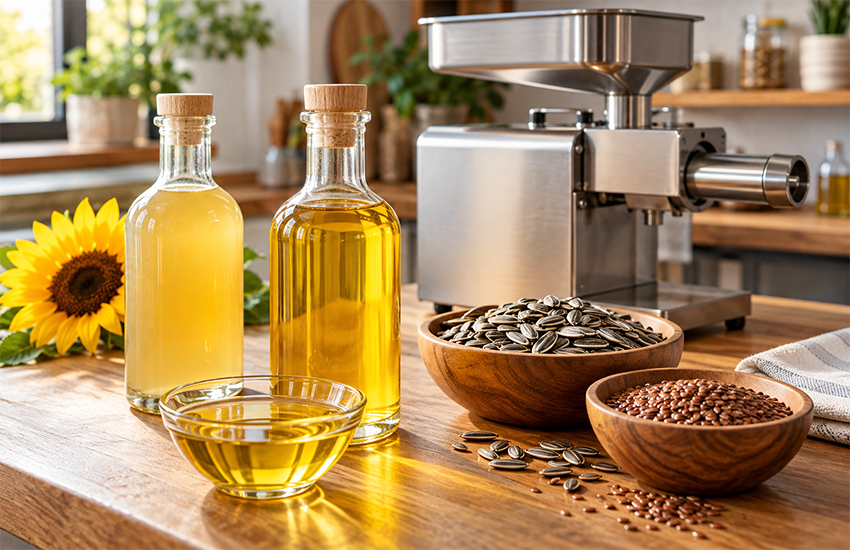
Yes, as long as the press can heat its pressing chamber. The home oil press for cold and hot pressing, 5-7.5 kg/h has an adjustable heater that brings the press head up to 200 degrees Celsius. Coconut oil flows out of it in liquid form and, once it cools below about 24 degrees in the container, sets into a firm white mass. The same press also works well with flaxseed, rapeseed, sunflower kernels, pumpkin seeds, sesame, peanuts and other nuts.
Does the fridge test show whether olive oil is genuine?
No. The composition of olive oil varies with olive variety, climate and harvest timing, so some authentic olive oils set quickly in the fridge while others stay liquid for a long time. Research by the Olive Center at the University of California, Davis showed that this popular test is unreliable and cannot replace laboratory analysis.
How can I safely restore the clarity of cloudy oil?
Simply stand the bottle at room temperature and wait for the crystals to dissolve. Sunflower oil with a high wax content may need a slightly warmer spot or a little more time. Do not heat oil on the stove or in hot water, because high temperature can damage delicate aroma compounds and speed up oxidation.