
Table of Contents
- The smallest part with the greatest authority
- Where pressure in a screw press comes from
- The triangle of dependencies - nozzle, speed and temperature
- Press cake as a record of the pressing run
- Different seeds, different nozzles
- From Anderson to modern presses - a short history of the choke
- Cold and hot pressing in one machine
- Changing nozzles in practice - how to find the right setting
- A small hole, a big difference
- Frequently Asked Questions
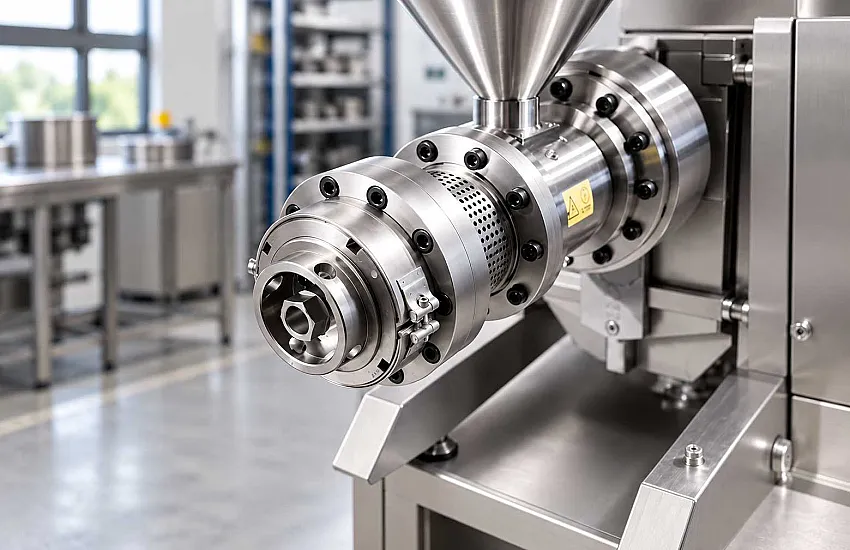
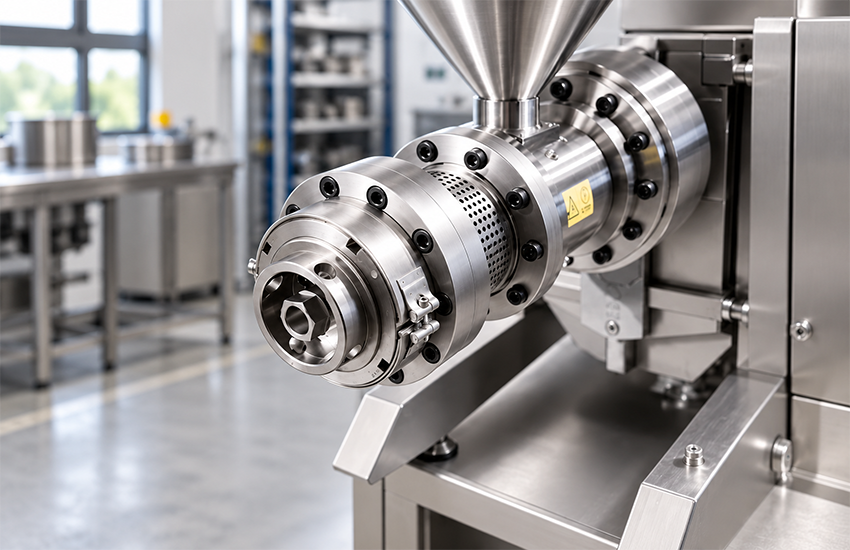
Every screw press contains a part small enough to hide in a closed fist and easy to overlook in a toolbox. It has no electronics, no moving parts and makes no sound of its own. And yet it decides whether the machine will actually press oil or merely shuffle seeds from the hopper to the other end of the barrel. We are talking about the nozzle - an unassuming sleeve with a hole in it, through which the press cake leaves the machine.
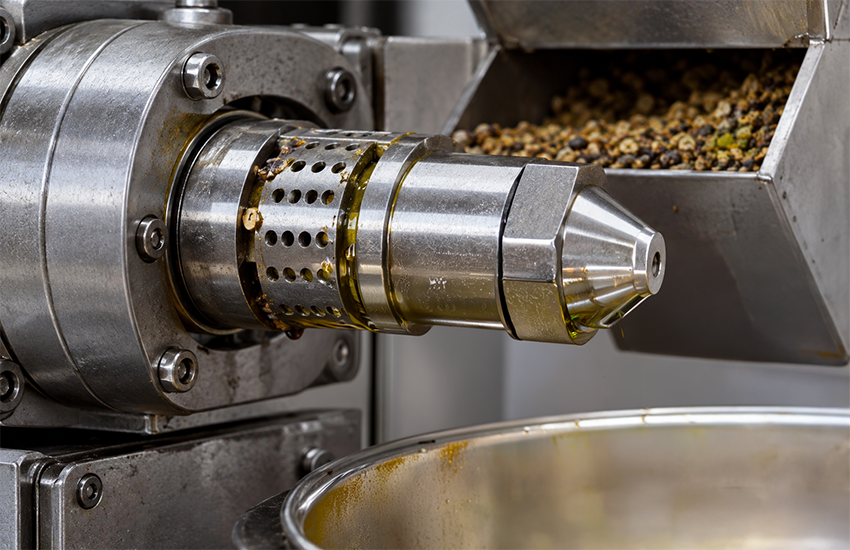
Anyone who has ever started a press without a nozzle fitted knows what that looks like. The screw turns obediently, the seeds travel along the barrel, a lightly crushed, greasy meal tumbles out of the outlet, and barely a few drops reach the oil tray. Screw in a nozzle of the right diameter and within minutes everything changes - the machine starts working in a different voice, the press head warms up, a steady stream of oil runs from the drainage holes and a firm, compact ribbon of press cake slides out of the outlet.
This article looks closely at that switch. Why can a difference of a few millimetres in the outlet diameter change the temperature of the oil, its clarity and even its aroma? What can you read from a piece of press cake before anyone reaches for a thermometer? And why do press manufacturers ship their machines with a whole set of nozzles rather than one universal part? It is a more technical piece than usual, but we promise - no tedious tables.
The smallest part with the greatest authority
It is easy to describe a screw press as a machine that crushes seeds. That is true, but incomplete. The screw on its own does not crush anything - it conveys. Its flights work like an endless transport auger, pushing material from the hopper towards the outlet. Only when that material meets resistance does what we call pressing actually begin.
That resistance is the nozzle. It narrows the outlet, and the narrowing means the seeds cannot leave the barrel freely. The screw keeps pushing, so they begin to pile up, compact and press against one another. Pressure rises, plant cell walls rupture, and the released oil looks for the shortest escape route - through the slots and holes in the barrel or press head.
In engineering terms, such a part is called a choke. Anyone who has put a thumb over the end of a garden hose knows the principle - flow drops and pressure upstream of the restriction climbs. An oil press works in a similar way, except that instead of water we are dealing with something closer to damp sand mixed with fat, which behaves very differently from a liquid.
That difference is exactly what makes the nozzle so interesting. The material in the press barrel does not flow like water - it moves as a compacted plug. The resistance it offers depends not only on the outlet diameter but also on friction against the walls, seed moisture, hull content and temperature. That is why the same nozzle behaves differently with rapeseed than with linseed, and differently in the morning than after three hours of running. A nozzle is not a setting - it is one element of a living system that you have to learn to read.
Where pressure in a screw press comes from
To understand the role of the nozzle, it helps to look inside the barrel and follow the journey of a single seed. It is a short trip, usually lasting a few dozen seconds, but as intense as almost anything in food processing. We wrote more about the design of the screw itself and the history of the idea in What Goes On Inside a Screw Oil Press? - here we focus on what happens at the very end of that journey.
A pump with nowhere to pump
In the feed zone, seeds drop loosely between the flights, with plenty of air around them. The screw picks them up and moves them along. In many designs, the pitch of the flights or the depth of the channel decreases towards the outlet, so the space available to the material gradually shrinks. The seeds are squeezed, air escapes, and the material begins to form a compact mass.
If there were no restriction at the end, that mass would simply fall out of the barrel before it had given up most of its oil. The screw would behave like a pump running in an open circuit - lots of motion, little effect. Only the nozzle turns it into a pump that pushes material against pressure. The screw still pushes, but the material has nowhere to go, so the drive's energy turns into compression and friction.
A curious detail is that pressure inside a press is not evenly distributed. The highest values usually occur in the last section before the outlet, just ahead of the nozzle. That is where the seeds are already packed into a dense plug and oil is squeezed out most intensively. Earlier parts of the barrel work more like a preparation zone - they crush, mix and warm the material.
Outlet resistance and the plug effect
The mass in the final zone of the barrel forms what process engineers call a plug. It is compact enough to partially seal the outlet by itself. As a result, pressure in the press depends not only on the nozzle diameter but also on the length and cohesion of that plug.
When the nozzle is too wide, the plug is short and loose. Material pushes through the outlet too easily, the oil has no time to be expelled, and the cake comes out greasy, soft and crumbling between the fingers. When the nozzle is too narrow, the plug becomes long and as hard as wood. Pressure climbs, friction climbs, and temperature follows. In extreme cases the press starts to choke, the motor labours under heavy load, and instead of a ribbon the cake emerges as dark, scorched fragments.
Between these extremes lies a narrow window in which the press works best. The cake comes out evenly, has a uniform colour, is firm but not baked, and the oil runs in a calm, steady stream. Finding that window for a particular seed is the real art of choosing a nozzle.
The triangle of dependencies - nozzle, speed and temperature
The nozzle never works in isolation. Its effect on pressing is always intertwined with two other parameters - screw speed and press head temperature. These three quantities form a kind of triangle in which moving one corner shifts the other two.
Smaller nozzle, warmer oil
In a screw press, heat comes mainly from friction. Seeds rub against the flights, against the barrel walls and against each other. The greater the resistance at the outlet, the greater the friction and the more heat is generated. That is why reducing the nozzle diameter almost always raises the oil temperature, even if nobody has switched on a heater.
This matters enormously to anyone pressing cold. The term "cold-pressed" does not mean the press is cool inside - it simply means the oil temperature stays below an agreed limit, most often set somewhere around 40°C, depending on the standard or the producer's own declaration. A nozzle that is too narrow can push past that limit on its own, without any external heating. A wider nozzle, on the other hand, keeps the temperature lower at the cost of leaving slightly more oil in the cake.
In hot pressing, the situation is reversed. Higher temperature is intentional here, because it lowers the viscosity of the oil and helps it flow, while also shaping the flavour profile. The nozzle then works together with the heater in the press head - the heater supplies warmth from outside, and the nozzle regulates how much additional heat is generated by friction. An experienced operator can balance these two sources to reach a stable temperature without overheating the material.
Screw speed and residence time in the barrel
The second corner of the triangle is rotational speed. Slower rotation means a seed spends more time in the barrel. It has more opportunity to release its oil, but it is also exposed to heat for longer. Faster rotation shortens that time and increases throughput, but it also intensifies friction per unit of time.
Here lies a surprising trap. You might assume slower speed always means cooler pressing. It does not have to. If you combine low speed with a narrow nozzle, the material will dwell in the high-pressure zone for a long time and may heat up more than it would at higher speed with a wider nozzle. That is why changing one parameter without watching the others so often leads to disappointment.
Stepless speed control makes this triangle much easier to work with. Instead of swapping the nozzle for every small correction, you can fine-tune the speed and watch the response. The nozzle then sets the working range, and the speed lets you move precisely within it. It is a bit like choosing a gear on a bicycle and then adjusting your cadence - the gear sets the frame, your legs do the rest.
The nozzle and oil clarity
There is one more, less obvious consequence of changing the nozzle - the amount of fine particles that leave the press along with the oil. In every screw press, some of the material squeezes through the slots and drainage holes together with the liquid. These microscopic fragments of seed tissue, hull and protein form a suspension that later sinks to the bottom of the settling tank.
When pressure in the barrel is very high, it is not just oil but also particles that are forced harder through the gaps. Oil from a narrow nozzle can therefore look cloudier straight after pressing and leave a thicker layer of sediment. A nozzle that is too wide, on the other hand, gives a loose plug, and material escapes more easily by various routes, which can also increase the amount of suspended solids. The clearest oil usually runs when the plug is compact but not overloaded.
Interestingly, a change in clarity often comes before other symptoms. Even before the cake changes colour and the thermometer shows a higher reading, the oil stream may turn hazy or start carrying noticeably more fines. A careful operator therefore treats the look of the stream as an early warning, and the bottom of the settling tank as an archive where, hours later, you can see the consequences of every decision made at the nozzle.
Press cake as a record of the pressing run
Most people treat press cake as a by-product to be collected and set aside. In fact, it is the most accurate recorder of the pressing process we have. Every centimetre of the ribbon leaving the nozzle is a record of the conditions inside the barrel a few dozen seconds earlier. You just need to learn how to read it.
The surface of the ribbon - from matt to glassy
The first thing worth looking at is the surface of the cake. When the nozzle is well matched, the ribbon usually has a matt, slightly rough texture. It is a little like pasta extruded through bronze dies - their roughness leaves microscopic scratches on the surface of the dough, which help the sauce cling. In an oil press, roughness indicates that the material passed through the outlet with moderate friction.
When the cake's surface turns shiny, almost glassy, it is a sign that friction was very high and the temperature at the contact with the nozzle was elevated. Fats and sugars on the surface start to melt, forming a thin, smooth skin. This is sometimes accompanied by darkening of the ribbon's edges. It is a hint to consider a wider nozzle or a speed adjustment.
At the other end of the scale is cake with an oily, sticky surface that leaves your fingers greasy. Such cake still contains a good deal of oil, and its softness tells you the plug in the barrel was too loose. The most common cause is a nozzle that is too large or seed that is too moist.
A cross-section that says more than a thermometer
Even more interesting information is hidden inside. Simply snap a piece of cake and look at the break. In a well-run pressing, the colour is uniform from the surface right through to the core. If, however, the outer layer is distinctly darker than the centre, it means the heat generated at the nozzle walls did not have time to spread through the whole volume of material. The surface was very hot, the centre cooler.
This colour gradient is a kind of historical thermometer. It does not give you an exact reading in degrees, but it tells you where heat was generated and how quickly it penetrated inwards. Experienced operators can use it to judge nozzle wear - a worn, enlarged nozzle produces a different cross-section from a new one.
It is also worth looking for layering. Sometimes thin, concentric rings are visible in the cross-section, as if the cake had been rolled from several sheets. This is the result of how material was wound and pushed through the last flights of the screw. Pronounced delamination can indicate uneven feeding or pressure fluctuations - for example, when the hopper periodically runs low.
Brittleness, snap and aroma
The third dimension of reading press cake is how it behaves under your fingers. A ribbon from a well-chosen nozzle breaks with a clear, dry snap and shows a compact, granular structure at the break. Cake that is too oily bends instead of breaking. Over-pressed, overly dry cake crumbles to dust, with sharp, hard edges.
Aroma is a clue too. Fresh cake from cold pressing smells nutty, grassy or cereal-like, depending on the seed. When it starts to resemble roasted seeds, the temperature in the outlet zone was already high. In hot pressing, that aroma is desirable, but if it appears during what was meant to be a cold run, it is a warning sign - and it arrives long before the change can be detected in the oil itself.
Taken together, these observations amount to diagnostics without instruments. They will not replace a thermometer or a lab analysis, but they let you respond in real time. And the response usually comes down to one of three moves: changing the nozzle, adjusting the speed or changing the press head temperature.
Different seeds, different nozzles
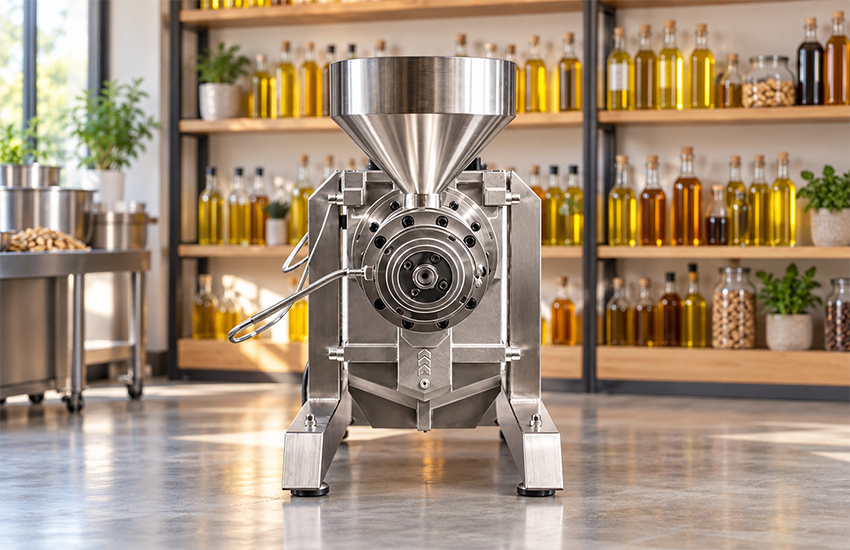
If all oilseeds behaved the same way, one nozzle would last forever. Reality is far more varied. Seeds differ in size, hardness, oil content, hull thickness and even in how their tissue responds to pressure. Each of these traits affects how much resistance the nozzle should provide.
Rapeseed, sunflower and linseed - three temperaments
Rapeseed is the seed many presses treat as their reference point. The seeds are small, round and fairly rich in oil. In the barrel they quickly form a compact plug, so they usually tolerate moderately narrow nozzles well. With correct settings, rapeseed cake comes out as a dense, hard ribbon with a greenish-brown tint.
Sunflower, especially unhulled, behaves completely differently. The hull acts as a skeleton - it stiffens the mass, increases friction and makes the plug form more easily, but also heat up faster. With unhulled sunflower, a nozzle slightly wider than for rapeseed often works well. Hulled sunflower kernels, by contrast, are soft and oily, so they need more resistance for pressure to build at all.
Linseed has a temperament of its own. Its seeds are slippery thanks to a mucilage layer on the seed coat, which reduces friction and makes it harder to build a plug. At the same time, linseed oil is particularly sensitive to temperature, so you cannot simply close the outlet down and hope for the best. Pressing flax is a balancing act - enough resistance for the seeds to release their oil, and friction moderate enough to keep the temperature low. We covered flax and its biology in more depth in Blue Field, Golden Seed.
Tiny seeds and hulled seeds
Black cumin, poppy and garden cress are very small seeds. They squeeze through gaps easily, compact quickly, but also overheat fast if resistance is too high. With these, not only the nozzle diameter but also the gap between the screw and the press head matters - if it is too wide, the tiny seeds will escape along with the oil as a suspension.
Pumpkin seeds sit at the opposite end. They are large, flat and very oily. With the hull on, they form a stiff, fibrous plug, while hull-less kernels behave almost like a paste. With pumpkin, the nozzle often has to be chosen by trial, while watching how the material's behaviour changes as the press head warms up.
Hemp has a hard, crunchy shell and a soft, oily interior. With a well-chosen nozzle, its cake is greenish, compact and smells pleasantly of fresh grass. If it starts to darken and take on a roasted note, the outlet resistance is too high for cold pressing.
This variety is the whole reason presses come with a complete set of nozzles. Each one is a different starting point for a different seed. The operator does not have to guess - they pick a nozzle as a first approximation and then fine-tune with speed and temperature.
From Anderson to modern presses - a short history of the choke
Mechanical oil extraction has thousands of years of history, but the continuously operating screw press is a relatively young invention. Around the turn of the twentieth century, the American engineer Valerius D. Anderson developed a machine that transformed the oil industry. Instead of pressing seeds in batches in bags or cages, his expeller moved material with a screw through a perforated barrel and squeezed out oil continuously.
One of the key elements of that design was an adjustable choke at the outlet. It allowed the operator to control pressure in the barrel without stopping the machine. Large industrial presses still use solutions that are direct descendants of that idea - movable cones or rings that change the width of the outlet gap.
Smaller presses, designed for farms, workshops and small producers, most often rely on interchangeable nozzles of different diameters, frequently complemented by gap adjustment. This approach is simpler mechanically and at the same time highly predictable. Each nozzle has a fixed, repeatable geometry, so a setting once found for a given seed can be reproduced next week or next year with the same result.
It is worth noting that the idea of a choke is much older than Anderson's press. Similar principles were used in clay-forming machines, in mills that extruded pastes and in early pasta-making equipment. In all these cases, a screw or a piston moves material, and the restriction at the outlet gives it shape and density. In an oil press, the same mechanism has one more job - separating the liquid from the solid.
Cold and hot pressing in one machine
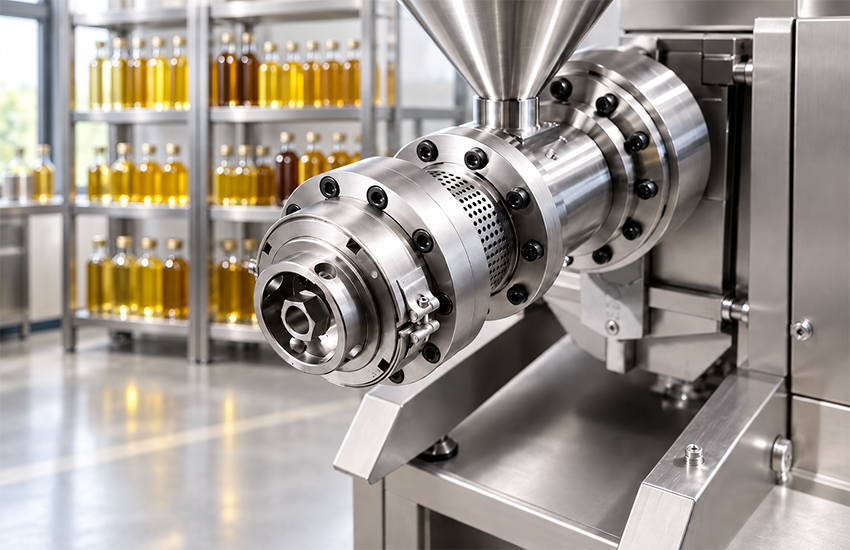
Everything described above is easiest to see in machines that let you consciously move around the whole nozzle - speed - temperature triangle. A good example is the Hot & Cold Oil Press 25 kg/h in stainless steel, model PTOW 510s. It is a German-made machine designed for steady, continuous work, in which each of the three corners of the triangle has its own control.
Speed is handled by continuous adjustment of the screw, driven by a 1.5 kW motor running on standard 230 V. Temperature is handled by a heater integrated into the press head, with digital temperature control - which makes it possible to switch between cold pressing below 40°C and hot pressing without changing machines. Outlet resistance is handled by a set of six interchangeable nozzles supplied with the press, complemented by an adjustable press gap.
What makes this model particularly interesting in the context of this article is the digital measurement of oil outlet temperature. Everything we said about reading press cake - the glassy surface, the darker edges, the roasted aroma - is an indirect way of inferring temperature. Here you also get a direct reading, right where it matters. Put the two together and the effect of each nozzle change stops being a matter of guesswork: you see the number on the display and, a minute later, its echo in the cake.
The press and its base are made of hardened, medical-grade stainless steel, and the press head is split, which matters a great deal for cleaning. Parts in contact with oil can be taken apart and washed, including in a dishwasher. When you switch seeds often - say from rapeseed to linseed and then to hemp - this shortens the breaks between batches and reduces the risk of carrying flavours over. The machine weighs 68 kg, measures 87 × 33 × 55 cm, can be connected to a silo, uses food-grade bearings and has been tested on more than a hundred seed varieties.
Why a nozzle set is a tool, not an accessory
It is tempting to treat the six nozzles in the box as an extra that ends up in a drawer for years. In fact, they define the range of what the press can do. A machine with one nozzle will press one or two seeds beautifully and work on a compromise with everything else. A machine with a full set lets you find a starting point close to the optimum for every seed.
Combined with digital temperature control and continuous speed adjustment, the nozzle set turns the press into a tool for experimentation. You can press the same rapeseed cold with a wider nozzle, getting a pale, delicate oil, and then hot with a narrower nozzle, getting an oil with a deeper colour and a bolder flavour. Two different products from the same seed and the same machine - the difference lies in a few millimetres of outlet diameter and a few degrees on the display.
The larger the volume, the more each of these decisions counts. In continuous production, a well-matched nozzle means consistent quality across a whole batch, not just a single bottle. This is where the repeatable geometry of interchangeable nozzles really pays off - settings, once written down, can be reproduced with every new delivery of seed. Operations that need far higher throughput move up to continuous expellers such as the screw oil press rated at 3.5-5 t/24h, but the principle at the outlet stays exactly the same.
Changing nozzles in practice - how to find the right setting
Theory is useful, but at the press what counts is method. Experienced operators rarely pick a nozzle from a table. Instead, they follow a simple, repeatable procedure that gets them close to the optimum for a new seed quickly.
The usual starting point is a medium nozzle, leaning towards the wider end of the set. The press runs with it for a few minutes until the head reaches a stable temperature. Only then is the cake assessed - its surface, cross-section, snap and aroma. An assessment on a cold machine is misleading, because in the first minutes the plug has not yet formed and friction is still building. We wrote more about how a press's behaviour changes over its first quarter-hours in our article on warming up an oil press.
If the cake is oily and soft, reduce the nozzle diameter by one step. If it is glassy, dark at the edges or smells roasted during a cold run, increase it. Assess each change only after another stabilisation period. Changing two parameters at once is the most common mistake, because it makes it impossible to tell which one produced the effect.
Once the nozzle is chosen, the rest is fine adjustment with speed and temperature. It is worth keeping a simple logbook in which, for each seed, you record the nozzle number, speed, head temperature, seed moisture and a short description of the cake. After a few seasons, that logbook becomes the most valuable operating manual you could have, because it describes how your particular machine behaves in your particular conditions.
Do not forget about wear. The nozzle works in the zone of highest pressure and friction, so over time its bore wears. The diameter grows, the edges round off, and the character of the press's work changes with them. If, at the same settings, the cake starts coming out oilier than it used to and the seed has not changed, the nozzle is one of the first suspects. Comparing the worn nozzle with a new one from the set confirms it quickly.
A great deal also depends on the seed itself. Seeds that are too moist act like a lubricant - they reduce friction, hinder plug formation and mean that even a narrow nozzle does not generate enough pressure. Over-dried seeds do the opposite - the plug forms quickly, but it is brittle and the temperature climbs sharply. So before changing the nozzle, make sure the problem is not in the seed. We looked at the role of water in pressing in more detail in The Few Percent of Water That Decide Everything.
A small hole, a big difference
The nozzle is the part that best shows how much oil pressing is a game of proportions. There is no single golden value you can set once and forget. Instead, there is a web of dependencies in which outlet diameter, screw speed, press head temperature and the condition of the seed constantly influence one another.
The most valuable thing about this knowledge is that the press itself tells you what is going on inside. Look at the cake - its surface, cross-section, colour and aroma - and you will know whether the nozzle is doing its job. It is a form of diagnostics open to anyone willing to spend a few minutes observing carefully.
Next time you change a nozzle, treat it not as an ordinary spare part but as the most important dial on the whole machine. A few millimetres can change everything - from the colour of the oil to the sound the press makes as it works.
Frequently Asked Questions
What does the nozzle do in an oil press?
The nozzle narrows the outlet through which press cake leaves the machine. Because of it, the material in the barrel cannot exit freely, so it compacts and builds the pressure needed to squeeze out the oil. Without a nozzle, the screw would merely move the seeds along, and the amount of oil obtained would be minimal.
How can I tell if the nozzle is too wide?
The most common sign is oily, soft press cake that bends instead of breaking and leaves your fingers greasy. Oil flows in a weaker stream, and more of it stays in the cake than it should. The press runs lighter, and the head warms up more slowly than usual.
How can I tell if the nozzle is too narrow?
The cake becomes hard and glassy on the surface, often darker at the edges than in the middle. It may smell of roasted seeds even during cold pressing. The motor works under a heavier load and the oil temperature rises. In extreme cases, the press starts to choke.
Does nozzle diameter affect oil temperature?
Yes, and significantly. A narrower nozzle increases resistance and friction in the barrel, and friction is the main source of heat in a screw press. That is why, in cold pressing, choosing the nozzle is one of the most important ways of controlling temperature, alongside adjusting screw speed.
Why do oil presses come with several nozzles?
Different seeds need different outlet resistance. Rapeseed, linseed, unhulled sunflower, pumpkin seeds and black cumin differ in size, hardness and oil content. A full set, such as the six interchangeable nozzles supplied with the PTOW 510s, lets you choose a starting point for each seed and then fine-tune with speed and temperature.
How often should a nozzle be replaced?
There is no fixed rule, because the rate of wear depends on the type of seed, its cleanliness and how intensively the press runs. Hard, hulled seeds and mineral contaminants such as sand wear the bore faster. A good signal to check the nozzle is when, at unchanged settings and with the same seed, the cake starts coming out noticeably oilier than before.
Can press cake tell you how the pressing went?
Yes - press cake is a very accurate record of conditions inside the barrel. The surface tells you about friction at the outlet, the cross-section about temperature distribution, the snap about oil content, and the aroma about whether the material overheated. Watching the cake regularly lets you correct the press as you go, before any change shows up in the oil itself.