
Table of Contents
- Winter and Its Effect on an Oil Press - What Happens to the Machine During Downtime
- Cleaning and Inspecting the Oil Press - Step by Step
- Preparing Raw Materials - A Critical Step Before the Season Begins
- Temperature Calibration and the Season's First Start-Up
- Oil Presses for the Spring Season - Recommended Models
- Clarifying Oil - The Final Stage of Preparation for the New Season
- Organising the Workspace for the New Pressing Season
- FAQ - Most Common Questions About Preparing an Oil Press for the Spring Season
- Summary - How to Start the Season in the Oil Mill Efficiently
March is the month that many oil producers and home press owners associate with a kind of awakening. After several months of reduced activity, the machines return to full operation. Seeds purchased in autumn or stored since the summer harvest are waiting to be pressed, and the first spring sunshine serves as a reminder that the season has truly begun. But before an oil press starts working, a number of steps must be completed - steps that will determine the quality of the oil, the longevity of the equipment, and the safety of the entire process.
Preparing pressing equipment after winter is not merely a routine technical task. It is also a moment to take a fresh look at the entire production process - from assessing the state of raw materials, through inspecting the working parts of the press, to organising the collection and clarification of the finished oil. Neglecting this stage can result not only in poor product quality but also in an unplanned breakdown in the middle of the season.
This guide walks through all the key steps for starting an oil press after a winter break, covering both mechanical aspects and those related to raw material quality. Along the way, it highlights equipment that effectively supports these preparations and proper oil production.
When Is the Best Time to Carry Out a Seasonal Press Inspection
The most optimal window for a seasonal equipment inspection is early March - before the first batch of fresh grain arrives or before any urgent production need arises. An inspection carried out under time pressure, squeezed between one batch of seeds and the next, tends to be rushed and incomplete, leaving no opportunity to properly dry cleaned parts or order any needed replacement components. Planning the inspection several weeks in advance gives the entire season a calm, controlled pace. Given the delivery times for certain accessories and service parts - sometimes several working days - it is worth flagging any maintenance needs with the equipment supplier as early as February or the very beginning of March.
Winter and Its Effect on an Oil Press - What Happens to the Machine During Downtime
Temperature Changes and Precision Press Components
Oil presses, whether home models or semi-industrial ones, are built from precision mechanical components. Ambient temperature has a direct effect on the condition of lubricants, seals, bearings, and all metal parts. In an unheated space - and many oil mills are located in farm buildings, cellars, or structures without continuous heating - metal is subjected to repeated freeze-thaw cycles through the winter. The result can be micro-corrosion, hardened lubrication, or minor damage to components worn over time.
Oils used to lubricate external moving parts can stratify or thicken, leading to increased resistance when the press is first started up. Rubber components also deserve attention - seals exposed to prolonged low temperatures lose their elasticity, which can cause leaks or a loss of seal integrity in the pressing chamber.
Deposits, Oil Residues, and Microbiology
Even a thoroughly cleaned oil press can, after several months of dormancy, become a place where traces of oil or organic matter left behind from the previous season transform into stubborn residue. Unrefined, cold-pressed oils are sensitive to oxidation - if any trace oiliness remains in the pressing chamber or on the auger screw, it may turn rancid over several months. Starting the press without a thorough cleaning would mean that the first batches of oil in the new season carry unwanted substances into the finished product.
That is why the golden rule of every March inspection is simple: cleaning first, calibration second, first test pressing last.
Cleaning and Inspecting the Oil Press - Step by Step
Disassembly and Washing of Working Parts
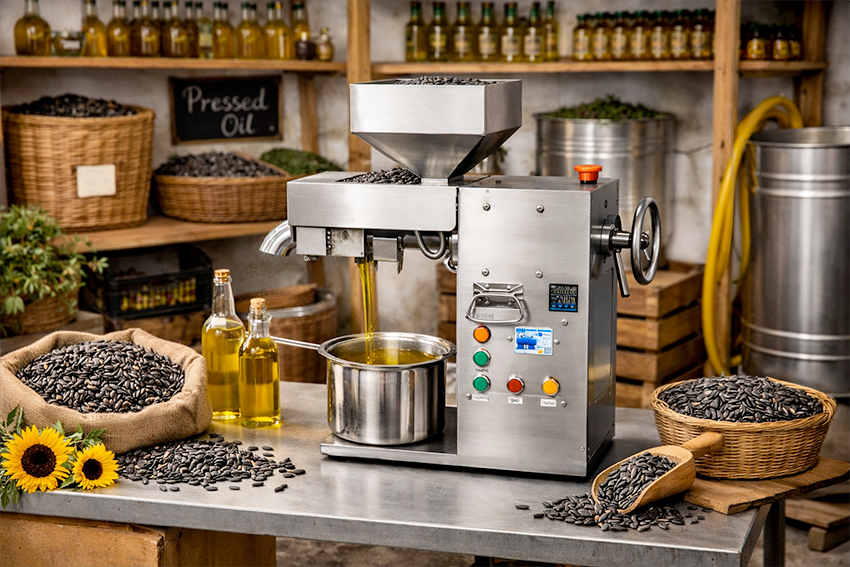
The seasonal inspection always begins with a full disassembly of the parts that have been in contact with seeds and oil. In typical screw presses, these are: the pressing auger, the press head, the sieve, the nozzle, and the casing of the pressing chamber. All of these components require thorough washing in hot water with a neutral detergent, followed by rinsing and drying.
Modern presses built from medical-grade stainless steel - such as the Hot & Cold Oil Press PTOW 100S - offer an additional convenience here: the parts can be washed in a dishwasher. This is a significant time-saver that also ensures hygienic cleaning standards without the risk of leaving any detergent residue behind.
Before reassembly, it is important to inspect the condition of the thread on the nozzle and the retaining nut. Any metal wear or thread damage can affect the even clamping of the press head, which directly impacts pressing quality and the percentage of oil remaining in the press cake.
Inspecting the Auger Screw and Pressing Chamber
The auger is the heart of an oil press. Both the efficiency and the temperature of the pressing process depend on its condition. During disassembly, the surface of the screw thread should be carefully examined for scratches, mechanical damage, or signs of corrosion. Even minor damage can disrupt the even movement of material through the chamber and cause uneven heating.
In presses equipped with two interchangeable auger screws - such as the Semi-Industrial Oil Press LY-129 - it is worth checking the condition of both and determining which is ready for immediate use and which may require servicing. Interchangeable augers are a great convenience, as they allow the press to be quickly and flexibly adapted to different raw materials - for example, hard-shelled seeds or materials that produce a particularly dense press cake.
Press Cake After the Winter Break - Assessing Condition and Next Steps
Press cake - the solid residue remaining after oil extraction - is a valuable by-product. Oil content in press cake from well-functioning semi-industrial presses is up to 5%, a figure that indicates the raw material has been efficiently processed. Press cake from rapeseed, sunflower, or flaxseed is commonly used as animal feed, a baking ingredient, or the basis for oil cake flour when processed through a grinder.
If press cake stocks remain from the previous season, their condition should be checked before use. Cake stored in damp conditions may have been affected by mould - signs of which include white or grey discolouration, an unpleasant smell, or a compact, clumped texture. Such cake should not be used as animal feed or for food purposes. Healthy press cake has an intense, characteristic seed aroma and is dry and crumbly.
Bearings, Drives, and the Gearbox
Below eye level lie components that are critical to the longevity of the press: bearings and the drive system. In presses with direct gear engagement - without a transmission belt - the risk of failure is significantly lower, but this does not eliminate the need for inspection. After winter, the bearing should be checked to ensure it rotates freely without resistance and without any unusual sounds (grinding, crunching, or uneven dragging). If any irregularity appears, it is advisable to contact a service technician before running the machine under full load.
The control panel, display, and head heater are further areas requiring attention. In models with digital temperature monitoring - such as the PTOW 100S - the sensor should be verified to ensure it reads temperature correctly and that the heater warms evenly to the set values. Parameters that are too low or too high will have a direct impact on oil quality and the progress of the pressing process.
Seals and Connections - Where to Look for Faults
March is a good time to replace any seals showing signs of wear. Plastic and rubber parts can become brittle or hardened after winter, meaning that at the first heating of the press, leaks may appear. All clamp and bolt connections should be retightened, as temperature changes can cause them to loosen. It is also worth checking the protective covers on power cables for insulation damage - the oily environment combined with moisture can degrade wiring if it is not properly protected.
Preparing Raw Materials - A Critical Step Before the Season Begins
Why Seed Moisture Determines Whether Pressing Will Succeed
Even the most technically advanced oil press will not extract the full potential of oil from seeds that have the wrong moisture content. This is one of the most underestimated factors in home and semi-industrial oil mills. Moisture that is too high - above the recommended values for a given variety - causes the material to clump in the pressing chamber, block the auger, and significantly reduce the efficiency of the process. The auger must then work with increased force, which leads to motor overheating and accelerated wear of components.
An even more serious problem is seed moisture from the perspective of the quality of the oil itself. Grain stored through winter in spaces with fluctuating temperatures and humidity can imperceptibly absorb moisture from the surrounding air. Overly moist seeds promote the growth of fungi and mould, and the mycotoxins they produce are highly harmful compounds that are not destroyed during the pressing process. Oil from improperly stored grain may have a shortened shelf life, an unpleasant smell, and reduced nutritional value.
Draminski GMM Mini II Moisture Meter - The First Measurement of the Season
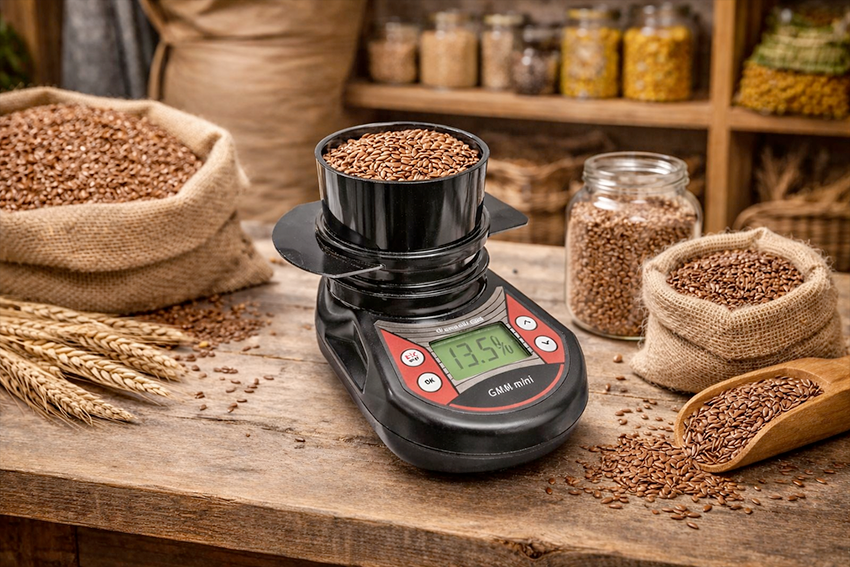
Before starting any production in March, it is worth checking the moisture content of stored seed stocks. The tool that gives a quick and accurate answer is the Draminski GMM Mini II moisture meter - a model calibrated specifically for oilseeds.
The Moisture Meter for Oilseeds Draminski GMM Mini II measures the moisture of 14 seed varieties, including rapeseed, hulled and unhulled sunflower, flax, hemp, nigella (black cumin), pumpkin, sesame, soy, milk thistle, walnut, hazelnut, and almond. Measurement is carried out using the capacitive method - simply fill the chamber with a sample using the included dispenser and read the result on the clear LCD display. Measurement accuracy is +/-1% in the range up to 10% moisture and +/-1.5% above this value. Seed temperature is automatically accounted for in the calibration, eliminating errors caused by temperature differences between the room and stored seeds. The device weighs just 700 g with batteries and fits in a pocket or backpack - making it equally useful when collecting raw materials directly from a grower.
How to Interpret Moisture Readings
Most oil presses - including the LY-129 and PTOW 100S models - operate optimally with seed moisture below 8-10%, depending on the variety. The PTOW 100S is designed for seeds with a maximum residual moisture of 8%, with the recommended range being 6-8%. Exceeding these values means the raw material must be dried before pressing.
Drying in a home or small oil mill setting can be done by spreading the seeds in a thin layer on a clean, well-ventilated surface in a heated room. Intense electrical heating directly above the seeds should be avoided - temperatures above 40 degrees Celsius begin to affect valuable unsaturated fatty acids, which is particularly important when planning subsequent cold pressing. The measurement should be repeated after drying to confirm that the raw material meets the requirements of the press.
Temperature Calibration and the Season's First Start-Up
Pressing Temperature - Cold or Hot
The choice between cold and hot pressing is a fundamental decision that shapes the character of the entire production run. Cold pressing means the oil temperature at the outlet does not exceed 40 degrees Celsius. All sensitive components are preserved: omega-3 and omega-6 fatty acids, natural antioxidants, enzymes, chlorophyll pigments, and volatile aromatic compounds. Cold-pressed oil retains its full nutritional value and a distinctive, true-to-variety flavour.
Hot pressing - at temperatures of 120-200 degrees Celsius, and up to 250 degrees in the case of the LY-129 model - allows for higher yields and the processing of seeds that release oil poorly without heat (e.g. hulled sunflower seeds or desiccated coconut). The price of higher yield is partial degradation of heat-sensitive components, making the hot mode suited to production where throughput takes priority over preserving the full nutritional profile.
Warming Up the Press After a Winter Shutdown
The first start-up of an oil press after a longer break should always be handled with caution. It is advisable to run the machine without any raw material for several minutes to check the evenness of the motor, the sound of the drive, and the free rotation of the auger. In machines with variable speed control - like the PTOW 100S - it is worth starting at low speed and gradually increasing it while observing the machine's behaviour. Any unusual sound - grinding, uneven humming, vibrations - should be treated as a signal to stop and check the assembly.
If the press has a built-in head heater with a digital temperature monitor - as is the case with the PTOW 100S - the head should be pre-heated to the target temperature before the first raw material is fed in. This ensures that the first portions of seeds arrive in an already optimally prepared pressing environment. This is especially important in early spring, when the ambient temperature in an unheated workshop or garage may be low. Digital measurement of the head temperature eliminates guesswork - the operator sees the exact value and can maintain it throughout the working session.
In models without a built-in head heater, such as the LY-129, warming up happens naturally during pressing - the auger generates heat through friction with the material, which gradually fills the chamber. The first few dozen grams of oil from a warming machine are best set aside and not mixed with the main production batch. Oil from a cold start-up may differ in colour, consistency, and mechanical particle content compared to oil from a stabilised process.
Test Pressing and Parameter Control
After the initial warm-up, a test pressing should be carried out on a small portion of seeds - around 0.5-1 kg. Output should be observed (how much oil flows from the nozzle per minute), the quality of the press cake (oil percentage, granule consistency), and the colour and clarity of the raw oil. The oil should flow evenly, without foam and without an excessive number of mechanical particles.
If the oil is too viscous or cloudy, this may indicate too low a temperature or too high a seed moisture. If the press cake is too wet and clumps together, the press is likely running at too high a speed or the nozzle is set too loosely. Adjusting the nozzle gap and auger speed - both of which are steplessly and precisely adjustable on the PTOW 100S - allows parameters to be fine-tuned to the specific seed variety.
Oil Presses for the Spring Season - Recommended Models
Semi-Industrial Press LY-129 - Compact Output to Kick Off the Season
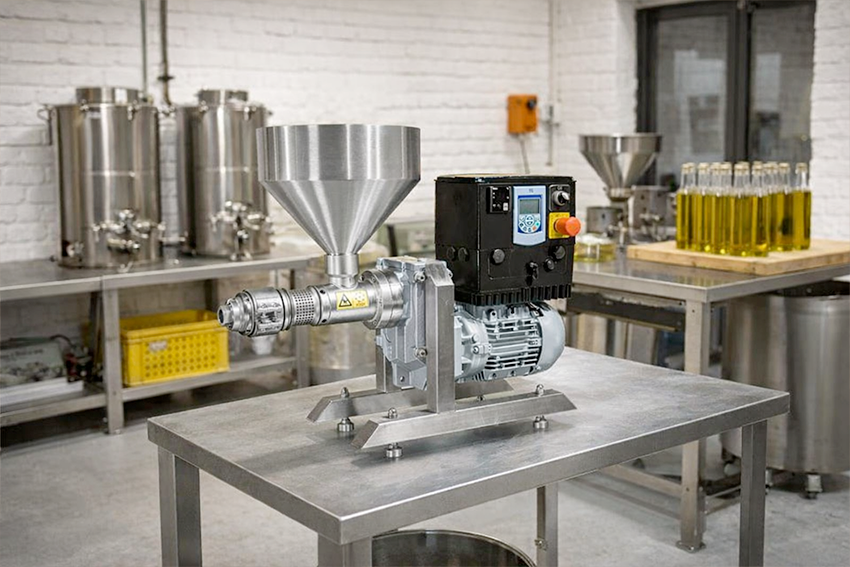
For oil mill owners planning production on a family or semi-industrial scale, the spring season is an ideal time to assess the capabilities of existing equipment or consider new machinery. The Semi-Industrial Oil Press LY-129 combines compact dimensions (70 x 30 x 74 cm) with a throughput of 15-20 kg of raw material per hour. A 1.5 kW motor works alongside a 500 W heater, enabling flexible pressing both cold and hot - up to 250 degrees Celsius. The hopper capacity is 4-5 kg, which with continuous operation delivers solid output without the need for constant supervision. The press weighs 53 kg and is made from 304 and 420 stainless steel - materials certified for contact with food. The set includes two interchangeable auger screws and, in the current promotion, one kilogram of organic seed.
Hot & Cold Oil Press PTOW 100S - Precision with Digital Temperature Control
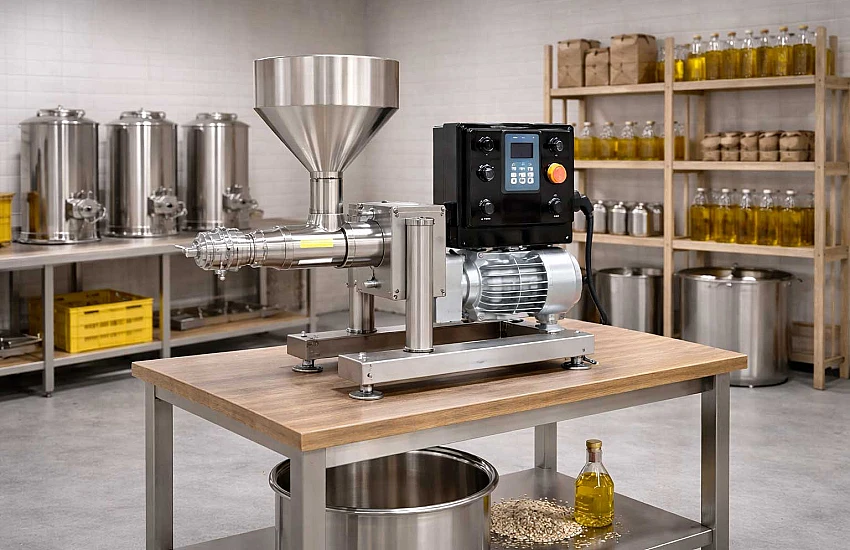
If the priority is precise process control and the ability to work in varied conditions - including outdoors, at markets or farm stalls - the Hot & Cold Oil Press PTOW 100S is a premium-class solution. This model comes from a German manufacturer and offers everything that matters most in professional oil pressing. Stepless speed control of the auger allows parameters to be adjusted to the specific characteristics of each seed type. The built-in head heater with digital temperature monitoring guarantees continuous oversight of the process - regardless of ambient conditions. Each of the 6 included nozzles enables different compression levels to be set, directly affecting oil yield and the character of the press cake. All parts in contact with the raw material are made from hardened medical-grade stainless steel, dishwasher-safe. The machine weighs 47 kg with dimensions of 80 x 25 x 57 cm, draws just 0.75 kW of power, and operates at a throughput of up to 14 kg of raw material per hour.
Clarifying Oil - The Final Stage of Preparation for the New Season
Why Freshly Pressed Oil Needs to Settle
Freshly pressed oil is not yet a finished product. It contains fine mechanical particles, husk dust, and small organic matter that left the pressing chamber along with the liquid. Over time, this matter settles to the bottom of a container - provided there is sufficient space and time. This process, known as sedimentation or settling, is the most natural and straightforward method available in home and small-scale oil mill settings.
Proper settling produces oil of significantly higher clarity and better shelf life. Organic particles that remain in unsettled oil accelerate oxidation processes and shorten the product's usable life. An investment in a good sedimentation tank is therefore an investment in the quality of the final product.
30-Litre Stainless Steel Sedimentation Tank - A Practical Solution for the Start of the Season
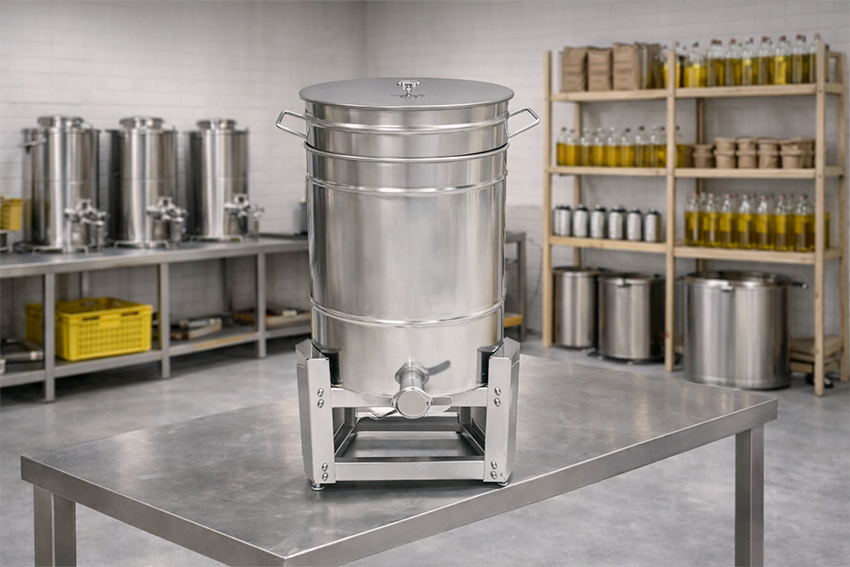
For the start of a new season, especially at moderate production volumes, the Sedimentation Tank 30 l works very well. Made from stainless steel with 0.8 mm sheet thickness, fitted with handles and a stable stand, it allows oil to be safely collected and clarified directly after pressing. The 6/4" drain valve is positioned to allow mounting at any height within the production line, meaning settled oil can be drawn off conveniently without disturbing the sediment at the bottom. External dimensions are 410 mm diameter and 300 mm height; weight is 8.5 kg.
How Long Should Oil Be Left to Settle
Sedimentation time depends on the type of oil and the temperature of the space where clarification takes place. Dense, wax-rich oils - such as linseed or milk thistle oil - may require up to 48-72 hours at room temperature (18-22 degrees Celsius). Lighter oils, such as rapeseed or sunflower, clarify more quickly: 24 hours are usually sufficient for the sediment to clearly separate from the clear portion. Lower temperatures slow sedimentation - if the oil mill or pantry is cool, the oil should be left to settle for longer. Heat should not be used to accelerate the process - warming oil to speed up clarification destroys sensitive components.
Organising the Workspace for the New Pressing Season
Hygiene and Safety in the Oil Mill
The new season is also an opportunity to tidy up the working space. Surfaces on which pressing and clarifying take place should be easy to clean and resistant to oils and fats. Cold-pressed oils - especially unrefined ones - leave permanent marks on untreated wooden surfaces, and accumulated oil can turn rancid over time and release an unpleasant smell that permeates subsequent production batches. Covering work surfaces with easy-to-clean materials - such as aluminium or stainless steel sheeting - is an investment that pays off in everyday operations.
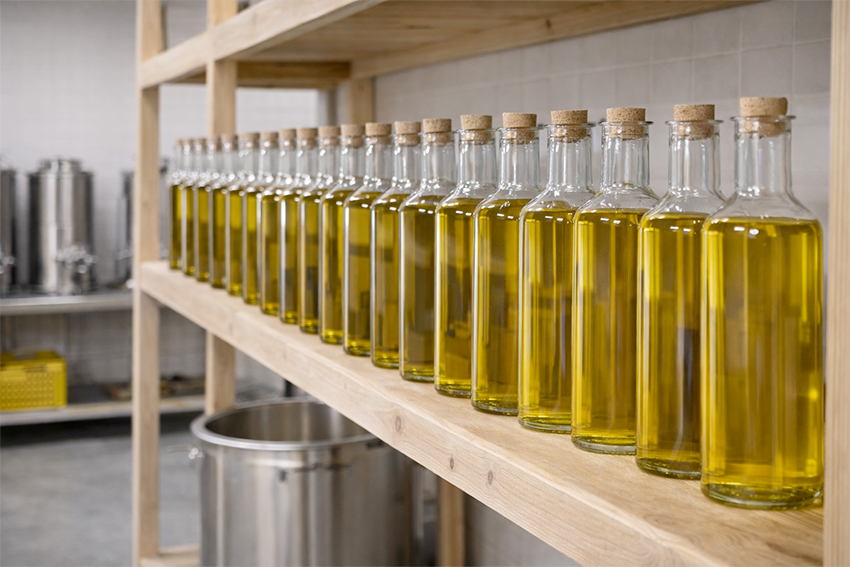
All containers used for collecting and storing oil should be thoroughly washed and dried before the new season. Glass bottles from the previous season may contain oxidised oil on their inner walls or under caps - even if they appear visually clean. The best cleaning method is rinsing with hot water containing a few drops of washing soda, followed by drying upside down on a rack.
For production intended for sale or regular customers, applicable hygiene standards must be observed. Stainless steel, which dominates in modern oil presses, greatly facilitates the maintenance of food safety standards. However, the machine material alone is not everything - the cleanliness of the environment and proper storage of raw materials and finished oil are equally important elements of the whole system.
Production Planning and Seed Stock Management
March is a good time to plan the production schedule for the entire season. The quantity of available raw material should be assessed, its condition checked - including moisture content using a moisture meter - and a pressing order planned. Varieties with a short freshness window, such as flaxseed or hemp, are worth pressing before those that are more stable and withstand longer storage. Raw material freshness also affects oil quality - the shorter the journey from harvest to the oil mill, the fuller the aromatic profile and the higher the yield of fatty acids.
When planning production, the capacity of the available sedimentation tank should be factored in. If the press can produce 15-20 litres of oil per day - which is realistic for the LY-129 at full load - the 30-litre tank will hold a full day's output, after which the clarified oil must be drawn off and the tank refilled. For larger production volumes, it may be beneficial to add a second tank to the setup, or to invest straight away in a larger-capacity model.
Labelling and bottling logistics are also worth thinking through. If production is destined for a local market, a farmers' market, or regular buyers, keeping accurate records of pressing dates and seed varieties will help build transparency in the offer and a professional image for the oil mill.
FAQ - Most Common Questions About Preparing an Oil Press for the Spring Season
How often should an oil press be cleaned during the season?
Cleaning frequency depends primarily on the intensity of use and the type of seeds being pressed. With daily operation in a small or medium-scale oil mill, it is generally accepted that full cleaning of the pressing chamber - including disassembly of the auger and sieve - should take place at least once a week. After each pressing session, it is worth running a few dozen grams of cleaning seed (e.g. flax or mustard) through the chamber, or briefly airing the working parts. In presses whose parts can be washed in a dishwasher, this is significantly simpler and takes considerably less time.
What are the optimal moisture parameters for the most commonly pressed seeds?
Rapeseed should have a moisture content of 4-8%, flax 5.4-9%, hulled sunflower 6-10%, and hull-less pumpkin around 5.8-10%. These are indicative values - a specific press may have its own manufacturer recommendations. The PTOW 100S operates optimally with seed moisture of 6-8%, with a permissible maximum of 8%. Exceeding these values results in reduced pressing performance and a risk of chamber blockage. The Draminski GMM Mini II moisture meter allows these parameters to be checked precisely before each production run begins.
What should be done when an oil press has low output after a winter shutdown?
Low output after a longer period of downtime can have several causes. The first is insufficient warm-up - the auger and pressing chamber need time to reach operating temperature. Another may be excessively high seed moisture or too much nozzle pressure, which restricts the flow of oil. It is also worth checking whether the auger is correctly seated and whether there are any residue deposits from the previous season blocking the flow paths. Adjusting the nozzle gap and auger speed are the first corrective steps to take.
How should cold-pressed oil be stored to keep it fresh as long as possible?
Cold-pressed oil should be stored away from light, in tightly sealed containers made of glass or stainless steel. A storage temperature of 10-15 degrees Celsius significantly extends the oil's shelf life compared with room temperature. Many oil varieties - linseed, hemp, and evening primrose oils - due to their high omega-3 content, should be kept refrigerated after opening. Unsettled oil has a shorter shelf life - which is precisely why the settling stage in a sedimentation tank is so important. Properly settled and stored rapeseed oil can remain fresh for 6-12 months; linseed oil, for around 3-4 months from pressing.
Can pressing start immediately after winter without inspecting the press?
Technically yes, but it is strongly inadvisable. After a winter shutdown - especially in spaces with variable temperatures - an oil press requires above all a thorough cleaning (residual oil from the previous season may have oxidised or hardened), a check on the auger condition, an inspection of seals, and possible lubrication of external parts. Starting the machine without this stage risks not only poor quality in the first oil batches, but also a potential breakdown caused by a seized auger or a damaged bearing that has been out of use for several months.
What is the practical benefit of a moisture meter calibrated specifically for oilseeds?
General grain moisture meters are calibrated for wheat, barley, or maize - varieties with entirely different dielectric properties than oilseeds. Using such a device to measure, for example, rapeseed or flax will produce a result with a significant error margin that can lead to the wrong decision about the raw material. The Draminski GMM Mini II is calibrated specifically for 14 oilseed varieties, which means its readings are accurate and suitable for making real production decisions. The difference is between guesswork and certainty about the state of the raw material before pressing.
Which pressing mode should be used for early spring oils - cold or hot?
The answer depends on the intended use of the oil. If the goal is a product with full nutritional value - rich in omega fatty acids and natural antioxidants - cold pressing is the only sensible choice. Spring production of linseed, hemp, or nigella oil should be carried out exclusively in this mode. Hot pressing is justified when yield is the priority or when the raw material is difficult to press cold. Regardless of the mode, the PTOW 100S press with digital temperature control allows the process to be precisely monitored and set parameters to be maintained throughout the working session - which is especially important in the cool conditions of early spring.
Summary - How to Start the Season in the Oil Mill Efficiently
March in the oil mill is a topic that brings together mechanics, chemistry, and raw material management into one clear procedure. A seasonal inspection of the oil press - starting with disassembly and cleaning, through checks on the auger, bearings, and seals, and finishing with the first test runs - is the essential foundation of the entire season. Alongside this, evaluating seed moisture with a meter calibrated for oilseeds helps avoid the most common production problems: low output, chamber blockages, and oils with a shortened shelf life.
The choice of the right press - whether the semi-industrial LY-129 or the precision PTOW 100S with digital temperature control - should be guided by the planned production scale, seed types, and expected quality of the final product. The LY-129 offers reliable, proven output and excellent thermal flexibility, while the PTOW 100S brings advanced process control precision and medical-grade build quality that performs equally well outside the oil mill - at markets, exhibitions, or in mobile production settings. Completing the line with a stainless steel sedimentation tank closes the entire production chain and ensures that the oil leaving the press arrives in the bottle clean, clear, and full of nutritional value.
The spring start is also a moment to reflect on the overall process and consider potential improvements. Every new season is worth beginning with a clear head - and with well-prepared machines.