
Table of Contents
- Why Producing Your Own Oil Is Worth It
- How to Think About Capacity – The Key Parameter When Choosing a Press
- A Home Press – When a Few Kilograms Per Hour Is Enough
- Stepping Up – Presses for Greater Domestic Needs and Small Businesses
- Presses for Small Oil Mills and Professional Operators
- Matching the Press to the Seed Type
- Press Cake – A Valuable By-product
- Practical Advice Before Buying an Oil Press
- FAQ – Frequently Asked Questions
Choosing an oil press seems straightforward at first glance – buy a machine and start pressing. In practice, the differences between individual models are enormous, and a mismatch between the press and the scale of production can mean either unnecessary overspending or constant frustration caused by insufficient capacity. A press perfectly suited for a family pressing flaxseed oil for their own use will break down within a week if run by a small oil mill operating around the clock. Conversely, an industrial machine installed in a kitchen is not only overkill – it is a recipe for failure due to its electrical requirements and sheer size. This guide helps you navigate the full spectrum of available solutions – from compact home presses to continuous professional pressing – and points to specific models matched to every stage of production.
The market for oil presses has grown rapidly over the past decade, driven by rising health awareness and growing interest in locally produced food. Not long ago, owning a personal oil press was a rarity – today you can find them in the kitchens of health-conscious households, on professionally run farms, and at market stalls alike. That surge in demand has broadened the product range considerably: manufacturers now offer machines at every level of technical sophistication and price, which on one hand gives buyers more choice, and on the other demands a clear understanding of the key parameters.
Why Producing Your Own Oil Is Worth It
Home-pressed oil vs. store-bought – a difference you can taste
Supermarket oil, even when labelled "cold-pressed", often undergoes refining, bleaching or deodorisation that strips away a significant portion of its nutritional value and characteristic aroma. Oil made at home is an entirely different product – pressed directly from the seed and consumed within a few weeks of production, it reaches the body in its fullest form, rich in unsaturated omega-3 and omega-6 fatty acids, fat-soluble vitamins and antioxidants. Flaxseed oil pressed from golden linseeds in a home press and stored in a dark bottle in the fridge is a product that has no equal on supermarket shelves in terms of nutritional density.
The difference is also visible to the naked eye and perceptible on the palate. Fresh rapeseed oil has an earthy, lightly nutty aroma; pumpkin seed oil boasts an intensely green colour and a bold flavour that is impossible to mistake for anything else. These qualities fade with time and industrial processing. Producing your own oil keeps them intact.
What determines the quality of home-pressed oil
Oil quality is shaped primarily by three factors: the freshness and variety of the raw material, the pressing temperature, and the cleanliness of the process. Seeds should be dry – moisture below 10 percent is a prerequisite for smooth pressing and avoiding a musty taste – and free from mould and contamination. The lower the pressing temperature, the more biologically active compounds are preserved in the oil, which is especially important for flaxseed or rapeseed oil intended for health purposes. Finally, the parts of the press that come into contact with the oil should be made from stainless steel, to avoid any metallic aftertaste and to ensure hygiene in line with food safety standards.
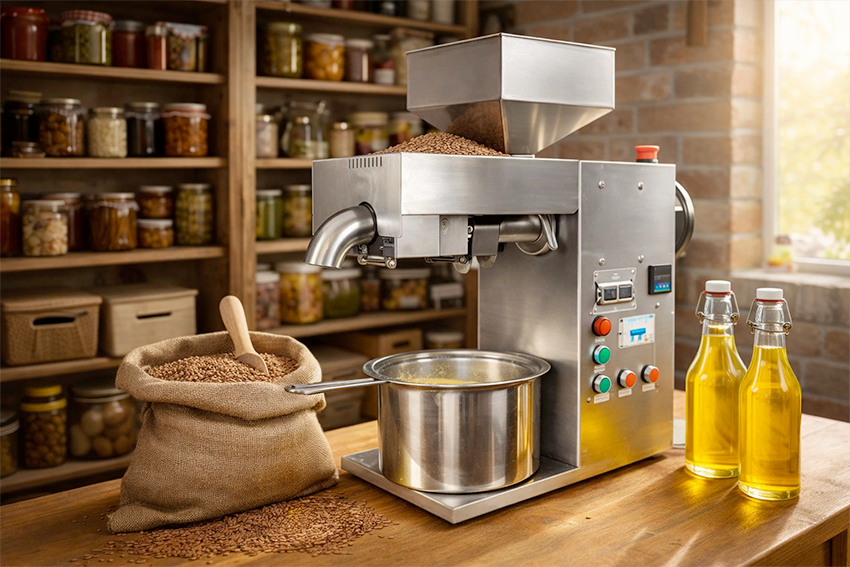
How to Think About Capacity – The Key Parameter When Choosing a Press
What kg/h means and how to translate it into real needs
The output of an oil press expressed in kilograms per hour tells you how many kilograms of raw material the machine will process per unit of time during continuous operation. For someone pressing oil for domestic use, a rating of 5–7.5 kg/h means the ability to process around 5 kilograms of seed in an hour, which – at a typical oil yield of around 35–40 percent for rapeseed – produces just over 2 litres of finished oil. At one pressing session per week lasting 2–3 hours, a family can obtain several litres of oil per month – more than enough.
For a small oil mill or a direct-sales operation, the picture looks different. At 25 kg/h over an 8-hour working day, 200 kilograms of raw material can be processed – which, depending on the seed type, translates into dozens of litres of ready-to-sell oil. Industrial presses go further still: the ZX85 model offers a throughput of 1.4–2 tonnes of raw material per 24 hours, corresponding to truly uninterrupted production. The choice of machine class should therefore always be based not on the current scale of activity, but on the scale you plan to reach.
When planning capacity it is also worth accounting for the time needed to prepare the raw material, clean the machine and wrap up a pressing session. In practice, effective pressing time rarely equals 100 percent of the machine's running time – longer sessions require breaks for topping up the seed hopper or emptying the cake container. Presses with a larger hopper, such as the LY-129 with its 4–5 kg capacity, allow for longer uninterrupted runs, which is convenient when processing larger batches.
Seed moisture and oil content – their effect on pressing efficiency
Seed with a high water content does not release oil readily – steam generated in the pressing chamber reduces yield and can contribute to premature wear of components. Most oil presses, including all the models discussed in this article, require seed moisture below 10 percent, and more precision-oriented machines ask for 6–8 percent. The minimum oil content of the raw material is equally important: the standard threshold is above 15 percent. This means that seeds with lower fat content, such as cereal grains or certain legumes, are not suitable for screw-press extraction and require different methods.
Domestic rapeseed typically contains 40–45 percent oil, flaxseed around 40 percent, hulled sunflower seeds up to 50 percent, and pumpkin seeds approximately 35–45 percent. These are very favourable parameters for mechanical pressing, which is why these materials are the most commonly chosen by both home producers and commercial oil mills.
An additional factor affecting pressing efficiency is the temperature of the raw material at the moment it is fed into the hopper. Seed stored in a cold environment – for example in an unheated warehouse in winter – behaves differently from seed at room temperature. Low temperature reduces the fluidity of the oil and can hinder its separation from the mass. In such conditions, briefly pre-warming the seed (not the pressing process itself, but the raw material) can significantly improve yield even in presses operating in cold-press mode.
A Home Press – When a Few Kilograms Per Hour Is Enough
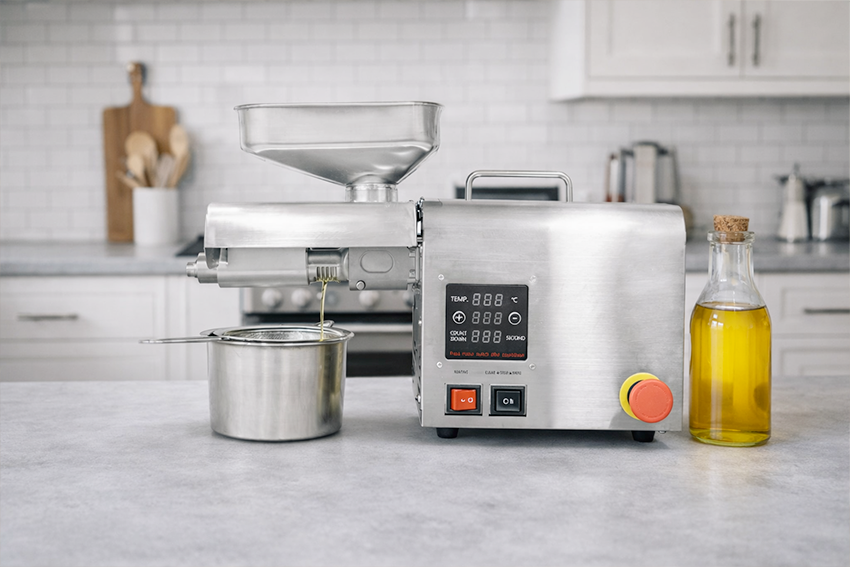
Home Oil Press Machine – Cold & Hot 5–7.5 kg/h (LY-02) – for families and hobbyists
The LY-02 is the machine where most home oil-pressing journeys begin. Its output of 5–7.5 kg/h is ideally matched to the needs of an average family – the ability to process several kilograms of linseed, nuts or pumpkin seeds in an hour's session means a stock of oil that lasts for many weeks. The press weighs just 12.5 kilograms, and its dimensions (50 × 30 × 18 cm) make it easy to place on a kitchen counter or store in a cupboard.
What sets the LY-02 apart from the competition in its price range is the adjustable heater temperature. Most inexpensive home presses either press only cold or operate with a fixed level of heat. The LY-02 combines both modes: cold pressing (up to 40°C) preserves all the omega-3 and omega-6 fatty acids, while warm pressing in the range of 120–200°C increases yield and makes it possible to work with materials that lack a hard shell, such as desiccated coconut or hulled sunflower seeds. The 300 W motor works together with a 450 W heater – together the machine runs from a standard 230 V socket with no special electrical requirements.
The stainless steel exterior ensures compliance with food hygiene standards and makes cleaning easy. The kit includes an oil container, a strainer, a protective glove and a cleaning brush. The LY-02 is an excellent starting point for anyone who wants to find out whether home oil production is for them – a modest investment that delivers reliable results from day one.
Stepping Up – Presses for Greater Domestic Needs and Small Businesses
Semi-Industrial Oil Press 15–20 kg/h (LY-129) – when a family becomes a business
The LY-129 looks like a sturdy home press from the outside, but conceals a throughput of 15–20 kg/h – three to four times that of the previous model. This makes it a popular choice among agritourism farms, larger family operations, community pressing cooperatives and start-up micro oil mills. At 53 kilograms and dimensions of 70 × 30 × 74 cm, it still falls within the category of countertop machines that require no special foundations or room modifications.
The 1.5 kW motor works alongside a 500 W heater, and the temperature inside the pressing chamber can reach up to 250°C – higher than many professional machines, which allows work with very demanding raw materials. The kit includes two interchangeable augers, a practical advantage: different augers optimise the pressing conditions for different seeds, increasing both the amount of oil recovered and the quality of the press cake. The parts in contact with the material are made from grade 304 and 420 stainless steel. The 4–5 kg hopper capacity allows for smooth, continuous operation without constant refilling.
Residual oil content in the press cake is up to 5 percent – a solid result for machines in this class, indicating good extraction efficiency and useful press cake for animal feed or flour production. The cake produced by this press takes the form of characteristic "chips" – flat wafers that are easier to store and dispense than powdery residue.
Hot & Cold Oil Press – 14 kg/h (PTOW 100S) – precision and hygiene at a professional level
The PTOW 100S belongs to a different world from the previous two models – despite a comparable throughput (14 kg/h), it is a German-made machine designed with pharmaceutical-grade hygiene and precision of control in mind, features previously reserved for much larger installations. All parts in contact with the raw material are made from hardened medical-grade stainless steel, and the press head and other components can be washed in an ordinary domestic dishwasher – a significant practical convenience and a safeguard against cross-contamination.
The direct drive without a V-belt means lower energy consumption, quieter operation and no belt components to wear out and replace. The auger rotation speed is continuously variable, allowing precise adjustment of pressing parameters for each of the more than 50 tested seed varieties. The kit includes 6 compression nozzles of different diameters, and the press also features an adjustable pressure gap – both mechanisms together provide wide scope for optimising the process in terms of either oil quality or extraction yield.
Digital temperature control of the press head is a particularly valuable feature for those pressing different seeds under varying conditions – including at outdoor market stalls or in unheated halls, where ambient temperature can destabilise the process. The machine weighs 47 kilograms and occupies a footprint of 80 × 25 × 57 cm. Power supply: 230 V.
Presses for Small Oil Mills and Professional Operators
Hot & Cold Oil Press – 25 kg/h Inox (PTOW 510s) – the complete solution for an oil mill
The PTOW 510s, also manufactured in Germany, is the direct, larger sibling of the 100S described above. At 25 kg/h over an 8-hour working day, it processes 200 kilograms of raw material daily – a figure that meets the needs of a small oil mill focused on direct sales or supplying regional organic food shops. Motor power increases to 1.5 kW, machine weight to 68 kilograms, and the dimensions (87 × 33 × 55 cm) still place it in the compact category: it can stand on a table or a sturdy shelf.
Unlike the 100S, the PTOW 510s features a split press head, which greatly simplifies cleaning and the replacement of worn components. The stainless steel control enclosure (Inox Box) protects the electronics from moisture and mechanical damage – an important feature in a production environment where oil and humidity are unavoidable. A separate motor circuit breaker provides additional electrical protection. The machine is designed to work with over 100 seed and grain varieties, making it an exceptionally versatile tool.
Maximum raw material moisture is up to 8 percent, residual oil in the press cake up to 5 percent. The press can be connected to an optional silo, enabling the construction of a production line with automated seed feeding. Delivery includes 6 compression nozzles, a stainless steel hopper with an anti-intervention guard, assembly tools and a full instruction manual.
Screw Oil Press 1.4–2 t/24h (ZX85) – continuous operation around the clock
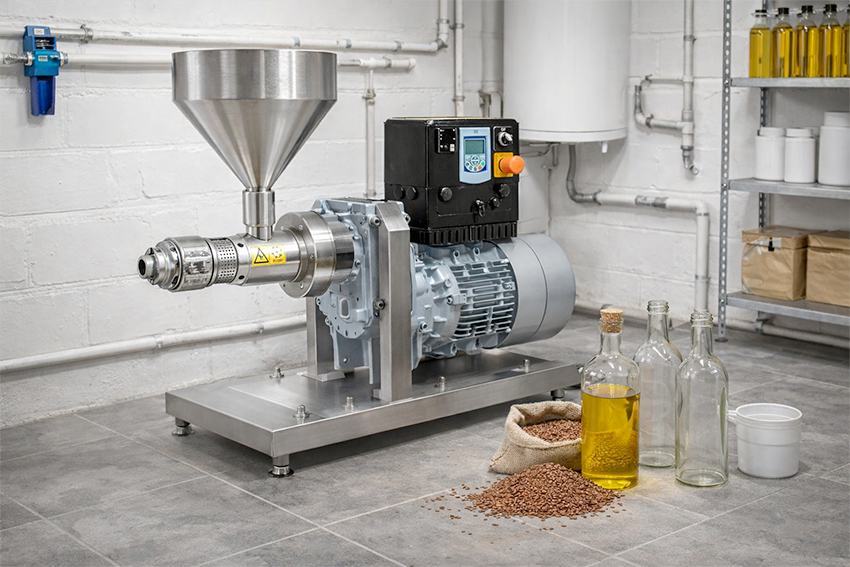
The ZX85 belongs to an entirely different league – its output is measured not in kilograms per hour but in tonnes per day. A throughput of 1.4–2 tonnes of raw material per 24 hours makes it a machine intended for farmers with their own oilseed crops, small oil mills working on commission or sourcing raw material from multiple farms, and operations seeking to process harvested rapeseed or sunflower in-house rather than selling it as a bulk commodity.
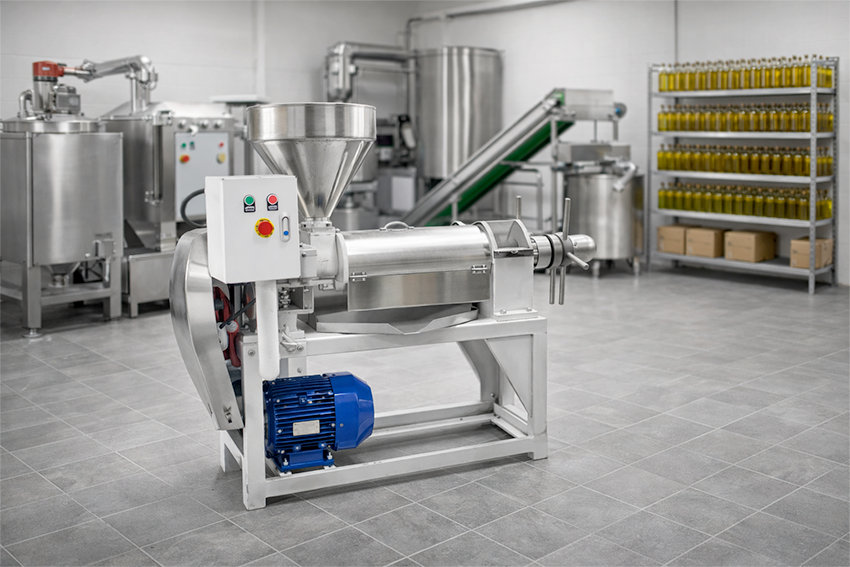
The 5.5 kW motor requires a three-phase 400 V supply – a critical detail when planning the installation. The press body weighs 250 kilograms and measures 130 × 60 × 120 cm, so it needs a permanent floor position, ideally in a dedicated production room or a covered agricultural building. The machine is engineered for fault-free continuous operation: high-grade motors ensure stable running around the clock, and the elevated frame makes collection of both oil and press cake convenient.
The pressing method is natural cold pressing, which preserves the nutritional qualities of the oil without any chemical additives. The raw material must have a natural, hard husk – soft seeds such as hulled sunflower or hulled pumpkin require the additional heat available in other models. Residual oil in the cake is up to 8 percent. PRIMA-TECH customers receive hands-on training covering machine operation and the production process, and post-warranty service and support are a standard part of the offer. The machine holds CE certification.
The ZX85 also works well as part of a larger production line: it can be combined with an automated seed feeding system and press cake transport to create a continuous processing chain. This is a popular choice among farmers processing their own rapeseed or sunflower – rather than selling the crop at bulk prices, they convert it in-house into oil and press cake, extracting significantly higher added value from each harvest.
Matching the Press to the Seed Type
Hard-husked seeds vs. soft kernels – why the pressing method matters
Not all seeds respond in the same way to mechanical pressing. Seeds with a naturally hard, dry husk – such as rapeseed, linseed, camelina, hemp, black cumin, whole pumpkin seeds, unhulled sunflower and sesame – can be cold-pressed directly, without any preliminary treatment. Their husk protects the interior from moisture and oxidation during storage, and at the same time plays an active role in the pressing process, releasing oil at relatively low pressure.
Soft, husked kernels – such as hulled sunflower, hulled pumpkin, desiccated coconut or certain nut varieties – require the pressing chamber to be heated to above 80–120°C for efficient extraction. Without heat, the mass becomes dense and sticky, impeding transport through the auger and potentially causing blockages or even machine damage. Presses with an adjustable heater, such as the LY-02, LY-129 and the PTOW series, handle these materials without difficulty thanks to precise head temperature control.
Pressing nuts (walnuts, hazelnuts, cashews, macadamia) requires an additional specialised nut auger, which can be ordered separately. It is worth factoring this in when planning your production profile in advance.
Cold pressing vs. warm pressing – what to know before buying
The distinction between cold and warm pressing is one of the most frequently discussed topics when choosing an oil press, and also one of the most straightforward to explain. Cold pressing means that the oil temperature at the outlet does not exceed 40°C – this preserves thermolabile components such as omega-3 fatty acids, vitamin E, phytosterols and phenolic compounds. The oil is lighter in colour, clearer and more delicate in flavour.
Warm pressing or heated-chamber pressing does not mean the oil is "damaged" – it is simply a different process yielding a different product. High temperature increases the fluidity of the oil and accelerates its separation from the mass, resulting in a higher extraction yield. Heat also enables oil to be released from materials that would press poorly or not at all at room temperature – peanuts for nut butter or desiccated coconut being typical examples. Oil produced by the warm method has a more intense, "roasted" aroma and a darker colour, and its oxidative stability is generally higher.
Most modern presses, including all the models discussed here, offer both modes, often with continuous regulation. This is a significant advantage over single-mode machines, providing flexibility to work across a wide range of raw materials. There is also a hybrid approach in which light pre-heating of the seed to around 50–60°C improves oil fluidity and increases extraction yield without exceeding the destruction threshold of the most sensitive components. Presses with digital temperature control, such as the PTOW 100S and PTOW 510s, allow this boundary to be maintained precisely without risk of overstepping it.
Press Cake – A Valuable By-product
Press cake as animal feed, flour and a food ingredient
Press cake – or presscake – is the dense mass remaining after oil has been extracted from seeds. There is a widespread misconception that it is a production waste product; in fact it is a fully nutritious raw material that, in a well-managed oil production process, should never go to waste. In the case of the ZX85 operating around the clock, the volume of press cake can be substantial, making a planned distribution or use pathway essential.
Rapeseed cake is one of the most valuable sources of plant protein for cattle, pigs and poultry. On a dry matter basis it contains around 30–36 percent protein and is one of the most widely used supplementary feed components in European agriculture. Linseed cake is valued in horse feed for its mucilaginous properties and beneficial effects on coat condition and digestion. Pumpkin seed and sunflower cake, meanwhile, are excellent feeds for poultry and farmed fish.
It can also be milled into flour, which serves as a high-protein addition to bread, pancakes, protein biscuits and smoothies. Home presses such as the LY-02 and LY-129 produce press cake in the form of granules or thin "chips" a few millimetres thick, which can be baked at home into a healthy snack. In this sense, home oil production fully embodies the zero-waste principle: from a single raw material, two fully nutritious products are obtained.
When planning production scale, press cake storage deserves attention. Fresh cake, due to residual moisture and oil content, can go rancid if not stored correctly. Dry cake in a cool, dark and well-ventilated place can be kept for several weeks; longer-term storage requires drying and pelletising. Partnering with local farms or livestock operations can turn press cake into an additional income stream.
Practical Advice Before Buying an Oil Press
Workspace, electrical installation and ergonomics
Before a press arrives on the counter or at its designated place in a production room, it is worth thinking through the logistics. Home presses (LY-02, LY-129) operate on standard 230 V and require no additional electrical infrastructure. The PTOW series presses also run on 230 V. The one exception among the models discussed here is the ZX85, which requires a three-phase 400 V supply – a condition typically met in agricultural buildings but not in a standard kitchen or garage.
For home presses, a flat, stable surface and access to a sink or oil container are sufficient. It is worth remembering that pressing oil generates aromas – intense and pleasant, but noticeable – as well as press cake particles that may scatter around the outlet. Suitable mats, a cake collection tray and good room ventilation are small details that greatly improve the working experience. For semi-industrial and industrial presses, it is necessary to plan working space around the machine, easy access to parts requiring cleaning, and a means of directing oil into intermediate storage tanks.
Planning for post-pressing processing is also worthwhile. Freshly cold-pressed oil contains fine particles of sediment that naturally settle to the bottom after a few hours of undisturbed storage. At a domestic scale, simple straining and a few days in the fridge is sufficient. At larger production scales – starting from the LY-129 and upward – it is worth considering filling machines and intermediate tanks to enable proper bottling of the finished product.
Service and training – what the manufacturer offers
All the presses discussed in this article are offered by PRIMA-TECH S.C., which provides professional after-sales service and post-warranty support. In the case of the ZX85, hands-on training in machine operation and the production process is a standard part of the purchase, enabling new users to start production efficiently from day one. This is a particularly valuable offer for those with no prior experience of production machinery. Support is also available for all other models – telephone and email contact is readily accessible through the manufacturer's website.
It is worth noting the availability of spare parts, particularly augers, which are consumable components. For PTOW series models, additional augers for nuts or specific seed types can be ordered separately, extending the production range without the need to buy a new press. When choosing a model, asking about the cost and availability of wear parts over the longer term is a sensible step that many buyers overlook.
FAQ – Frequently Asked Questions
Which oil press should I choose for a single family's domestic needs?
For home oil production a Home Oil Press Machine – Cold & Hot 5–7.5 kg/h is entirely sufficient. Its compact dimensions, standard 230 V power supply, ease of use and the ability to press both cold and warm make it the ideal solution for a household. With 2–3 hours of operation per week, it is possible to produce a dozen or more litres of oil per month.
Can oil presses be used to press walnut oil?
Yes, but with a caveat. Most screw presses, including the models discussed here, can work with walnuts after fitting a specialised nut auger, which is not part of the standard equipment. Walnuts are rich in oil (approximately 60–65 percent fat), but their consistency requires the correct auger tooth profile. For PTOW series models a dedicated nut auger is available as an optional extra.
What is the difference between cold pressing and warm pressing, and when should each be used?
Cold pressing (up to 40°C) preserves the maximum nutritional value – omega fatty acids, vitamins and antioxidants. It is the choice for those who prioritise the health properties of the oil. Warm pressing or heated pressing (above 80°C) increases extraction yield and makes it possible to process soft raw materials or those with a lower oil content. For rapeseed, linseed and pumpkin seeds, cold pressing is recommended; for desiccated coconut, hulled sunflower and roasted cocoa nibs – warm pressing.
Can the ZX85 be operated in a small oil mill without prior experience?
Yes, provided the basic training offered by the manufacturer has been completed. The Screw Oil Press 1.4–2 t/24h is designed for continuous 24-hour operation and has straightforward controls, but due to its size, weight (250 kg) and the requirement for a three-phase 400 V supply, it needs an appropriately prepared room and several hours of training before production begins. PRIMA-TECH provides full support during commissioning.
How much oil can be obtained from one kilogram of rapeseed?
Rapeseed typically contains 40–45 percent oil. Mechanical cold pressing can recover around 30–38 percent of the seed mass as oil – the remainder stays in the press cake, where residual oil content should ideally be below 5–8 percent (depending on the model). This means that from 10 kilograms of rapeseed, approximately 3–3.5 litres of oil and around 6–7 kilograms of nutritious press cake are obtained.
Are PTOW series presses suitable for mobile sales at markets and fairs?
Yes – the manufacturer explicitly identifies this as one of their primary applications. The Hot & Cold Oil Press – 14 kg/h and the Hot & Cold Oil Press – 25 kg/h Inox both run on 230 V and are compact enough to fit on a market stall or in a van. The digital press head temperature control is particularly useful in unheated halls or outdoors, where low ambient temperature could destabilise the pressing process. Many mobile oil mills use exactly this approach, pressing oil in front of customers as part of the retail experience.
Is it worth buying a more expensive press with future business growth in mind?
This is one of the key decisions when planning a purchase. If expanding production within 2–3 years is on the horizon, it is often more cost-effective to invest in a machine with somewhat higher capacity from the outset – rather than deploying capital twice into successive machines. A family currently pressing oil for home use that plans to start selling at a local market next year might already consider the Semi-Industrial Oil Press 15–20 kg/h instead of the home model. A small oil mill thinking about broadening its product range, in turn, might opt for the PTOW 510s or ZX85 – machines that will serve its needs for many years without requiring replacement.