
Table of Contents
- What is hot pressing and how does it differ from cold pressing
- When hot pressing is a better choice than cold pressing
- The role of temperature in the oil pressing process
- Filtration of hot-pressed oil and its importance for bottling
- An integrated solution: a press with heaters and a vacuum filter
- Organizing the hot pressing process with simultaneous filtration
- Which oils are best suited to hot pressing
- The economics of hot pressing in a small oil mill
- Maintenance and upkeep of a press with heaters and a filter
- Legal and hygiene aspects of hot-pressed oil production
- Comparing hot and cold pressing in oil milling practice
- Frequently asked questions
- Conclusion
Running a small oil mill means constantly balancing product quality against production efficiency. Many novice oil producers begin their journey with cold pressing, treating it as the only legitimate path to a high-quality product. Meanwhile, hot pressing - carried out under controlled temperature conditions - opens up entirely new possibilities in terms of both yield and the range of oils that can be offered to customers. When this process is paired with proper filtration, the oil coming off the production line is ready for immediate bottling, with no need for days of settling or additional clarification steps.
What is hot pressing and how does it differ from cold pressing
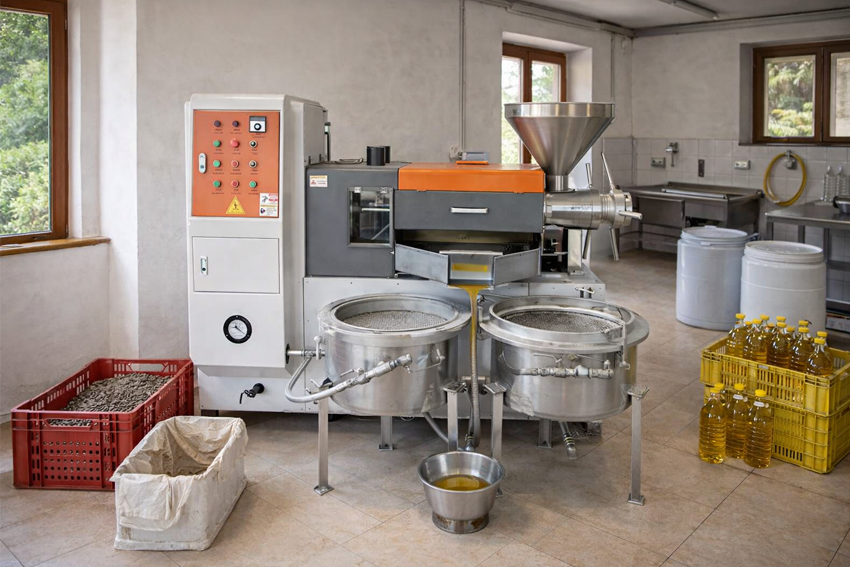
Hot pressing is a process of mechanically extracting oil from seeds and grains in which the raw material is subjected to elevated temperatures, typically in the range of 80 to 200 degrees Celsius. This temperature is generated by heaters mounted directly in the pressing chamber of a screw press. Unlike cold pressing, where the chamber temperature should not exceed 40 to 50 degrees Celsius, hot pressing deliberately uses thermal energy to loosen the cellular structure of the seeds and release a greater quantity of oil.
The difference between the two methods goes beyond temperature alone. Cold pressing preserves most of the bioactive compounds, vitamins, and natural aroma of the raw material, which is why it is particularly valued in premium oil production. Hot pressing, on the other hand, delivers noticeably higher yield, meaning that significantly more oil can be obtained from the same amount of raw material. For some seeds, the yield difference reaches as much as ten or more percentage points, which at a production scale of several tonnes per day translates into very tangible financial benefits.
It is worth emphasizing that hot pressing under small oil mill conditions does not mean refining or the use of any chemicals. It remains a purely mechanical process in which temperature is the only additional factor. Oil obtained by this method retains its natural character, although its flavour and aromatic profile may differ somewhat from cold-pressed oil produced from the same raw material.
When hot pressing is a better choice than cold pressing
The decision to use elevated temperatures in the pressing process should stem from a thoughtful analysis of the raw material, customer expectations, and the business objectives of the oil mill. There are several clear situations in which hot pressing proves to be not only a better solution but, in fact, an essential one.
Raw materials that require high temperatures
Some seeds and grains simply do not lend themselves to efficient pressing at low temperatures. A classic example is hulled sunflower - its soft structure, lacking a hard shell, means that at low temperatures the screw of the press cannot generate sufficient pressure to effectively separate the oil from the protein mass. A similar situation applies to desiccated coconut, sesame, and pumpkin seeds, which at cold pressing temperatures yield very modest amounts of oil, often on the edge of profitability.
Elevated temperature changes the rheological properties of the pressed mass, loosens the bonds between fat molecules and the cellular structure of the seed, and allows for far more effective extraction. In practice, this means that raw materials which previously left ten or more percent of oil behind in the press cake can, under hot pressing conditions, release up to half as much additional fat.
Maximizing yield with large batches of raw material
Even for raw materials that press well at cold temperatures, such as rapeseed or flaxseed, using a heated chamber can make economic sense at larger production volumes. If an oil mill processes several tonnes of raw material per day, every additional percentage point of yield translates into dozens of extra litres of oil over the course of a week. At current market prices for pressed oils, this difference quickly covers the energy costs associated with heating.
It is also worth noting that many small oil mills offer both cold-pressed and hot-pressed oils, treating them as two distinct product lines. Cold-pressed oil goes to customers seeking a premium product, while hot-pressed oil, offered at a somewhat lower price, allows the mill to reach a broader group of buyers who value above all the naturalness and locality of the product.
Pressing raw materials with elevated moisture content
In oil milling practice, it is not always possible to ensure ideal raw material moisture, particularly during autumn harvests or when purchasing seeds from multiple suppliers. Hot pressing can to some extent compensate for the problem of excessive moisture, since the high temperature in the pressing chamber causes some of the water to evaporate from the raw material during the pressing process itself. This does not replace proper drying and seed preparation, of course, but it gives the mill greater operational flexibility and reduces the risk of downtime caused by imperfect raw material quality.
The role of temperature in the oil pressing process
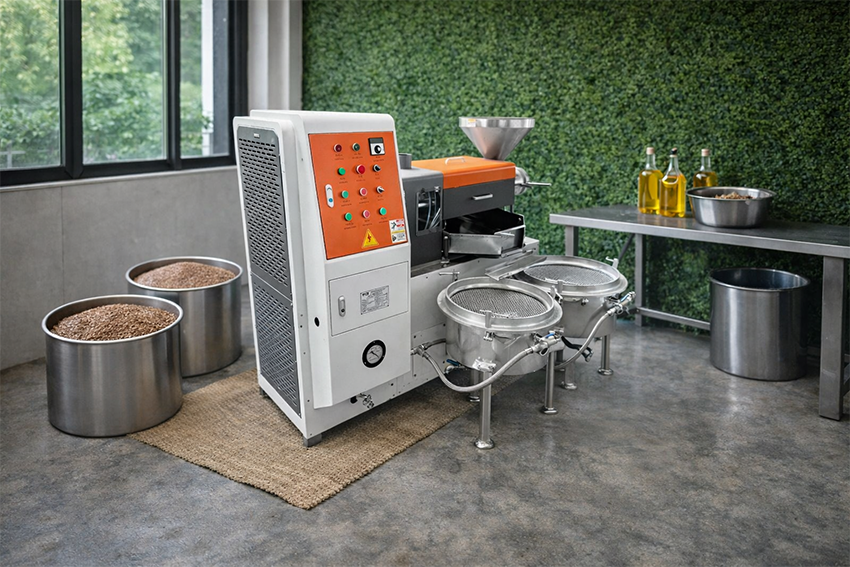
Temperature is one of the key parameters affecting the course and efficiency of pressing. In screw presses equipped with a heating system, the operator can precisely set the pressing chamber temperature, adapting it to the type of raw material being processed and the desired properties of the finished oil.
How temperature affects pressing yield
The relationship between temperature and pressing yield is non-linear. In the range from ambient temperature to around 80 degrees Celsius, the increase in yield is relatively gentle. Above 80 degrees, the yield curve becomes significantly steeper, with the biggest jump typically occurring in the 100 to 140 degree range. Further increases in temperature bring progressively smaller yield gains, while beginning to affect the oil's flavour profile, giving it a characteristic, more intense aroma reminiscent of roasted seeds.
For many raw materials, the optimal compromise between yield and sensory quality lies in the 100 to 130 degree Celsius range. At this temperature, the oil still retains much of its natural flavour qualities, while pressing yield is markedly higher than with cold processing. Oil residue in the press cake with properly conducted hot pressing drops to around 6 percent, which is an excellent result and allows the raw material's potential to be maximized.
Temperature control and oil quality
Modern screw presses with heating systems offer adjustable temperature control, enabling the operator to tailor pressing conditions to the specifics of each batch of raw material. This is particularly important because even the same type of seed may require slightly different settings depending on the variety, moisture level, or degree of maturity.
Precise temperature control also allows for multi-stage pressing, in which the raw material is first pre-heated to a lower temperature and then the temperature is gradually raised during the process. This approach minimizes the risk of localized overheating and produces a more uniform product with repeatable quality parameters.
Filtration of hot-pressed oil and its importance for bottling
Oil leaving the pressing chamber of a screw press - whether cold-pressed or hot-pressed - always contains a certain amount of fine solid particles originating from the pressed raw material. These are shell fragments, remnants of the seed flesh, microscopic press cake particles, and other mechanical impurities that give freshly pressed oil its characteristic cloudy appearance. While for oil intended for personal use this cloudiness is not a problem, oil destined for retail sale must look appealing and, above all, be microbiologically stable.
Solid particles suspended in oil provide a substrate for microbial growth and significantly shorten the product's shelf life. Cloudy oil spoils several times faster than filtered oil, which in a retail context means financial losses and the risk of complaints. Effective filtration is therefore not so much a convenience as an absolute necessity for any oil mill that wants to offer a bottle-ready product.
Filtration methods in a small oil mill
In small and medium-sized oil mills, three methods of removing mechanical impurities from oil are most commonly used. The first and simplest is sedimentation - the natural settling of solid particles under gravity. This method, however, requires large settling tanks and time measured in days or even weeks, generating additional costs and extending the production cycle.
The second method is pressure filtration using frame or plate filters, which gives good results but requires a separate filtration station and additional handling. The third and most effective method, particularly in combination with hot pressing, is vacuum filtration. In this method, a vacuum pump creates negative pressure in the filter vessel, forcing the oil through the filter medium. Solid particles settle on the filter surface forming a so-called filter cake, while the cleaned oil flows into the vacuum-side tank, ready for bottling.
Why vacuum filtration works best with hot pressing
The efficiency of oil filtration is closely linked to its temperature. Warm oil has lower viscosity, which means it flows through the filter medium more easily and quickly. In practice, this means that hot-pressed oil leaving the pressing chamber at 60 to 120 degrees Celsius is an ideal candidate for immediate vacuum filtration. It requires no additional heating or lengthy waiting, and the filtration process proceeds smoothly and efficiently.
The minimum temperature of oil subjected to vacuum filtration should be approximately 60 degrees Celsius. At lower temperatures, oil viscosity increases enough to make flow through the filter too slow and reduce cleaning efficiency. Hot pressing naturally ensures this condition is met, making the combination of both processes an exceptionally logical and efficient technological solution.
An integrated solution: a press with heaters and a vacuum filter
The traditional approach to organizing a production line in an oil mill involves separate stations for pressing and filtration, requiring additional space, separate equipment, and manual transfer of oil between production stages. For a small oil mill, where every square metre of floor space and every hour of operator time matters, this arrangement can be problematic. The market does, however, offer machines that integrate both processes into a single compact system.
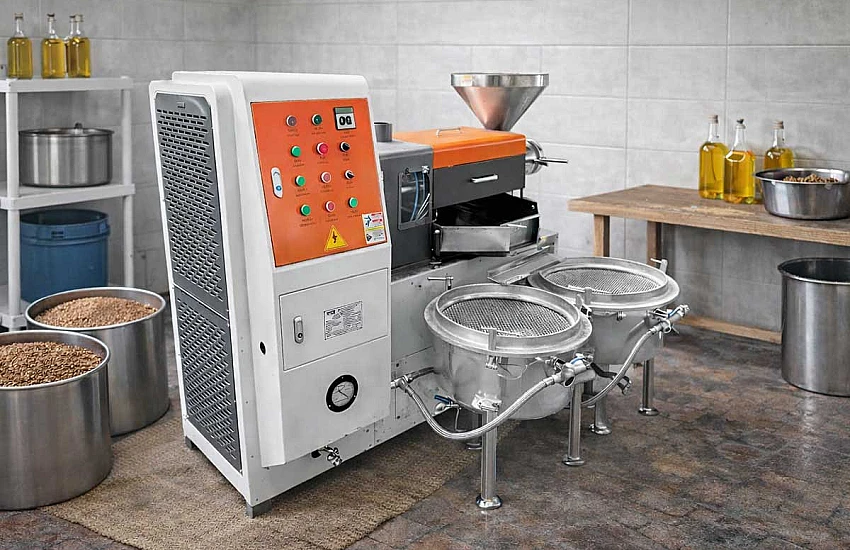
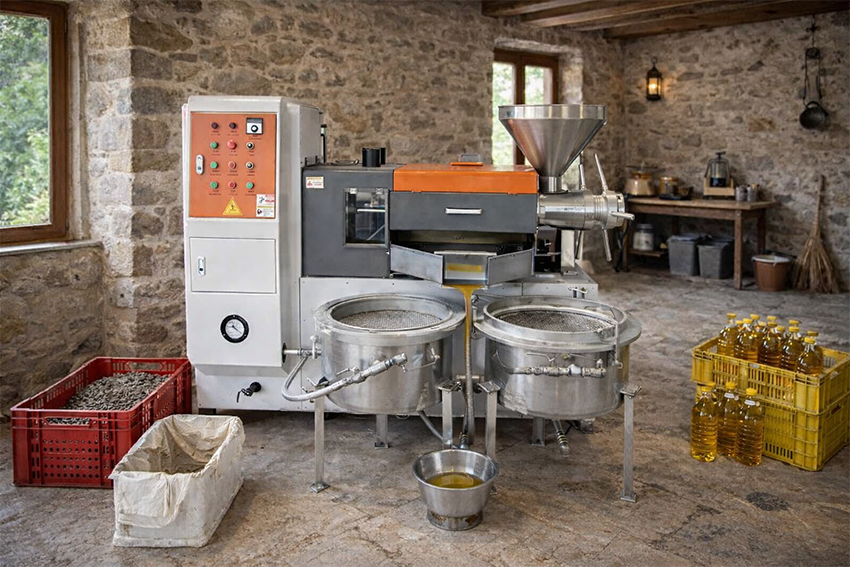
An excellent example of such an integrated solution is the Screw Oil Press with Filters model LY120, available at pureoilpress.com. This machine combines a screw press with an adjustable heating system and a set of vacuum filters, creating a complete line for producing bottle-ready oil.
Technical specifications of the LY120 press
The LY120 press has been designed for oil mills processing several to a dozen or so tonnes of raw material per day. The machine's output ranges from 180 to 260 kilograms of oil per day, depending on the type of raw material being pressed and the operating parameters set. At the heart of the press is a screw with a diameter of 120 millimetres, rotating at 36 revolutions per minute inside a pressing chamber with an internal diameter of 122 millimetres.
The press is driven by an 11 kilowatt motor powered by three-phase 400V supply. The 4 kilowatt heating system allows the pressing chamber to be heated to a maximum temperature of 200 degrees Celsius with smooth adjustment. The integrated vacuum filtration system is equipped with its own 1.1 kilowatt pump. The entire machine weighs 915 kilograms with dimensions of 205 by 140 by 180 centimetres, allowing it to be installed even in a relatively small production room.
Build quality and durability
One of the key aspects when choosing a press for an oil mill is its durability and ability to withstand long, uninterrupted operation. The LY120 press has been built for continuous 24-hour-a-day operation. Its massive construction, weighing nearly a tonne, ensures stability and minimizes vibrations during work, which translates into both operator comfort and the longevity of mechanical components.
Components that come into contact with oil, including the drip tray and the pressing chamber cover, are made of stainless steel. This is important not only for hygiene and the sanitary requirements placed on food producers but also for the durability of these components when in contact with fatty acids, which can corrode ordinary steel.
Press cake as a valuable by-product
The oil pressing process on the LY120 press produces press cake in the form of characteristic chips, which constitutes a full-value by-product with high energy content. Oil residue in the press cake is up to 6 percent, meaning it is a protein-rich material ideally suited as feed for livestock, a semi-finished product for fuel pellet production, or a base for making gluten-free flour and baking additives. For many small oil mills, selling press cake represents an additional and significant source of revenue that improves overall production profitability.
Organizing the hot pressing process with simultaneous filtration
Proper organization of the production process is the key to obtaining oil of repeatable quality with minimal losses. Below we describe the typical course of hot pressing with simultaneous vacuum filtration on an integrated machine such as the LY120 press.
Preparing the raw material before pressing
Every pressing process should begin with careful preparation of the raw material. Seeds intended for processing should have moisture content below 10 percent and oil content above 15 percent. Before loading into the press, it is worth carrying out a visual inspection of the raw material for the presence of foreign bodies such as stones, metal fragments, or plant residues that could damage the screw or the pressing chamber.
In the case of hot pressing, an additional step that can improve yield is pre-heating the raw material. This can be done using a seed roaster, setting the roasting temperature at a relatively low level just to warm the seeds without scorching them. Alternatively, it is sufficient to rely on the heating system of the press itself, which will warm the raw material once inside the pressing chamber.
Setting the pressing parameters
After loading the raw material, the operator sets the pressing chamber temperature using the control panel. For most oilseeds, the optimal range is 100 to 140 degrees Celsius, although the exact value depends on the type of raw material. Hulled sunflower presses best at 120 to 150 degrees, rapeseed in the 90 to 120 degree range, and desiccated coconut requires temperatures of 140 to 180 degrees.
Once the 4 kilowatt heaters reach the set temperature, the machine is ready to begin pressing. The screw, rotating at 36 revolutions per minute, moves the raw material through the heated chamber while exerting increasing pressure. Oil flows out through the gaps in the pressing chamber and drains onto the stainless steel drip tray, from where it is directed straight to the filtration system.
Filtration and bottling of the finished oil
Warm oil flowing from the pressing chamber goes directly into the integrated vacuum filter system. The 1.1 kilowatt vacuum pump creates negative pressure in the filter vessels, forcing the oil through the filter medium. Solid particles are retained on the filter surface, forming a filter cake, while cleaned oil collects in the tank on the clean side of the filter.
The entire filtration process takes place mechanically, without the use of any chemicals, which means that the structure and chemical composition of the oil remain unchanged. The only effect of filtration is the removal of solid particles, rendering the oil clear and transparent. Oil cleaned in this way is ready for immediate bottling, eliminating the need for days of settling and repeated decanting, significantly speeding up the oil mill's production cycle.
Which oils are best suited to hot pressing
Hot pressing opens the door for a small oil mill to expand its range with products whose production via cold pressing would be unprofitable or outright impossible. Below we discuss raw materials that respond particularly well to processing at elevated temperatures.
Sunflower oil from hulled sunflower seeds
Hulled sunflower is a raw material that causes many technical problems when cold-pressed. The absence of a hard shell means the pressed mass is too soft and fails to generate adequate pressure in the chamber. Hot pressing at 120 to 150 degrees solves this problem, yielding sunflower oil with a pleasant, slightly nutty aroma and a golden colour. Such oil works equally well as a cooking oil for frying and as a base for natural cosmetics production.
Coconut oil from desiccated coconut
Desiccated coconut is one of the most demanding raw materials in oil milling. Its high fat content, reaching 60 to 65 percent, might suggest easy pressing, yet at low temperatures coconut fat is too thick to be effectively separated from the solid mass. Only temperatures above 140 degrees Celsius liquefy the fat sufficiently for the pressing process to run smoothly. Hot-pressed coconut oil retains most of its valuable properties and is a product eagerly sought by customers interested in natural skincare and healthy nutrition.
Sesame oil, peanut oil, and other specialty oils
Hot pressing also enables the production of oils that represent niche products in many markets but are growing in popularity. Sesame oil, peanut oil, pumpkin seed oil, and walnut oil are products that at elevated temperatures develop a deeper, more complex flavour profile, valued particularly in Asian and Middle Eastern cuisines. A small oil mill offering these specialties can differentiate itself in the market and attract customers seeking authentic, artisanal products.
The economics of hot pressing in a small oil mill
The decision to invest in a press with a heating system and vacuum filtration should be preceded by a thorough economic analysis. The LY120 screw oil press with vacuum filter is priced at EUR 8,330 net, which in the context of professional oil mill equipment is an amount that pays for itself relatively quickly thanks to higher yield and the elimination of additional production stages.
Savings from higher yield
With hot pressing, oil residue in the press cake drops to around 6 percent, compared with a typical 8 to 12 percent for cold pressing depending on the raw material and operating conditions. A difference of a few percentage points may seem small, but when processing 200 kilograms of raw material per day it means several additional litres of oil, which at retail prices of pressed oil in the range of EUR 8 to 20 per litre generates measurable additional revenue.
Eliminating the sedimentation and multi-stage filtration steps
The integrated vacuum filtration system makes it possible to eliminate the costly and time-consuming sedimentation step, which in traditional oil mills requires large tanks and time measured in days. Oil that has passed through the vacuum filters is immediately ready for bottling, meaning a shorter production cycle, less need for storage space, and faster capital turnover. For a small oil mill that often works to order and needs flexibility in production planning, this is an enormous operational advantage.
Maintenance and upkeep of a press with heaters and a filter
Every piece of production equipment requires regular maintenance to retain its efficiency and reliability over years of operation. A screw press with a heating system and vacuum filtration is no exception, although its servicing is not particularly complicated.
Daily care after finishing work
After each production cycle, the drip tray and pressing chamber should be cleaned of residual raw material and oil. Stainless steel components can be washed with warm water and a mild food-grade detergent. Particular attention should be paid to the screw and the interior of the pressing chamber, where press cake residue can accumulate. Neglecting cleaning leads to a build-up of deposits that over time can affect oil quality and the machine's mechanical efficiency.
The filter medium in the vacuum filters requires regular replacement or regeneration. The frequency of replacement depends on the volume of raw material processed and the degree of oil contamination, but as a guideline, the filter should be checked after every working day. The filter cake - the layer of deposits retained on the filter - should be removed and the filter surface cleaned.
Periodic inspections and replacement of wear parts
The press screw and pressing chamber elements are subject to natural wear due to friction and contact with hard seeds. Depending on the intensity of use and the types of raw materials being pressed, screw replacement may be necessary every few to several months. The 4 kilowatt heaters should be periodically checked for circuit continuity and possible insulation damage. The 11 kilowatt main motor and the 1.1 kilowatt vacuum pump motor require standard maintenance including bearing checks, lubrication, and inspection of drive belts.
It is worth taking advantage of the service offered by the equipment supplier. The pureoilpress.com store provides its customers with professional service support, post-warranty care, and training in machine operation, enabling quick resolution of any technical issues and maintaining production continuity.
Legal and hygiene aspects of hot-pressed oil production
Running an oil mill, even a small family-run one, entails the need to meet certain legal and sanitary requirements. Oil intended for sale as a food product must be manufactured under conditions that comply with food safety regulations.
The production room should be clean, well-ventilated, and equipped with machinery that meets hygiene standards. The use of stainless steel in components that come into contact with oil, as is the case with the LY120 press, is not only good practice but often a requirement imposed by sanitary authorities. The oil producer should maintain production documentation covering dates and parameters of pressing, the type of raw material, quality control results, and bottling dates.
Hot-pressed oil does not require special labelling distinguishing it from cold-pressed oil, although transparency towards the customer is always good practice. It is worth including information on the label about the production method, the type of raw material, the pressing date, and storage conditions. This approach builds customer trust and allows the oil mill to stand out from mass-produced products.
Comparing hot and cold pressing in oil milling practice
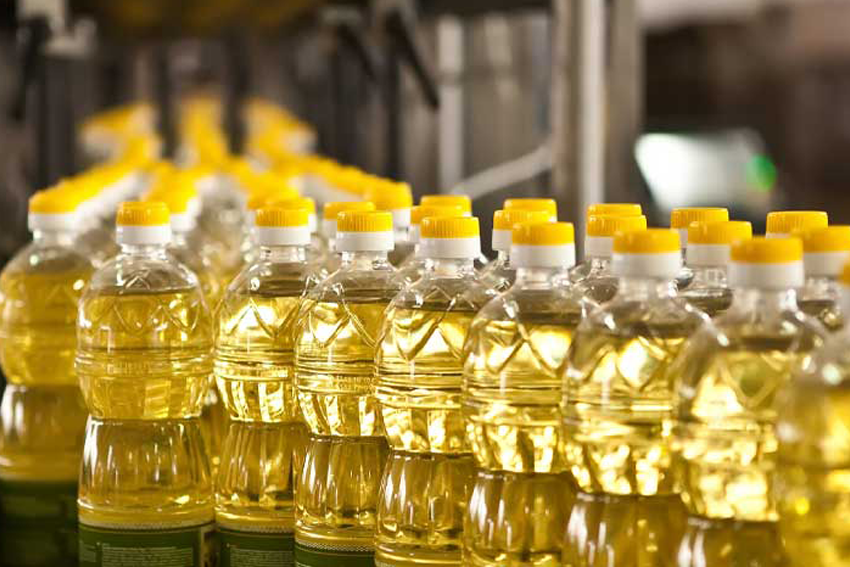
To summarize the differences between the two pressing methods, it is worth setting them side by side across several key aspects. Cold pressing preserves the most bioactive compounds and the natural aroma of the seeds but offers lower yield and requires raw material with ideal parameters. Hot pressing increases yield by as much as ten or more percentage points, enables the processing of more demanding raw materials, and facilitates filtration thanks to the lower viscosity of warm oil, but requires investment in a press equipped with a heating system.
In practice, the most sensible approach for a small oil mill is to have a machine that enables both types of pressing. A press with an adjustable heating system, such as the LY120 model, gives the operator complete freedom in selecting pressing parameters, making it possible to adapt the process on the fly to current needs, the type of raw material, and customer expectations. The ability to switch off the heaters and run cold pressing means that one machine replaces two separate devices, which is a major advantage where production space is limited.
Frequently asked questions
Is hot-pressed oil less healthy than cold-pressed oil?
Hot-pressed oil retains most of its nutritional value, although some heat-sensitive bioactive compounds, such as certain vitamins, may undergo partial degradation under the influence of temperature. This difference is, however, smaller than is commonly believed, especially when pressing in the 100 to 140 degree Celsius range. Hot-pressed oil remains a natural product, free from chemicals and refining, and its health profile is still significantly more favourable than that of refined oils available in mass retail.
What is the minimum oil temperature needed for effective vacuum filtration?
The minimum temperature of oil subjected to vacuum filtration should be approximately 60 degrees Celsius. Below this value, oil viscosity increases to the point where flow through the filter medium becomes too slow and cleaning efficiency drops significantly. With hot pressing, this condition is met naturally, since the oil leaves the pressing chamber at a temperature well above 60 degrees. In the case of cold pressing, vacuum filtration requires additional heating of the oil, generating extra energy costs.
Can the LY120 press also be used for cold pressing?
Yes, the LY120 press is equipped with an adjustable heating system, meaning the heaters can simply be switched off to run pressing at ambient temperature. The machine then functions as a standard cold-press screw press. This gives the operator full flexibility in choosing the pressing method and allows for the production of both hot-pressed oils and premium cold-pressed oils, depending on current needs and customer orders.
How often does the filter medium in the vacuum filter need to be replaced?
The frequency of filter medium replacement depends on several factors, primarily the volume of raw material processed, the type of seeds being pressed, and the degree of oil contamination. As a guideline, the filter medium should be inspected and the filter cake removed after every working day. Full replacement of the filter medium is necessary when, despite cleaning, filter throughput drops noticeably, which in practice means replacement every few to several weeks of intensive use.
How much oil per day can the LY120 press produce?
The LY120 press has a capacity of 180 to 260 kilograms of oil per day, with the exact figure depending on the type of raw material being pressed, its moisture content, oil content, and the pressing parameters set. Seeds with high fat content, such as sunflower or rapeseed, allow the upper end of the capacity range to be reached, while more demanding raw materials like sesame or desiccated coconut will be closer to the lower limit. The machine is designed for continuous 24-hour-a-day operation, allowing its production potential to be fully utilized.
Does hot pressing affect the shelf life of the oil?
Hot-pressed oil, after proper vacuum filtration, has good storage stability. Removing solid particles during filtration significantly extends shelf life, since it is precisely the mechanical impurities that are the main source of oxidation and microbial growth in oil. Properly filtered and bottled hot-pressed oil, stored in dark bottles in a cool place, retains its properties for many months.
Is specialized training required to operate the LY120 press?
The LY120 press is equipped with a simple control panel that allows the basic operating parameters to be set. Operating the machine does not require specialized education, although familiarity with the basics of oil milling and pressing processes is certainly helpful. When purchasing the press, pureoilpress.com provides training in machine operation covering both technical aspects and practical tips on optimal settings for different raw materials. Professional service support and post-warranty care are also available, ensuring that even in the event of problems, the operator will not be left without assistance.

Conclusion
Hot pressing in a small oil mill is not an alternative to cold pressing but its natural complement. Thanks to elevated temperatures in the pressing chamber, the oil producer gains higher yield, the ability to process a wider range of raw materials, and easier filtration of the finished product. Combining hot pressing with vacuum filtration within a single integrated machine, such as the Screw Oil Press with Filters LY120, allows for the production of oil ready for immediate bottling, eliminating time-consuming and costly intermediate steps.
Investing in a press with a heating system and integrated filtration is a step towards professionalizing production that enables a small oil mill to compete with larger players in terms of quality and efficiency, while preserving the artisanal character and naturalness of its products. Regardless of whether the oil mill specializes in premium cold-pressed oils or a broad assortment of hot-pressed oils, the versatility of a machine with an adjustable heating system gives the operator the tools to respond flexibly to market needs and customer expectations.