
Table of Contents
- The Final Stage of Oil Production – Why It Matters Most
- The Enemies of Fresh Oil – Light, Oxygen and Temperature
- Filtering Oil Before Bottling
- The Proper Bottling Process – Step by Step
- The Role of the Filling Machine in Preserving Oil Quality
- Single-Head Liquid Filler 100–1000 ml – The Right Choice for Small and Medium Oil Mills
- Two-Head Liquid Filler 100–1000 ml – For Higher Production Volumes
- Storing and Labelling Bottled Oil
- Frequently Asked Questions
Oil pressing is a process that demands precision and knowledge at every stage – from selecting the right raw material, through the operational parameters of the press, to the moment the finished product is sealed in a bottle. Many producers invest enormous care into seed quality, pressing temperature, and equipment selection, only to lose part of that effort at the very last stretch of production. The filling stage – the interval between filtration and capping the bottle – is precisely when freshly pressed oil is most exposed to the factors that degrade its properties: atmospheric oxygen, light, heat, and moisture.
The Final Stage of Oil Production – Why It Matters Most
From the Press to the Bottle – What Can Go Wrong
Freshly pressed oil contains the maximum concentration of antioxidants, unsaturated fatty acids, and bioactive compounds. It is, however, a highly reactive substance – the very components that make it beneficial are also those that degrade most rapidly when exposed to external factors. Industrial production addresses this through refining, bleaching, and deodorisation, which stabilise the oil and extend its shelf life, but at the cost of losing much of its nutritional and sensory value.
With cold-pressed oils, the entire quality-preservation strategy rests not on chemical modification but on physical protection – the right storage environment and a fast, hygienic bottling process. Every minute oil spends in an open tank, every contact with humid air, and every unnecessary transfer through an additional container represents irreversible loss.
What Defines the Quality of Cold-Pressed Oil
Oil quality is defined by several parameters. The acid value reflects the degree of triglyceride hydrolysis; a rising figure signals progressive fat degradation. The peroxide value (PV) measures primary oxidation products. The anisidine value tracks secondary oxidation products. In practice, a small-scale producer does not need to measure these parameters in a laboratory after every batch – but understanding that all three values rise faster the more poorly the post-pressing stage is managed is essential.
An oil that leaves the press in perfect condition but then sits for several days in an open tank, gets poured manually through a funnel, and is bottled in clear plastic will reach the end customer with a peroxide value many times higher than an oil bottled the same day using a closed, precise filling system and sealed in dark glass. The difference may be invisible to the eye, but it will be apparent in flavour – and after a few weeks, indisputable.
The Enemies of Fresh Oil – Light, Oxygen and Temperature
How Light Destroys Oil – Photooxidation
Ultraviolet and visible radiation triggers photooxidation in oil, a reaction in which singlet oxygen attacks unsaturated fatty acids directly, bypassing the classical free-radical mechanism. Photooxidation proceeds several hundred times faster than thermal autooxidation and is especially destructive for oils rich in linolenic acid (omega-3), such as those pressed from flaxseed, hemp, or rapeseed. Even a few hours of exposure to diffuse daylight can generate the first perceptible notes of rancid flavour in the oil.
This is why proper bottling should take place away from direct sunlight, and the finished product should be transferred immediately to packaging that blocks UV radiation – dark glass (amber or green) or opaque plastic. Retail display fixtures with bright LED lighting will damage cold-pressed oil in clear bottles within days, something worth communicating clearly to distributors and retailers.
Oxygen as the Primary Cause of Rancidity – Lipid Oxidation
Lipid autooxidation is a chain free-radical reaction that proceeds in three phases: initiation, propagation, and termination. The initiation phase – generation of the first free radical – can be triggered by heat, light, trace amounts of transition metals (iron, copper), or microorganisms. Once the reaction enters the propagation phase, it becomes self-sustaining and no longer requires an external stimulus. This is why minimising the oil's contact with oxygen at every stage – both in the storage tank and during filling – is a preventive measure, not a corrective one. Once oxidation has started, it cannot be reversed.
A practical indicator of process quality is the headspace remaining in the bottle after sealing. The smaller the air gap between the oil surface and the cap, the less oxygen is trapped inside the packaging, and the slower oxidation proceeds. Professional filling machines with precise dosing capabilities fill bottles to the optimal level with repeatable accuracy, eliminating accidental underfilling and excessive overfilling alike.
Temperature During Filling – A Boundary Not to Cross
Temperature matters in both directions. Oil that is too warm during bottling accelerates oxidation and can cause water vapour to condense on the inner walls of the bottle, creating conditions that favour hydrolysis and microbial growth. Oil that is too cold – particularly in the case of oils with a high content of saturated or monounsaturated fatty acids – becomes more viscous and may impede flow through the filling nozzle.
The optimal temperature range for most edible oils during bottling is between 15 and 25°C. Flaxseed and hemp oils, given their exceptional sensitivity of omega-3 acids to heat, should be bottled as cold as practically possible – ideally directly after pressing and initial cooling to room temperature or below. The machines described in this article handle liquids up to 70°C, a specification that is relevant for processes requiring heated filling, though for cold-pressed oils this threshold matters primarily as a measure of the equipment's technical robustness.
Moisture and Microorganisms as Secondary Factors
Moisture present in bottles, on the filling nozzles, or in the air above the storage tank acts as a catalyst for hydrolysis – the process in which water attacks the ester bonds of triglycerides, releasing free fatty acids. Rising free fatty acid content increases the acid value of the oil and degrades its flavour. Washing and drying containers before filling is mandatory, and the hygienic construction of the entire filling unit – including all components that come into contact with the oil – has a direct bearing on the shelf life of the finished product.
Filtering Oil Before Bottling
Why Filter Before Bottling
Directly after pressing, oil contains various mechanical impurities: particles of press cake, seed hull fragments, protein particles, and traces of emulsified water. Some settle naturally during sedimentation; others remain in suspension. The presence of these substances in bottled oil shortens its shelf life for several reasons: organic particles provide nutrients for microorganisms, proteins catalyse oxidation, and water accelerates hydrolysis. In addition, cloudy oil with sediment – while for many consumers it signals a natural, unrefined product – tends to be less acceptable to retailers and institutional buyers.
Filtration Methods Used in Small and Medium-Scale Production
The simplest method is gravity filtration through filter cloth or filter paper. It is inexpensive and requires no additional equipment, but it is slow and does not eliminate all fine particles. Pressure filtration through frame filters with cellulose plates is faster and more effective, though it requires investment in a filter press. For a home or small artisan press, a multilayer sieve lined with flannel or a dedicated filter bag suspended above a collecting tank is usually sufficient. The key is that filtration should take place with minimal air exposure and as close to the time of bottling as possible.
When to Filter and When to Let the Oil Settle
Gravity sedimentation is the cheapest and gentlest method of oil clarification – it requires no equipment and minimises mechanical intervention. Oil transferred to a sealed stainless-steel tank and left for 24–72 hours in a cool, dark place will surrender most mechanical impurities to the bottom. The upper layer can then be drawn off with a silicone tube or drained through a valve, leaving the sediment behind. This procedure is sufficient for oil intended for immediate consumption and short-term local sale. Mechanical filtration is advisable when the oil is to be stored for longer periods or distributed through retail channels.
How Filtration Affects Shelf Life and Clarity
Well-filtered oil can be stored several weeks longer than its unfiltered equivalent, provided other storage conditions are similar. Filtration is not a substitute for good packaging and proper bottling – only the combination of all these elements determines whether the oil reaches the consumer with its full properties intact.
The Proper Bottling Process – Step by Step
Preparing Containers and Packaging
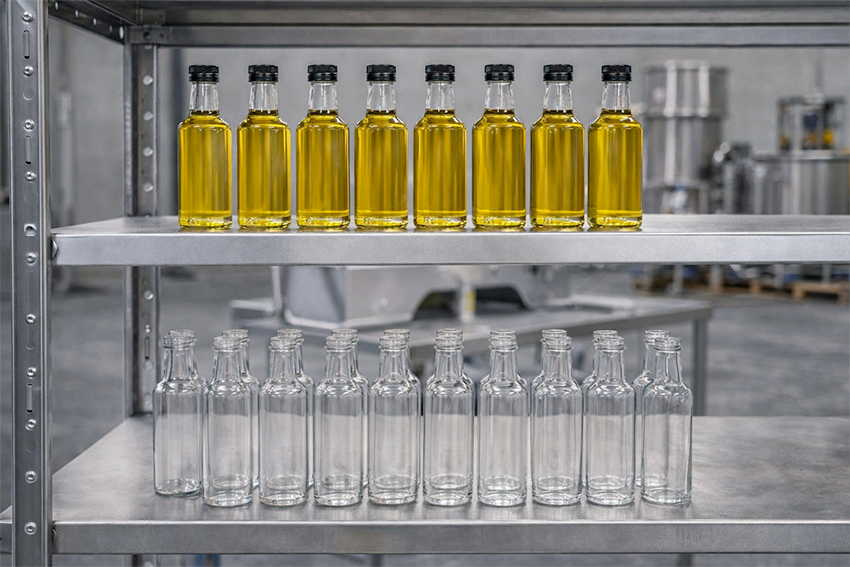
Before bottling begins, all bottles should be clean, dry, and free of foreign odours. New glass bottles should be rinsed with hot water and dried thoroughly – ideally in a drying cabinet or by standing them upside down on a clean rack for several hours. Caps and corks should be kept in sealed packaging until the moment of use. Reusable bottles from previous batches require washing with food-grade detergent, rinsing, heat treatment, and subsequent drying.
Choosing Bottles – Material, Colour, Volume
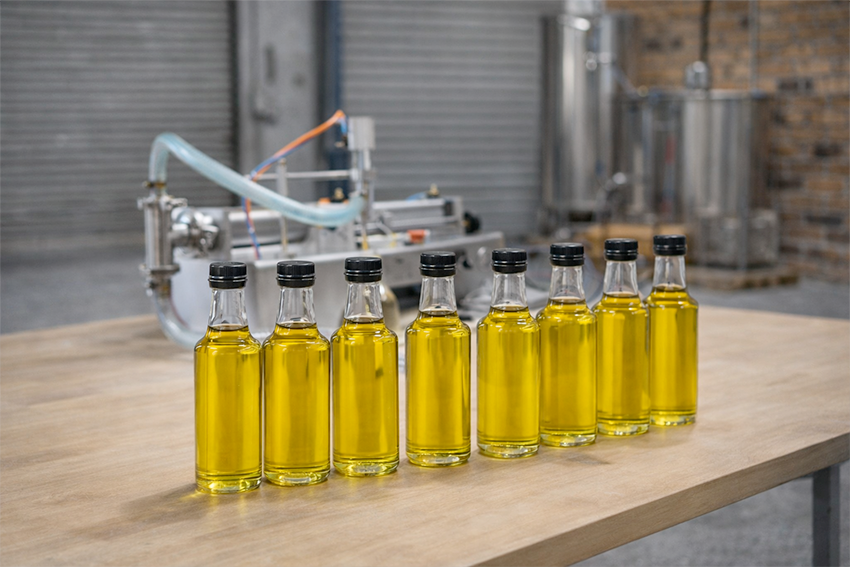
Dark amber or green glass is the best choice for cold-pressed oils. It protects against photooxidation more effectively than plastic and is chemically inert, eliminating any risk of packaging components migrating into the oil. PET bottles are lighter and cheaper, but they allow oxygen to permeate through their walls, shortening shelf life – particularly for polyunsaturated oils. For products distributed through retail or online channels, where the time between bottling and consumption may span several months, glass is the industry standard.
Oil Temperature During Bottle Filling
Oil should be at or slightly below ambient temperature – typically between 15 and 22°C. If the oil has been stored in a cool place after pressing, it is worth leaving it at the target room temperature for an hour before filling, which will reduce viscosity and allow for more precise dosing. Filling warm oil – still at 40–50°C depending on press settings – is technically feasible with the machines described here, but from a product quality perspective it is better to wait for it to cool, as warmer oil absorbs oxygen more readily during the filling process.
Minimising Air Contact During Filling
There are two approaches to reducing the oil's exposure to oxygen while filling bottles. The first is bottom-up filling, in which the nozzle is inserted to the bottom of the bottle and gradually withdrawn as the oil level rises – this prevents the oil from falling from above, eliminates foaming, and avoids drawing in air. The second is displacing the bottle atmosphere with an inert gas such as nitrogen or CO₂ before and after filling, which is standard practice in industrial settings but rarely used in small artisan operations due to equipment costs. Piston-type filling machines fill bottles in a controlled, low-turbulence manner, which in itself minimises aeration of the oil during the filling cycle.
Hermetic Sealing as the Final Barrier
The bottle should be capped immediately after filling – every second of delay means additional oxygen uptake. Caps with induction seals offer the highest hermeticity and are the standard for commercial oil bottling. Natural corks and silicone stoppers are a good solution for artisan production and direct sales. Regardless of closure type, it is worth checking a few randomly selected bottles after each batch by inverting them gently and waiting several seconds to verify that they are airtight.
The Role of the Filling Machine in Preserving Oil Quality
Why Manual Filling Becomes a Problem at Scale
For a few bottles a week for personal use, manual filling with a funnel is sufficient – though even then it requires care. The problem arises when production grows to tens or hundreds of litres per month. Manual filling is slow, volumetrically inconsistent, and inevitably leads to oil spilling outside the bottles, generating product waste and creating hygiene problems at the workstation. Achieving repeatable quality through manual filling is also difficult – every change of operator brings a different technique, different pace, and different level of aeration. In the food industry, repeatability is a value in its own right, not just for aesthetic reasons but for legal ones too: the label on the bottle declares a nominal volume, and deviations from that figure are subject to regulation.
How a Semi-Automatic Liquid Filling Machine Works
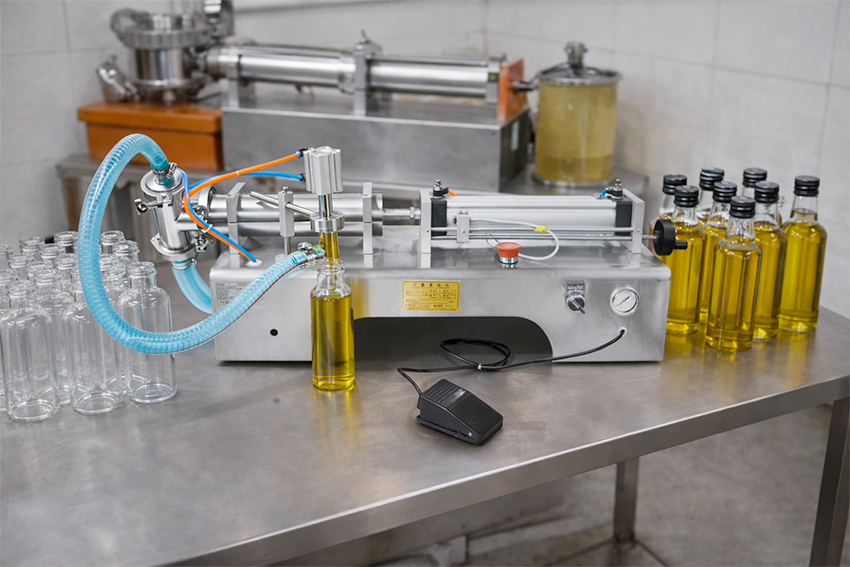
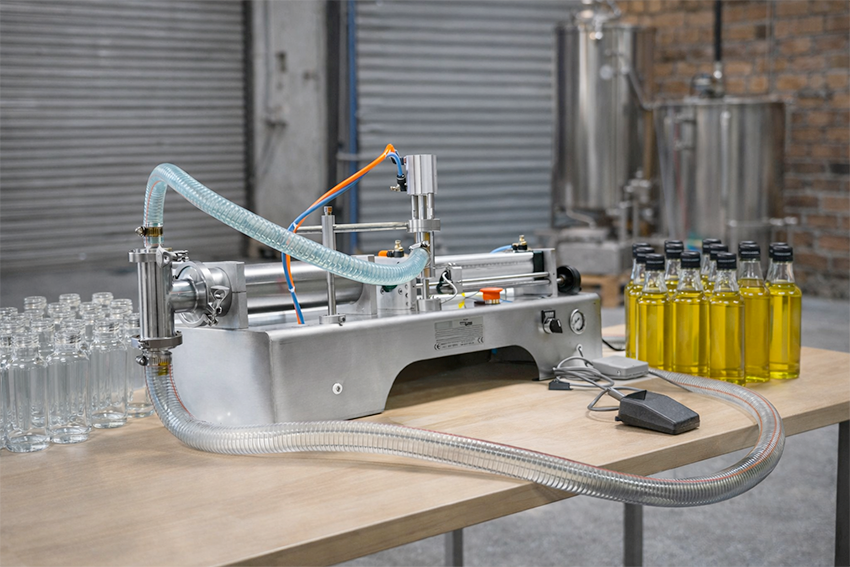
A semi-automatic piston filling machine operates on the principle of aspiration and liquid displacement. The liquid is drawn from an external tank through a flexible tube into the piston cylinder, then pushed through a dosing valve to the filling nozzle inside the bottle. The volume of each dose is adjusted mechanically, according to the set range. The machine can operate in automatic mode or in manual mode activated by a foot pedal, giving the operator full control over the moment the valve opens and closes.
The piston filling mechanism minimises the oil's contact with air – the liquid moves within a closed system rather than being poured freely from above. The mechanism is also precise and independent of liquid viscosity within the range that edible oils occupy, meaning that low-viscosity linseed oil and higher-viscosity rapeseed oil can both be dosed to the same accuracy without changing the settings.
Dosing Precision, Waste, and Production Profitability
A dosing accuracy of ±1–2% translates in practice to a difference of 1 to 20 ml when dispensing 1000 ml. At a production volume of 500 bottles per month, even 5 ml of overfill per bottle means losing 2.5 litres of oil per month. Losses from manual filling can be many times higher. Over the course of a year, that difference has a meaningful impact on the profitability of a small oil mill. A professional filling machine pays for itself not only through product savings, but also through reduced bottling time, lower labour input, and less oil waste at the workstation.
Single-Head Liquid Filler 100–1000 ml – The Right Choice for Small and Medium Oil Mills
For oil mills producing from a few dozen to several hundred litres per month and looking for their first professional bottling solution, the natural starting point is the Single-Head Liquid Filler 100–1000 ml.
Technical Specifications and Scope of Use
The machine is equipped with one dosing head with an adjustable range of 100 to 1000 ml, covering the most common bottle formats used in oil retail – from 250 ml through 500 ml up to 1 litre. Output capacity is 10–25 bottles per minute, meaning that at a fill volume of 0.5 litres, between 600 and over 1,000 bottles can be filled per hour. Dosing accuracy is ±1–2%. Filling is carried out by a piston mechanism. The filling nozzles are interchangeable and available in various internal diameters – standard 8/10 mm, with optional variants from 3/4 to 14/16 mm – allowing work with narrow-neck bottles without adapters. The oil tank is not an integral part of the machine; oil is drawn directly from an external container through a flexible suction tube, which makes integration with an existing production line straightforward. All components are manufactured from stainless steel, meeting food-contact hygiene requirements. Machine dimensions are 92 × 30 × 35 cm, weight 26 kg.
Automatic and Manual Mode – The Foot Pedal as an Ergonomic Advantage
The ability to switch between automatic and manual mode with a foot pedal is a feature appreciated by operators working alone. The pedal frees both hands – the operator can hold the bottle with one hand, position or adjust it with the other, and trigger the dosing cycle with a foot. This is particularly important with glass bottles, which are heavy and require a firm grip. Automatic mode suits a stable bottling station with a bottle guide, or where a dedicated worker operates the machine.
Stainless Steel and Process Hygiene
All parts in contact with oil are made from stainless steel, as required by food-contact material regulations. Stainless steel does not react chemically with edible oils, does not absorb odours, does not corrode, and is straightforward to sanitise. Daily cleaning after bottling should include flushing all contact components with warm food-grade detergent solution, rinsing with clean water, and thorough drying. The machine requires connection to an air compressor with a tank capacity of at least 60 litres and a power rating of 1.3–1.5 kW; the compressor is not included in the set.
Two-Head Liquid Filler 100–1000 ml – For Higher Production Volumes
When production volume grows to the point where a single filling head becomes the bottleneck of the bottling line, the Two-Head Liquid Filler 100–1000 ml is the natural step up.
Two Heads, Twice the Output
The two-head design means two dosing cycles run in parallel – one press of the pedal or one automatic cycle fills two bottles simultaneously. This model delivers an output of 20–50 bottles per minute, which in practical terms translates to filling 1,200 to 3,000 half-litre bottles per hour. For a mill producing several hundred litres of oil per week, this is the difference between a half-day task and a few hours of work.
The technical specifications are virtually identical to the single-head model in terms of dosing range (100–1000 ml), filling method (piston), compressor requirements, and stainless-steel construction. The differences lie in the number of heads, machine weight (40 kg versus 26 kg for the single-head model), dimensions (92 × 42 × 35 cm), and above all, the twice-higher output for the same investment of time and energy. The machine draws just 20 W, making it exceptionally economical to run for the throughput it delivers.
When the Two-Head Model Is Worth the Investment
The case for the two-head version is clearest when monthly oil production regularly exceeds 200–300 litres, when bottling is done in larger single runs, and when filling time is constrained by other production processes or staff availability. The price difference between the two models is relatively modest. Given that the two-head filler can halve bottling time – and that an operator's time has a concrete financial value – the investment typically recovers quickly at regular production volumes. It is also worth considering the growth perspective: buying the two-head model from the outset eliminates the need to replace the machine as production scales up.
Comparing Both Models
Both machines offer the same dosing range (100–1000 ml), the same filling method, interchangeable filling nozzles, automatic and manual operating modes, and stainless-steel construction. The single-head filler weighs 26 kg and takes up slightly less floor space, which may matter in smaller production rooms. The two-head filler is heavier and marginally wider, but delivers twice the throughput. The choice comes down to answering one question: what is the current and expected production volume, and how much time can be allocated to bottling?
Storing and Labelling Bottled Oil
Storage Conditions for Finished Oil
Bottled oil should be stored in a dark, cool location – a temperature between 10 and 18°C is optimal for most edible oils. The storage space should not be subject to temperature fluctuations, which cause moisture to condense inside bottles as pressure changes. Bottles should stand upright rather than lying on their sides – in the upright position the cap has less contact with the oil, which reduces the risk of oxidation near the seal. Direct exposure to sunlight or artificial fluorescent lighting shortens shelf life even for oil packaged in dark glass.
Labelling and Best-Before Dates
Polish and EU food law requires producers to state on the label, among other things, the product name, ingredient list, producer details, storage conditions, net weight, and best-before or use-by date. For cold-pressed oils, a best-before date (minimum durability date) is used rather than a use-by date. Typical shelf life for cold-pressed oils ranges from 6 to 18 months depending on oil type, packaging, and storage conditions. Oils rich in omega-3 fatty acids such as linseed or hemp have a shorter shelf life (4–6 months), while high-oleic oils can retain quality for over a year.
Dark Glass, Plastic, or PET – Which to Choose for Storing Oil
Dark amber or green glass is the undisputed leader in terms of protection against photooxidation and chemical inertness towards the oil. Its drawbacks are weight, fragility, and higher cost. Brown-tinted PET bottles with UV barrier coating are a viable compromise – lighter, cheaper, less prone to breakage, but with a higher oxygen transmission rate. For producers who prioritise the image of an artisan product, dark glass with an induction-sealed cap and a label on textured or matte paper is a packaging choice that communicates quality before the customer even opens the bottle.
Frequently Asked Questions
Does cold-pressed oil need to be filtered before bottling?
Filtration before bottling is not a legal requirement, but it is strongly recommended in the interest of product quality and shelf life. Unfiltered oil contains press-cake particles, protein fragments, and traces of emulsified water, all of which accelerate oxidation and hydrolysis. Sediment in the bottle is natural and not a sign of poor quality, but it can raise doubts among consumers accustomed to clear oils from the supermarket. A minimum approach is sedimentation for several dozen hours in a sealed tank, decanting the upper layer carefully. For longer storage or retail distribution, filtration through cloth or a frame filter is advisable.
What temperature is safe for oil during bottling?
For cold-pressed oils, the optimal bottling temperature is 15–22°C. Filling warm oil (above 35–40°C) is technically possible – the machines described here handle liquids up to 70°C – but it results in more intense oxygen contact during the filling process and encourages moisture condensation inside the bottle. Linseed and hemp oils should be filled as cool as practically possible. Temperatures below 10°C may increase viscosity and impede accurate dosing with some oil types.
Why use a filling machine for oil rather than filling by hand?
A filling machine delivers a repeatable, precise volume with every bottle – to an accuracy of ±1–2% – eliminating product waste and deviations from the declared label volume. The piston filling mechanism minimises aeration of the oil during the filling cycle, which directly affects product shelf life. A filling machine speeds up the process compared to manual filling, reduces oil waste at the workstation, and lowers the demands on the operator's experience and technique. At regular production volumes above a few dozen litres per month, the investment pays off quickly.
How long can cold-pressed oil be stored after bottling?
Shelf life depends on oil type, packaging, and storage conditions. Cold-pressed rapeseed and sunflower oil retains quality for 6–12 months in dark glass bottles stored in cool, dark conditions. Linseed oil should be consumed within 4–6 months of bottling and kept refrigerated after opening. Pumpkin seed and peanut oil have a somewhat longer shelf life of up to 12–18 months under optimal conditions. With PET bottles, shelf life is typically reduced by 20–30% compared to dark glass.
What bottles are best for storing oil?
Dark amber or green glass bottles sealed with induction-lined caps are the best choice. Glass is chemically inert, does not allow oxygen to permeate through its walls, and effectively blocks the UV radiation responsible for photooxidation. Brown-tinted PET bottles with anti-diffusion coating are an acceptable compromise at lower budget levels or for oil intended for rapid sale. Fully transparent packaging – glass or plastic – should not be used for premium cold-pressed oils, as exposure to light in the retail environment or at the consumer's home can degrade the product before its best-before date.
Does an oil filling machine require an air compressor?
The semi-automatic filling machines described in this article are pneumatically powered and require connection to an air compressor with a tank capacity of at least 60 litres and a motor rating of 1.3–1.5 kW. The compressor is not included in the set – any compressor already in use at the facility can be utilised. This is a practical arrangement, as a compressor is common equipment in small production facilities and farms, and buying it separately allows the specification to be matched to existing needs.
What is the difference between a single-head and a two-head liquid filler?
The fundamental difference is the number of bottles filled simultaneously in one cycle. The single-head filler fills one bottle per cycle, with an output of 10–25 bottles per minute. The two-head filler fills two bottles simultaneously, reaching an output of 20–50 bottles per minute. Both machines offer the same dosing range (100–1000 ml), the same level of precision, the same operating modes, and stainless-steel construction. They differ in weight (26 kg versus 40 kg) and footprint. The choice should be guided by current and projected production volume – at monthly production up to 150–200 litres, the single-head model is fully sufficient; above that level, the two-head filler will significantly shorten bottling time.