
Table of Contents
- A Plant From the New World
- The Serf From Alekseyevka and the Fasting Oil
- The Flower That Follows the Sun - and Then Stops
- Mathematics in the Flower Head
- A Seed That Is Really a Fruit
- October in the Field - Harvest and Drying
- One Gene That Changed Sunflower Oil
- Sunflowers in the Screw Press
- A Press Cake That Turns Green
- The Sunflower That Cleans Water
- A Field That Looks East
- Frequently Asked Questions
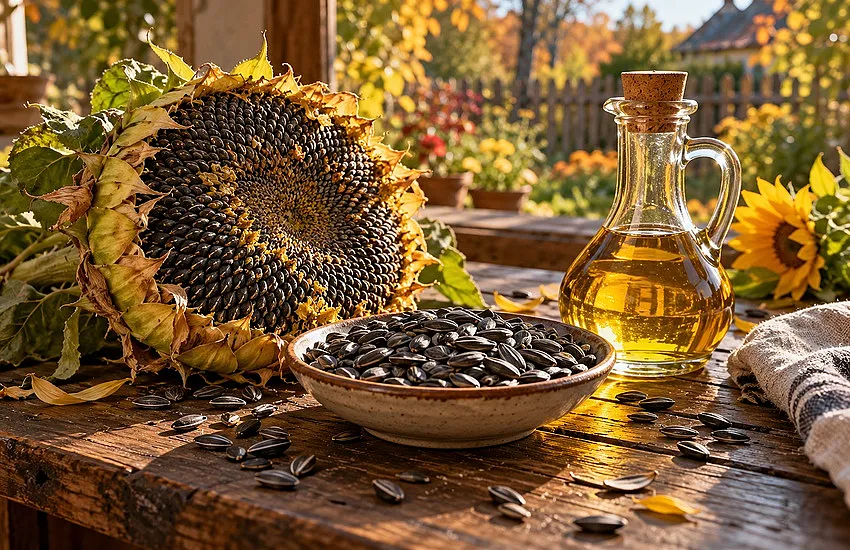
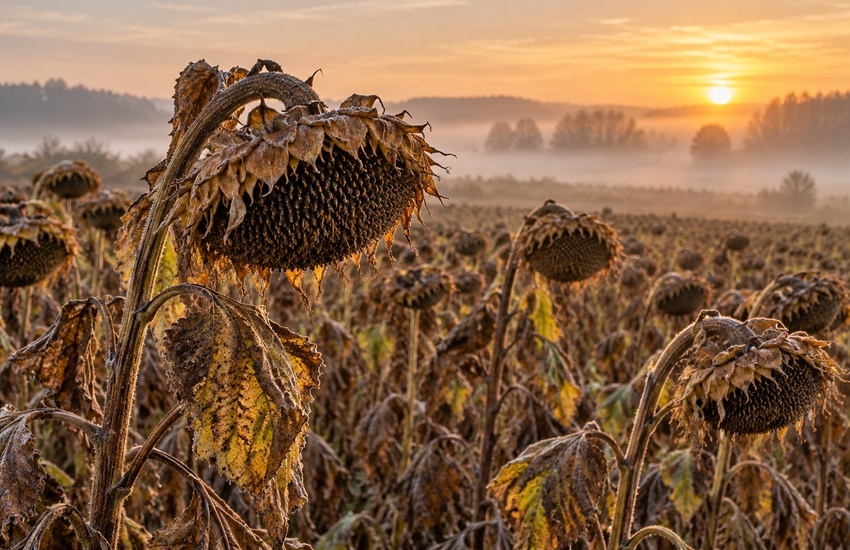
Drive past a sunflower field in October and you see a very different picture from July. Instead of a sea of yellow petals, there is a forest of dark, dried stalks hung with heavy, drooping heads. The leaves are brown and brittle, the petals long gone, and the whole field looks a little like an army of weary soldiers at the end of a long march. Yet there is something that catches the eye of even a casual passer-by. Every single head is facing the same way: east.
It is neither chance nor the work of the wind. It is the last trace of one of the most remarkable behaviours in the plant world, which scientists explained only a few years ago. And inside those bowed heads, ready for harvest, lie thousands of seeds that become an oil found in almost every kitchen in Europe and far beyond. An oil so ordinary that we rarely stop to ask where it came from, how it is made, and why the oil from a small press tastes so utterly different from the one on the supermarket shelf.
In this article we take a close look at the sunflower - from its journey out of North America through Spain and Russia, to the biological clock that steers the movement of its head, the mathematics hidden in the arrangement of its seeds, and what happens to them inside the barrel of a screw press.
A Plant From the New World
The common sunflower (Helianthus annuus) is native to North America. Its Latin name combines the Greek words helios, the sun, and anthos, a flower. Wild sunflowers still grow on the prairies and waste ground of the United States and Mexico - shorter, branching plants with many small heads instead of one enormous one.
Indigenous peoples of North America domesticated the sunflower several thousand years ago, most likely in what are now the eastern and central United States. The seeds were eaten raw and roasted, ground into flour for flatbreads, and the fat that floated to the surface when crushed seeds were boiled in water was skimmed off and used. The petals gave a yellow dye and the stalks a fibre. The sunflower was one of the few crops domesticated in North America itself, rather than brought up from the south of the continent.
A Flower for Gardens, Not the Larder
The sunflower reached Europe in the sixteenth century with the Spanish, and for a long time it was above all an ornamental plant. It was grown in botanical and monastery gardens, admired for its sheer size and described in herbals as a curiosity from the New World. Someone noticed the seeds were edible, someone else tried pressing oil from them, but for almost three hundred years nobody in Western Europe treated it as a serious oil crop.
According to a popular story, the sunflower was carried to eastern Europe by Tsar Peter the Great, who is said to have seen it in Holland during his famous journey west. Whether this is fact or legend, it was in Russia and Ukraine that the sunflower found its true homeland as an oilseed.
The Serf From Alekseyevka and the Fasting Oil
The year 1829 is regarded as the birth of sunflower oil as a product. In the village of Alekseyevka in the Voronezh province, a serf named Daniil Bokarev built a simple press and extracted oil from sunflower seeds. The experiment was a success - the oil tasted good and quickly found buyers. Before long the first mill processing sunflower seed opened in Alekseyevka, and the crop spread rapidly across the steppes of southern Russia and Ukraine. By the end of the nineteenth century, sunflowers covered a large share of the fields in some regions.
Did the Sunflower Slip Past the Fast?
The sunflower's career in Russia is often linked to a story about fasting. The Orthodox Church had very strict fasting rules that, during many periods of the year, restricted fats, including oil. According to the popular version, the sunflower - a new plant, unknown when the old rules were written down - did not appear on the list of forbidden foods, so its oil was considered acceptable during fasts. Historians treat this story with caution, because fasting rules were complex and varied by region and period, but there is no doubt that sunflower oil quickly became Russia's "fasting oil", the basic fat for the days when butter and lard disappeared from the table.
To this day, Russian and Ukrainian cooking particularly prizes unrefined sunflower oil from roasted seeds - deep gold, intensely aromatic, with a taste reminiscent of halva and toasted seeds. It is a completely different product from the neutral, refined sunflower oil found in most shops, and a perfect example of how much an oil's character depends on how it is pressed.
The Flower That Follows the Sun - and Then Stops
Back to the October field. Everyone has heard that sunflowers "turn to follow the sun". It is true, but only in part. In 2016, a team of scientists from the University of California, Davis and the University of California, Berkeley published research in the journal Science that finally explained how and why the sunflower moves.
A Stem That Grows First on One Side, Then the Other
It turned out that only young plants track the sun, before they flower. In the morning the shoot tip with its flower bud faces east, during the day it slowly swings westward, and at night it returns east to greet the rising sun at dawn. The sunflower has no special "joints" or motor organs of the kind some plants, such as beans, possess. It does this in a different and very elegant way.
During the day the east side of the stem grows faster, which tilts the tip towards the west. At night the west side grows faster and the tip swings back east. The whole movement is therefore the result of uneven growth, not muscles or changes in cell pressure. Most importantly, this rhythm is not just a simple response to light. The researchers showed that it is driven by the plant's internal biological clock, the same kind of clock that regulates sleep and waking in humans. Plants kept indoors under lamps that "travelled" across the ceiling like the sun tracked the artificial light correctly when the cycle lasted about 24 hours, but lost the rhythm when the cycle was noticeably longer.
Sun-tracking matters. Plants that the researchers tethered in place, or turned every day so they faced the wrong way, ended up smaller and with less leaf area than those that could follow the sun freely.
Why Mature Heads Face East
As the sunflower matures and begins to flower, its growth slows and the movement gradually fades. The biological clock makes the plant respond more strongly to morning light than to afternoon light, so eventually the head comes to rest facing east. And there it stays - throughout flowering and ripening, right up to October.
The researchers also asked why. They found that east-facing heads warmed up much faster in the morning than heads deliberately turned to face west. And warm flowers are more attractive to insects - east-facing heads received around five times as many pollinator visits. Bees like warmth, and the sunflower exploits this to improve its chances of pollination and of setting full, oil-rich seeds.
That is why every dried head in an October field faces the same direction. It is a souvenir of the morning sun that, months earlier, warmed them to lure the bees.
Mathematics in the Flower Head
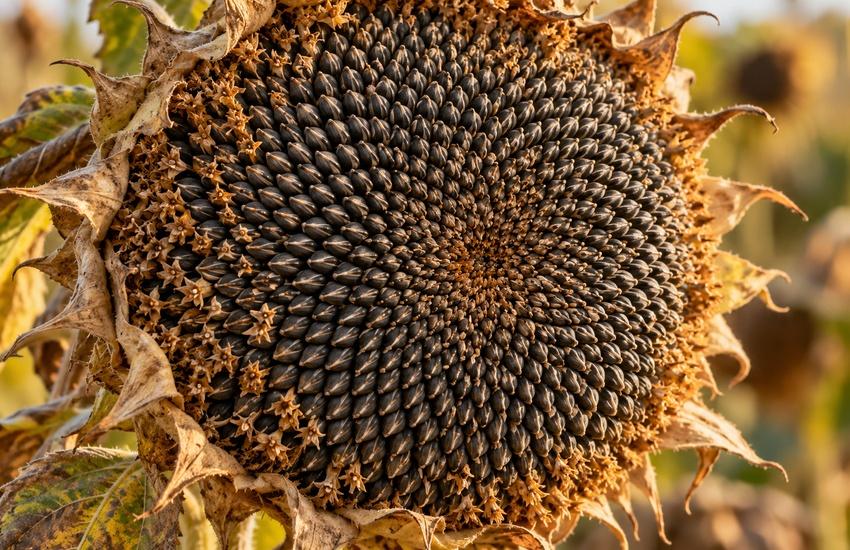
A sunflower head is not a single flower but an entire bouquet. Botanists call it a capitulum. The large yellow "petals" around the edge are actually separate ray florets, which are sterile - they produce no seeds and exist only to attract insects. The centre of the head is packed with hundreds, and in large varieties well over a thousand, tiny disc florets. Each of them, if pollinated, produces one seed.
Spirals That Count Themselves
Look closely at a ripe sunflower head and you will see that the seeds are not arranged at random. They form two sets of spirals - one running clockwise, the other anticlockwise. Count them, and in a great many heads you will get pairs of numbers such as 34 and 55, 55 and 89, or 89 and 144. These are consecutive terms of the Fibonacci sequence, in which each number is the sum of the two before it.
Where does this come from? New florets form at the centre of the head, and each one appears at an angle of about 137.5 degrees from the previous one. This angle, known as the golden angle, is linked to the golden ratio and has a remarkable property - it allows the seeds to be packed as densely as possible, with no gaps and no overlaps. If the angle were even slightly different, the seeds would line up in straight spokes with plenty of empty space between them. The Fibonacci spirals are therefore not decoration but the result of making optimal use of the space the plant has available.
One Sunflower in Five Doesn't Do the Maths
Interestingly, nature does not always follow the rules. In 2016, results were published from a large project in which volunteers in several countries grew sunflowers and counted the spirals in their heads. Although most heads did indeed show Fibonacci numbers, roughly one in five had spirals that did not fit the sequence, or an arrangement too irregular to count. Some of them matched other, related number sequences. Mathematics in nature is a tendency rather than an unbreakable law - which makes it all the more interesting.
Counting sunflower spirals is, incidentally, a wonderful autumn activity for children and adults alike. All you need is a ripe, dried head, a few coloured pins or felt-tip pens and plenty of patience. While you are at it, you can count how many seeds a single flower produces - the answer is often surprising.
A Seed That Is Really a Fruit
What we call a sunflower seed is botanically a fruit, more precisely an achene. The hard, striped or black hull is the wall of the fruit, and inside lies the true seed - a pale, soft kernel that holds almost all of the fat. The distinction matters in practice, because the hull is not fused to the seed and separates from it relatively easily.
Black and Striped - Two Different Sunflowers
Two main types of sunflower are grown in the field. Oilseed sunflower has small black seeds with a thin hull, tightly filled by the kernel. Their fat content reaches 40-50 percent of the whole seed, and the hull makes up a relatively small part of the mass. This is the type that becomes oil.
Confectionery sunflower has large, elongated seeds striped black and white or grey and white, with a thicker hull and a more loosely seated kernel. It contains less fat, but it is easier to shell and better for snacking. These are the seeds sold roasted and salted, and in eastern Europe cracking them between the teeth on a bench outside the house is almost a national pastime.
Waxes in the Hull
The sunflower hull has one more feature that anyone who presses sunflower oil will know. It is coated with a thin layer of plant waxes that protect the fruit from moisture and pests. During pressing, some of these waxes pass into the oil. When warm they are invisible, but as the oil cools they crystallise and form a delicate haze, and sometimes even a sediment at the bottom of the bottle. This is an entirely natural phenomenon and no sign of poor quality - on the contrary, it is proof that the oil has not been refined. Large refineries remove the waxes in a process called winterisation; small presses often leave them alone.
October in the Field - Harvest and Drying
Across most of Europe, sunflowers are harvested in September and October. The crop is ready when the back of the head turns from green to yellow-brown and the leaves have dried. At this stage the seeds still hold a good deal of water, and damp heads are heavy and prone to mould.
In October the sunflower also has plenty of competitors for its crop. Sparrows, greenfinches, goldfinches and tits pick the seeds straight from the heads, and in some years birds take a noticeable share of the harvest. Gardeners growing sunflowers often protect the ripening heads with netting or paper bags.
From Field to Store
After harvest, the seeds must be quickly cleaned of head fragments, petals and dust, and then dried. For safe storage, sunflower needs a moisture content of just a few percent, noticeably lower than cereals. That is because fat-rich seeds contain fewer substances that bind water, so the same amount of water is more "available" to moulds and bacteria.
For a screw press, moisture is critical. Seeds that are too wet give a cloudy oil and a soft, crumbling cake, while seeds that are too dry can overheat in the barrel and give an oil with a slightly scorched taste. Most presses, including home models, work best with seed below 10 percent moisture, and experienced pressers find their own "sweet spot" for sunflower by trial and error.
One Gene That Changed Sunflower Oil
Classic sunflower oil is dominated by linoleic acid, a polyunsaturated omega-6 fatty acid. In typical varieties it makes up more than half of all the fatty acids, with oleic acid - the same one that dominates olive oil - in second place. These proportions are not fixed, however - they depend on the weather during ripening. In cooler climates the plant makes more linoleic acid, in warmer ones more oleic, because the enzymes that create double bonds behave differently at different temperatures.
Pervenets - a Sunflower From a Single Grain of Pollen
In 1976 the Soviet breeder Konstantin Soldatov published the results of an experiment that changed the world of vegetable oils. He treated seed of the sunflower variety VNIIMK 8931 with a solution of dimethyl sulphate, a chemical that induces mutations. He then spent several generations searching the offspring for plants with an unusual oil composition. His patience was rewarded - he found plants whose oil contained well over half oleic acid, and after further selection as much as 80-90 percent.
The new population was named Pervenets, meaning "firstborn". Later genetic studies revealed something extraordinary - the whole population traced back to a mutation that arose in a single grain of pollen. The mutation affected the gene responsible for converting oleic acid into linoleic acid. When that enzyme works less efficiently, oleic acid accumulates in the seed instead of being turned into linoleic acid.
Today almost all high-oleic sunflower varieties in the world descend from Pervenets. Their oil is far more resistant to oxidation and high temperatures, because it has fewer polyunsaturated chains for oxygen to attack. It is another example - after the shell-less Styrian pumpkin - of how a single change in one gene can create an entirely new oil.
Sunflowers in the Screw Press
Sunflower is one of the most rewarding raw materials for a screw press. It is oily, widely available and presses well. It does have a few traits worth understanding, though, if you want the best oil.
The Hull - the Press's Best Friend
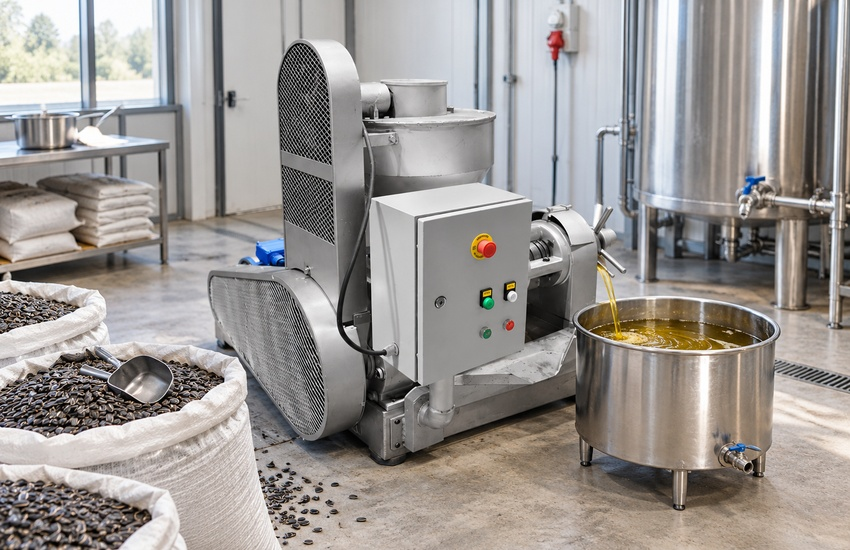
The most important of them is the hull. In a screw press it acts as the skeleton of the meal. Hard, fibrous fragments of hull build a structure in the barrel that resists the screw, allows high pressure to develop and opens channels through which the oil can drain out through the slots of the cage. Without hulls, a meal of pure kernels behaves like paste - it is slippery, escapes through the gaps and fails to form a firm cake.
That is why oilseed sunflower is usually pressed whole, hull and all. Partial dehulling is sometimes used when a paler oil with fewer waxes is wanted, but some hull is always left in so the press can run steadily.
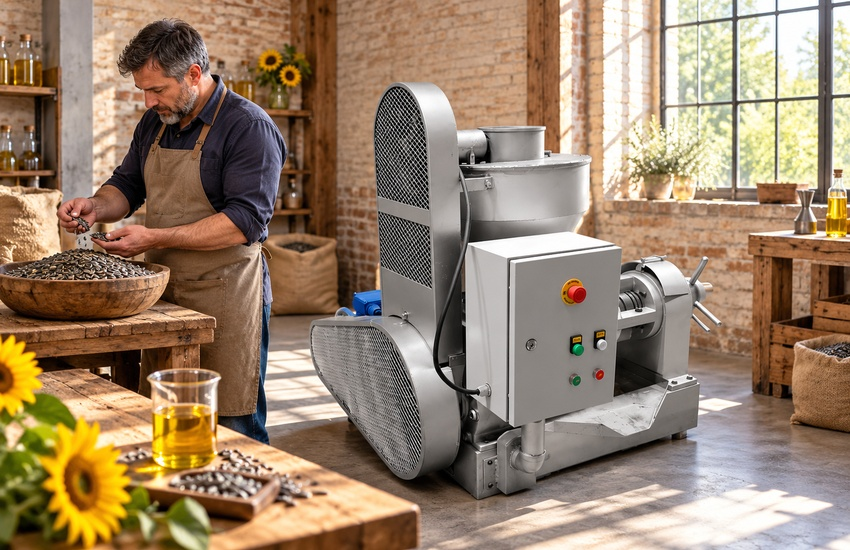
This is easy to see with a continuous-duty screw oil press with a capacity of 3 tonnes per 24 hours. The manufacturer states explicitly that it gives the best results with seeds that keep their natural husk, and oilseed sunflower is an almost textbook raw material for it. A three-stage pressing system raises the pressure gradually, and residual oil in the cake of up to 8 percent means most of the fat is recovered from the seed. Built to run around the clock, it can process an October harvest from a large acreage before the seed loses its freshness - and with cold-pressed oil, it is the freshness of the raw material that decides the flavour.
Pressing at Home - an Oil You Won't Find in Shops
Anyone who has pressed sunflower seed in a small press knows that freshly pressed sunflower oil tastes nothing like the oil in a supermarket bottle. It has a distinct aroma of fresh seeds, slightly nutty, sometimes with a hint of green grass, and a pleasant, rounded sweetness. Refined oil has none of these flavours, because refining removes all the compounds responsible for aroma.
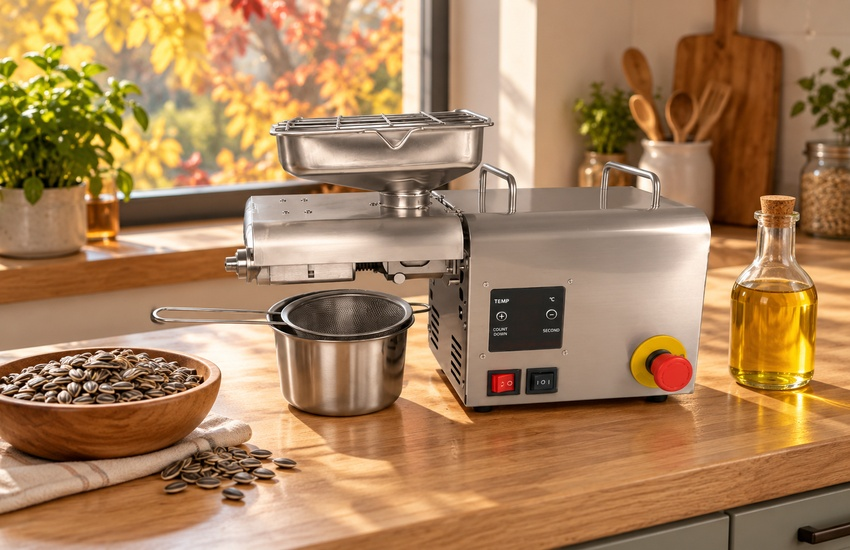
For this kind of home pressing, a home oil press for hot and cold pressing with an output of 5-7.5 kg/h is ideal. Sunflower is among the raw materials the manufacturer lists as suitable, and the adjustable heater lets you choose between cold pressing, with oil leaving the press at up to around 40 degrees Celsius, and warm pressing. That makes for a fascinating experiment - from the same batch of seed you can press a delicate, "green" cold-pressed oil, and then, after lightly toasting the seeds in a pan, an eastern European style oil, darker and smelling of halva. Tasting the two side by side is the best lesson there is in how temperature changes an oil's character.
Roasting - How Halva-Scented Oil Is Made
Oil from roasted sunflower seeds is a classic in eastern Europe and well worth getting to know. The seeds are roasted at temperatures where Maillard reactions between sugars and amino acids begin. These produce pyrazines and other volatile compounds responsible for the aroma of roasted nuts, bread and caramel. At the same time the proteins in the kernel coagulate and the cell walls rupture, making it easier for the oil to flow.
The key is moderation. Too short a roast gives no clear aroma; too long or too hot leaves a bitter, burnt taste. Home pressers usually roast the seeds in a dry pan, stirring constantly, until the kernels are lightly golden and smell strongly. Once cooled, the seeds go into the press, and the oil that flows out is the colour of dark gold, with an aroma that fills the whole kitchen.
The First Weeks After Pressing
Freshly pressed sunflower oil is cloudy, golden yellow and full of fine particles of meal. It is best left for a few days somewhere cool and dark so the suspension settles, then the clear part gently decanted. During this time the oil not only clarifies but also "settles" in flavour - sharper, green notes soften and the seed aroma becomes fuller and rounder.
Tasting is best done as with other cold-pressed oils. Pour a few drops into a small glass, warm it in your hand, smell first and only then taste. A good sunflower oil smells of fresh seeds, sometimes faintly of butter or grain, and on the palate it is mild, with a gentle sweetness and a pleasant, seedy finish. Notes of mustiness, cardboard or stale nuts mean the raw material was badly stored or the oil has begun to oxidise.
Classic sunflower oil, rich in linoleic acid, is fairly sensitive to oxygen and light. It is best kept in a dark, tightly sealed bottle somewhere cool and used within a few months. Oil from high-oleic varieties is far more stable in this respect, which shows nicely how fatty acid composition translates into everyday kitchen experience.
In the kitchen, fresh cold-pressed sunflower oil is best used raw - on cabbage and carrot salads, with fermented vegetables, on buckwheat, on potatoes with dill or with fresh cheese. Oil from roasted seeds, more intense, is superb with a tomato and onion salad, with pickled herring, roast beetroot and fresh bread with salt - just as it has been eaten for generations in eastern Europe.
A Press Cake That Turns Green
Sunflower press cake, the residue left after pressing, is rich in protein and fibre and has long been used as animal feed. Ground into flour, it can also go into the kitchen - into bread, flatbreads or cereal bars. It has one surprising property, though, that is worth knowing before you bake with it.
Sunflower seeds contain a good deal of chlorogenic acid - a phenolic compound also found in coffee. In alkaline conditions, for example in the presence of baking soda, chlorogenic acid reacts with proteins and forms green pigments. The effect can be spectacular. Cookies made with sunflower cake flour or sunflower seed butter and baked with baking soda can turn green inside after a few hours. They look strange but are perfectly safe - it is just chemistry. The greening can be reduced by using less baking soda or by adding something acidic, such as a little lemon juice or yoghurt.
The Sunflower That Cleans Water
Finally, a curiosity that shows just how remarkable a plant the sunflower is. It has a very extensive root system and can take up various elements from water and soil, including heavy metals and radioactive isotopes. This ability was put to use after the Chernobyl disaster. In the 1990s scientists ran experiments there in which sunflowers set on floating rafts on a contaminated pond took up caesium and strontium isotopes from the water. Similar ideas were later considered after the accident at the Fukushima power plant in Japan.
The method is called phytoremediation - cleaning up the environment with plants. The sunflower is of course no miracle cure and cannot replace engineered clean-up methods, but it is a good example of how versatile a plant we usually associate only with oil and seeds can be. Needless to say, seeds from sunflowers used in experiments like these are not fit for eating or pressing.
A Field That Looks East
The sunflower brings together almost everything that is fascinating about the world of oils. It holds a story of migration from the North American prairies through Spanish gardens and Russian steppes. It has a biological clock that steers the movement of its stem, and mathematics that arranges its seeds in spirals. It carries a single grain of pollen from which a new kind of oil grew. And it holds a simple truth - that freshly pressed oil from well-dried seed tastes completely different from anything we know from the supermarket shelf.
If you pass a field of dried sunflowers this October, stop for a moment. Look which way the heads are facing. Pick one up, count the spirals, shell a few seeds and bite into them. In that one seed lies a whole story - of the sun, of bees, of a biological clock and of an oil waiting for someone to press it.
Frequently Asked Questions
Do sunflowers really turn to follow the sun?
Only young plants do, before they flower. During the day their shoot tip moves from east to west, and at night it returns east. The movement results from uneven growth on opposite sides of the stem and is controlled by an internal biological clock. Mature, flowering heads stop moving and come to rest facing east.
Why do mature sunflowers face east?
East-facing heads warm up faster in the morning sun, and warm flowers attract more insects. Research published in 2016 showed that east-facing heads received around five times as many pollinator visits as heads turned to face west.
Are there really Fibonacci numbers in a sunflower head?
In most heads the seeds are arranged in spirals whose numbers match consecutive terms of the Fibonacci sequence, such as 34 and 55 or 55 and 89. This happens because each new floret forms at the golden angle of about 137.5 degrees. A large volunteer study showed, however, that roughly one head in five departs from this pattern.
What is the difference between oilseed and confectionery sunflowers?
Oilseed sunflowers have small black seeds with a thin hull and a fat content of 40-50 percent. Confectionery sunflowers have larger striped seeds with a thicker hull and less fat, but they are easier to shell and better for eating.
Why does cold-pressed sunflower oil turn cloudy?
The sunflower hull is coated in plant waxes, some of which pass into the oil during pressing. At low temperatures the waxes crystallise and form a haze or sediment. This is a natural phenomenon that shows the oil has not been refined, and it does not harm its quality.
Do sunflower seeds need to be dehulled before pressing?
Usually not. In a screw press the hull acts as the skeleton of the meal - it helps build pressure and creates drainage channels for the oil. Oilseed sunflower is normally pressed whole. Partial dehulling is used when a paler oil with fewer waxes is wanted, but some hull is always left in.
What is high-oleic sunflower?
It is sunflower whose oil is dominated by oleic rather than linoleic acid. Almost all such varieties descend from the Pervenets population, created in 1976 by the Soviet breeder Konstantin Soldatov through chemical mutagenesis. Oil from these seeds is far more resistant to oxidation and high temperatures.