
Table of Contents
- The European Beech - a Tree Shaped by Climate
- Mast Years - Why Beech Trees Fruit in Bursts
- An Avalanche in the Forest - What a Beech Year Sets in Motion
- Oil of Hard Times and Oil of Fine Taste - Beechnuts in European History
- The Dark Side of the Nut - Why Raw Beechnuts Can Make You Ill
- From Leaf Litter to Press - Preparing Beechnuts for Pressing
- Beechnuts in the Press Barrel - What Happens During Pressing
- The Composition and Character of Beechnut Oil
- Beechnut Press Cake - What Remains After Pressing
- Beechnuts as a Lesson in Humility for Anyone Who Presses Oil
- Frequently Asked Questions
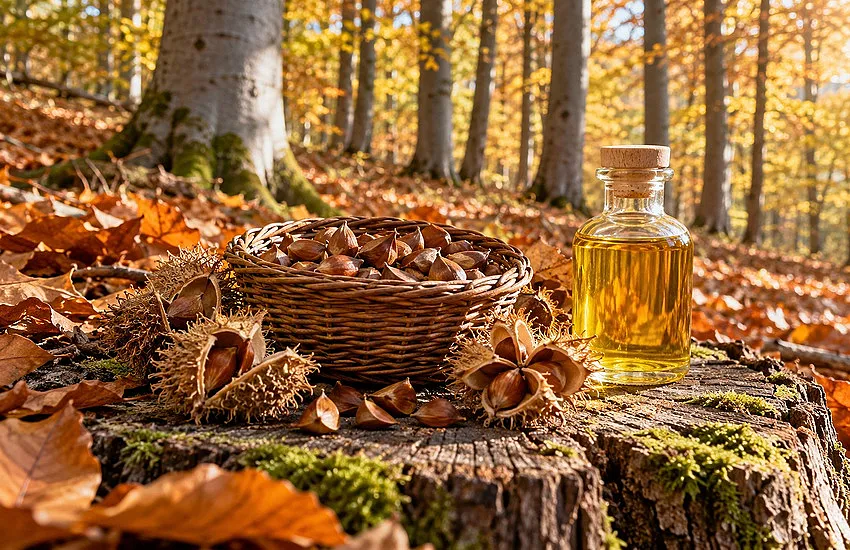
Anyone who has walked through an old beech wood in October knows the sound. A quiet, irregular tapping, as if someone were tossing pebbles into the leaf litter. These are beechnuts falling - small, three-sided nuts that drop from the canopy by the thousand. For a few weeks the forest floor can be so thickly carpeted with them that every step crunches. And then, for three, four or sometimes seven years - almost nothing. A handful of empty husks, a few scattered seeds that squirrels carry off before anyone notices them.
This irregularity is one of the most fascinating puzzles in European natural history, and - more importantly for us - for centuries it decided whether a jug of pale, mild oil would stand in the rural larder. Beechnut oil was once an entirely ordinary product across Central and Western Europe. It was pressed in Germany, Austria, Czechia, Poland, France and Britain, and in years of hunger and war it could be the only fat an ordinary family could obtain without ration coupons. Today hardly anyone remembers it, which is a pity, because it is one of the most interesting oils you can press from a raw material gathered quite literally underfoot.
In this article we look at beechnuts from every angle - botanical, historical and practical. You will learn why beech trees fruit in bursts, what makes raw beechnuts upset the stomach, how mass harvests were once organised, and what happens to this small, hard seed inside the barrel of a screw press.
The European Beech - a Tree Shaped by Climate
The European beech (Fagus sylvatica) dominates the natural woodland of much of the continent, from southern England and northern Spain to the Carpathians. Its range is defined by climate. Beech dislikes harsh continental frosts and, above all, late spring frosts that scorch its tender young leaves, which is why its natural eastern limit runs through Poland and the western edge of Ukraine. In the mild, moist climate of the Atlantic fringe it forms vast, shady forests in which little else can grow.
Where the tree lives also shapes how it fruits. Beech woods in the cooler, more continental parts of the range experience heavy seed years differently from those in the gentle climate of France or western Germany, and the weather of a single season can determine whether the forest floor is empty or full in autumn. Some of the most celebrated beech forests on earth - the ancient and primeval beech forests of the Carpathians and other regions of Europe - are now protected as a joint UNESCO World Heritage Site, a reminder of how central this tree is to the continent's ecological identity.
A Fruit That Is a Nut
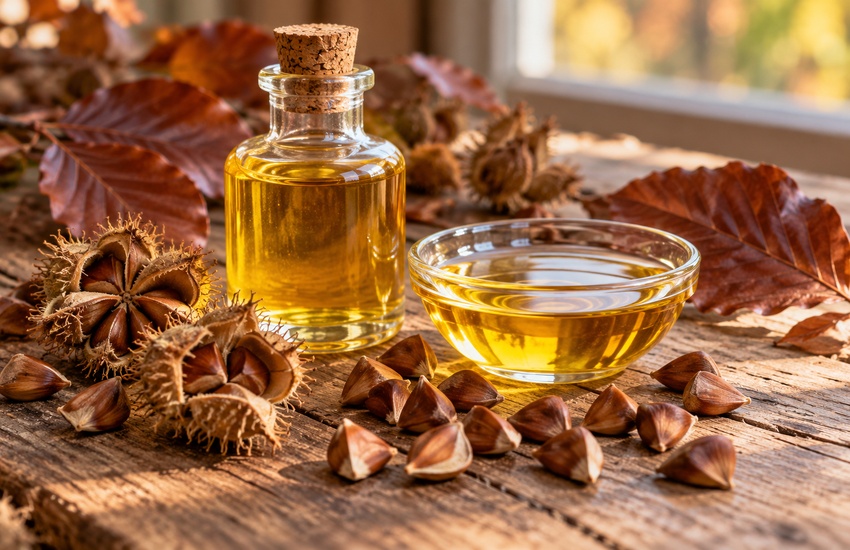
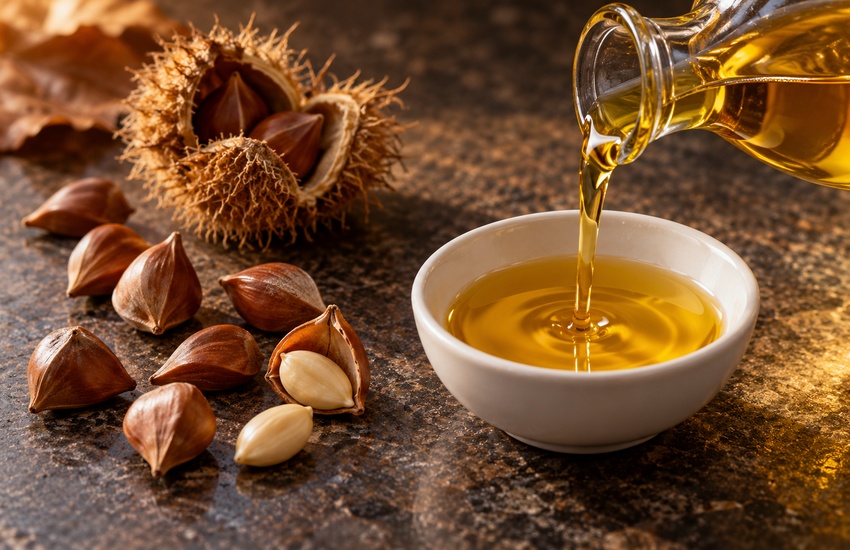
Botanically, the beechnut is a true nut, though few people call it that. Each fruit is enclosed in a woody, bristly cupule that splits into four valves in autumn and usually releases two triangular seeds. Each seed has a smooth, brown, leathery shell, and beneath it a pale, creamy kernel wrapped in a thin brown skin. The kernel is tiny, weighing just a few tenths of a gram, but it is remarkably rich in fat.
The catch is that many of the nuts are empty. In poor years there may be more hollow seeds than full ones. The tree builds the shell but never fills it with an embryo. Experienced gatherers spotted them at once - an empty beechnut is light, its shell gives under the fingers, and when dropped in water it floats. It is a simple test that has survived to this day, and it is worth knowing before carrying several sacks of raw material to a press.
Mast Years - Why Beech Trees Fruit in Bursts
Foresters speak of mast years, a term derived from the Old English word for the fallen nuts of forest trees, related to the German Mast. It describes a phenomenon in which beech trees across a huge area, sometimes across several countries at once, produce a gigantic crop of seed in one year and almost nothing in the following years. This is neither coincidence nor the result of a single good summer. It is a synchronised strategy that has evolved over millions of years.
Starving the Seed Eaters
The most convincing explanation is called the predator satiation hypothesis. Beechnuts are nutritious and eagerly eaten by wild boar, deer, wood mice, voles, dormice, squirrels, jays and hawfinches. If beech fruited moderately every year, the populations of these animals would adapt to a steady food supply and eat practically everything. The tree would have little chance of regenerating.
But when seeds are almost absent for several years, rodent and bird populations shrink. Then, suddenly, a year arrives when tens of thousands of nuts lie beneath every tree. The animals cannot eat them all - there are too few mouths and too much food. Some seeds survive the winter, germinate in spring and give rise to a new generation of forest. The beech pays for this system with years without offspring, but over the span of a century it pays off.
Wind, Pollen and Budgets
A second explanation concerns pollination. Beech is wind-pollinated, and wind pollination becomes far more efficient when many trees flower at once and the air is thick with pollen. A tree that flowered alone while its neighbours rested would waste energy on flowers that mostly went unpollinated. Synchrony makes sense for this reason too.
A third, complementary explanation is about the resource budget. Producing thousands of fat-rich seeds is an enormous expense for a tree. Carbohydrates, nitrogen and phosphorus are stored over several seasons and then spent in a single burst. After a mast year, beech trees grow more slowly, lay down narrower growth rings and need time to rebuild their reserves. Tree-ring researchers can read a mast year from the trunk decades later, because it shows as a distinctly narrower ring.
A Thermometer the Tree Carries in Its Memory
How do trees hundreds of kilometres apart agree on the same year? The answer is weather. Beech flower buds are formed in the summer before flowering, and their number depends on temperature. Researchers have found that one of the best predictors of a heavy crop is the difference in temperature between two consecutive summers - a cool summer followed by a noticeably warmer one sends the trees a signal that the time is right. Because weather patterns cover large areas, all the beech trees in a region receive the same signal and respond together.
In recent decades mast years have become more frequent than in the past, a change linked to the warming climate. For the forager this is good news; for the forest perhaps less so, because more frequent fruiting leaves less time to rebuild reserves and makes trees more vulnerable to drought. It is a subject European foresters now take very seriously.
An Avalanche in the Forest - What a Beech Year Sets in Motion
A full beech mast is not just a matter for the trees. It is an event that reshapes entire ecosystems for several years. In the autumn and winter after a mast year, wild boar have plenty to eat, more piglets are born and sows are in better condition. Wood mice and bank voles breed at a rate that surprises even naturalists - in the spring after a mast year their numbers can rise more than tenfold.
Predators follow the rodents - foxes, martens, weasels, tawny owls, buzzards - and so do ticks, which feed on small mammals. That is why public health agencies in countries such as Germany and Switzerland watch the beech woods to forecast years with more ticks and the diseases they carry. Surprising but true - a bristly beech cupule falling in October can say something about the tick season a year and a half later.
For anyone gathering beechnuts for oil, this avalanche has one very practical consequence. In a mast year you have to move fast. Boar, jays and rodents work from dawn to dusk, and the best of the crop disappears from the ground within a few weeks.
Oil of Hard Times and Oil of Fine Taste - Beechnuts in European History
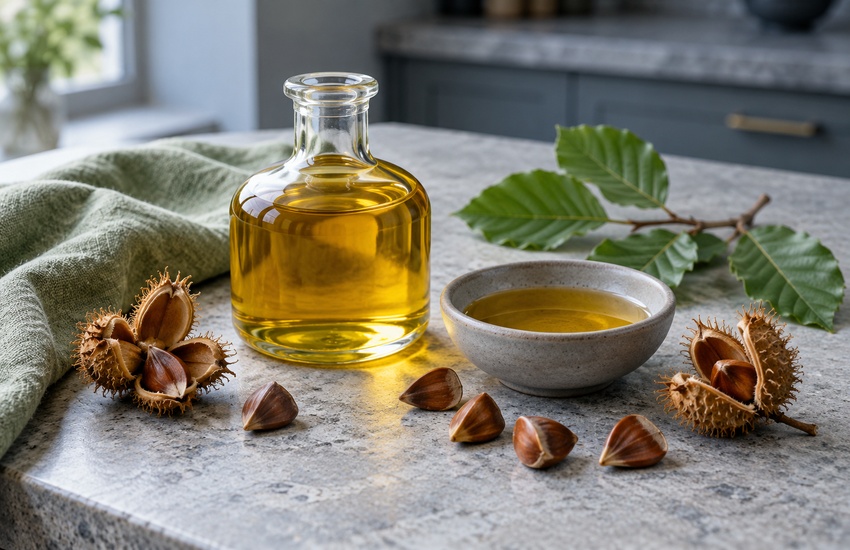
Beechnut oil has a long and, for such a modest raw material, surprisingly rich history. Nineteenth-century German encyclopaedias described it with real respect. Meyer's lexicon of the 1880s gives a characterisation that reads like a description of a modern premium oil: cold-pressed from shelled seeds it is almost water-clear, mild in flavour and odourless, while hot-pressed from unshelled seeds it is yellowish and sharp. That single remark contains the whole technology we will return to later.
War Years and Mass Harvests
Beechnut oil truly came into its own in times of scarcity. During the First World War, Germany had an official committee for oils and fats that issued leaflets on gathering and storing beechnuts. Appeals to the public at the time stated that 4-5 kilograms of oil could be obtained from 25 kilograms of nuts, and schools, teachers and whole villages were encouraged to take part. The leaflets also noted that beechnuts ripen in early to mid-October, that the empty seeds fall first and the best ones last, and that gathering should be done on dry days.
The harvests after the Second World War were on an even greater scale. The autumn of 1946 was a full mast year in many regions of Central Europe, and it coincided with a severe shortage of fats. Local chronicles from Hesse describe woods literally besieged by people from the surrounding area - they gathered by hand, swept the leaf litter and even climbed trees to shake the branches. The nuts were carried in baskets and sacks, by bicycle and handcart, to town oil mills where they could be exchanged for finished oil. In Vienna, crowds made their way into the Vienna Woods, and beechnuts were turned not only into oil but also into flour and coffee substitute. Authorities in some German states issued circulars openly encouraging people to gather beechnuts as a way of increasing their fat ration.
Local sources from those years also emphasise that beechnut oil was valued because it did not go rancid for a long time. It is an interesting observation, and we will come back to it when we look at its composition.
Pannage, Fasting and the Village Larder
Across Europe beechnuts had another long-standing use. In medieval and early modern times, villagers held the right of pannage - turning pigs out into the woods in autumn to fatten on acorns and beechnuts. In England's New Forest the practice survives to this day. Beechnuts were also pressed for oil wherever beech was common, and beechnut oil appears in old household manuals alongside linseed and rapeseed oil as an edible oil for fasting days, when animal fats were forbidden by the church calendar.
Over time, as rapeseed, sunflower and imported oils came to dominate the twentieth century, and industrial oil mills took over production, beechnut oil vanished from everyday use. It remained a curiosity for ethnographers and - increasingly - a treasure for wild food enthusiasts and small oil presses looking for something truly exceptional.
The Dark Side of the Nut - Why Raw Beechnuts Can Make You Ill
Anyone who ate a handful of raw beechnuts as a child may have discovered that they are not as innocent as they look. In larger amounts they can cause nausea, stomach ache and dizziness. In the past the blame was laid on a substance called fagin, believed to be an alkaloid. Modern research is more cautious about that name - the unpleasant effects are now attributed to a mixture of compounds found mainly in the shell and the brown skin around the kernel, including saponins, oxalic acid and tannins.
From the point of view of oil pressing, two observations matter here. First, most of these substances are water-soluble or remain in the solid fraction rather than in the fat, so they end up in the press cake rather than in the oil. Second, heat treatment markedly reduces their effect - which is why beechnuts intended for eating were always roasted, and why old oil mills often warmed the meal before pressing.
That second point has a practical consequence. Beechnut press cake, especially from unshelled, cold-pressed seeds, should not be fed thoughtlessly to every kind of animal. Old farmers knew that pigs and poultry tolerated it well, but horses could be sensitive to it. It is a reminder that the press cake of every raw material has its own character, and it is worth knowing before putting it to use.
From Leaf Litter to Press - Preparing Beechnuts for Pressing
Beechnuts are a temperamental raw material, and that is precisely what makes them so interesting. Everything we have learned about the tree matters here - from the uneven filling of the seeds to their structure.
Gathering and the First Sieve
The best time to gather is the second half of October, after the empty and early seeds have fallen and the finest part of the crop lies on the ground. Nuts are gathered by hand or onto sheets spread beneath the trees after gently shaking the lower branches. Rules on foraging vary from country to country and from one woodland to another - collecting for personal use is often permitted in public forests, but nature reserves, national parks and many protected beech woods forbid it, so it is worth checking before setting out with a sack.
After gathering, the first task is to separate the nuts from the cupules, leaves and twigs, then to remove the empty ones. The water test mentioned earlier works beautifully - full seeds sink, empty ones float. Just remember that after a soak the beechnuts must be dried very thoroughly.
Drying - the Key to the Whole Process
Freshly fallen beechnuts contain far more water than a screw press can accept. For most presses, including home models, the recommended moisture content of the raw material is below 10 percent. The nuts are therefore spread in a thin layer in a dry, airy place and turned daily for several weeks, or finished off at a temperature no higher than a few dozen degrees Celsius. Drying too quickly and too hot can scorch the kernel and give the oil a bitter edge.
Well-dried beechnuts rattle when shaken, and the kernel is brittle rather than rubbery when broken. Stored like this, in linen sacks and well away from rodents - which in a mast year are everywhere - they will keep through the winter.
Shelled or Unshelled - a Century-Old Dilemma
This brings us back to the remark in the old encyclopaedia. Oil from shelled seeds is paler, more delicate and more refined. Oil from whole seeds is darker and more assertive, with a noticeable bitterness and sharpness that comes from the shell and skin. Both versions have their devotees.
Shelling beechnuts is laborious, however, because the seeds are small and triangular and the shell clings tightly to the kernel. In the past they were run through stone mills set to a wide gap, which cracked the shells, and the mixture was then winnowed in the wind. Today you can use a mill with an adjustable gap or a simple roller crusher, and blow away the light shells with a stream of air.
Remember one thing that applies to screw presses in general. A certain amount of husk in the raw material is beneficial - it acts as a skeleton that lets the meal resist the screw and creates drainage channels for the oil. Fully shelled, very oily kernels can make a press extrude paste instead of firm, dry press cake. The best solution is often partial shelling - removing most of the shells but leaving some so the meal keeps the right structure.
Beechnuts in the Press Barrel - What Happens During Pressing
How do beechnuts behave in a screw press? Above all, they demand patience. The seeds are small, hard and irregular, so the first minutes of operation are often spent letting the press take hold of the material and build a stable plug of press cake at the nozzle.
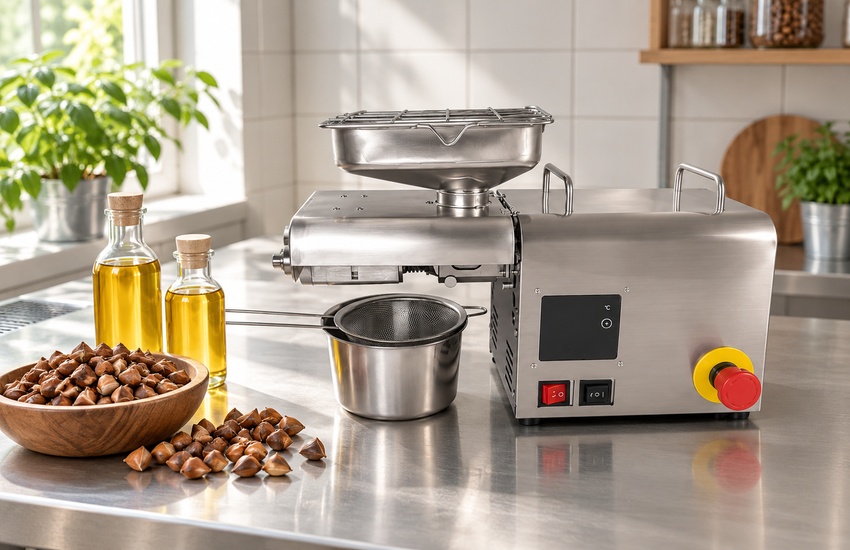
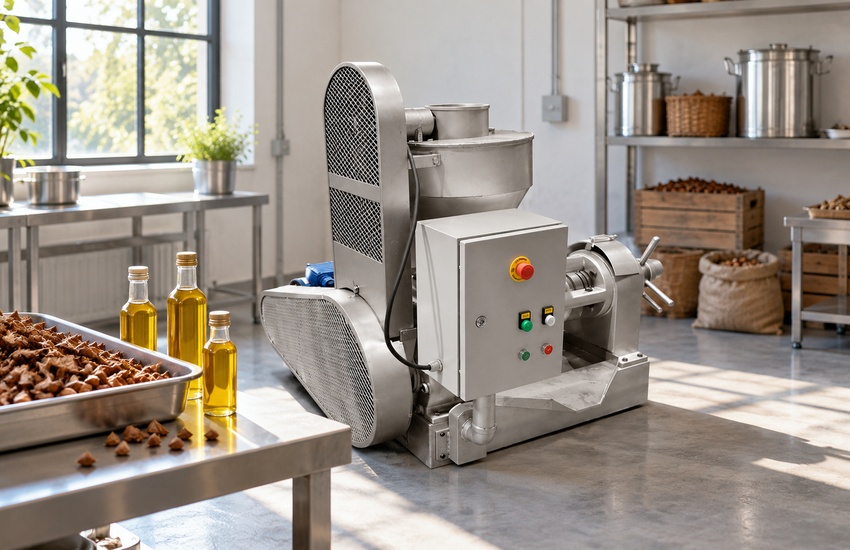
For home use, a compact home oil press for hot and cold pressing with an output of 5-7.5 kg/h works very well. Its adjustable heater lets you choose between cold pressing, with oil leaving the press at up to around 40 degrees Celsius, and warm pressing. This matters with beechnuts in particular - cold pressing gives a pale, mild oil, while gently warming the press head helps with unshelled nuts, eases start-up and reduces the effect of unwanted compounds. Beechnuts easily meet the requirement of at least 15 percent fat and moisture below 10 percent, provided they have been dried thoroughly. An output of a few kilograms an hour is ideal for a raw material gathered by hand - a hard-working day in a beech wood yields roughly as many nuts as a press like this can process in an afternoon.
First Drops and First Impressions
Freshly pressed beechnut oil is cloudy with a suspension of fine particles, and its colour depends on how much shell went in - from straw to golden brown. After a few days in a settling tank it clears and reveals its true character. The aroma is delicate and nutty, a little like freshly sliced bread, and in the unshelled version there is a distinct tannic note, similar to what we know from hazelnuts with their brown skins on.
The yield can be unpredictable. It depends on how many empty seeds were removed, how thoroughly the nuts were dried and how much shell went into the press. The old figures - a few kilograms of oil from a few dozen kilograms of beechnuts - reflect the reality of pressing whole seeds well. With partial shelling, the share of oil in the raw material rises because the ballast of the shell is gone.
A Larger Scale - a Community Harvest in a Mast Year
In a full mast year there can be a great many beechnuts, and the old collection drives show that whole villages could gather them by the tonne. If a rural association, a woodland trust or a local artisan producer wanted to repeat that experience today, they would need a machine of a different order. A continuous-duty screw oil press with a capacity of 3 tonnes per 24 hours is built with a three-stage pressing system and a 5.5 kW motor, designed to run around the clock, and the manufacturer notes that it gives the best results with seeds that keep their natural husk. That describes beechnuts pressed the old way, shell and all, with the shell helping to build the structure of the meal. A press like this could process an entire local harvest in a few autumn days - exactly as the old town oil mills did when queues of people with sacks lined up outside in 1946.
The Composition and Character of Beechnut Oil
Beechnut oil is dominated by unsaturated fatty acids. Oleic and linoleic acid lead the profile, while there is little alpha-linolenic acid - far less than in linseed oil or even rapeseed oil. That explains the observation in post-war chronicles that beechnut oil kept for a long time without turning rancid. Fewer polyunsaturated chains mean fewer points for oxygen to attack.
Natural antioxidants add to this - tocopherols and phenolic compounds, which are especially abundant in oil pressed from unshelled nuts. Paradoxically, then, what adds bitterness also adds shelf life. Old millers, without knowing the chemistry, knew perfectly well that oil "with the husk" survived the winter better in the larder.
Flavour in the Kitchen
In the kitchen, beechnut oil behaves like a delicate nut oil. The version from shelled seeds suits salads with bitter leaves - chicory, radicchio, rocket - roast beetroot and squash, and fresh cheese with herbs. The unshelled version, darker and sharper, works better with mushrooms, buckwheat, dark bread and game. It is a lovely culinary loop - the forest that gave us mushrooms and venison also gives us the oil to go with them.
Like most cold-pressed oils, beechnut oil tastes best raw or added at the very end to warm dishes. High heat strips it of what makes it interesting.
How to Taste Beechnut Oil
Tasting fresh beechnut oil is a pleasure in its own right and a good way to learn how the raw material shapes the final product. It is best to compare two samples side by side - one from shelled nuts, one from whole nuts. Pour the oil into small glasses, ideally dark ones, warm them in your hand for a minute and only then smell. Warmth releases volatile aroma compounds that remain imperceptible in cold oil.
The shelled version usually reveals an aroma of fresh nuts, a slight butteriness and something many tasters describe as dry leaves or hay. The unshelled version adds a toasted, earthy, sometimes faintly smoky note, and on the tongue a clear astringency that lingers for a few seconds. That astringency comes from tannins and phenolic compounds - the very same ones that protect the oil from oxidation.
Another worthwhile exercise is comparing oil from different trees or different years. Beechnuts gathered on a dry, sunny slope usually give oil with a fuller aroma than those from a damp valley floor, and nuts from a full mast year can be slightly smaller and less oily than those from a moderate year, because the tree spreads its resources across an enormous number of seeds. It is the same logic winemakers know well - quantity and concentration rarely go hand in hand.
It pays to keep a simple pressing notebook recording where the nuts were gathered, the date, drying method, degree of shelling, pressing temperature and tasting notes. After two or three seasons, such a notebook becomes an invaluable map of your own beech woods - you know which trees fruit best, where the nuts are oiliest and which press settings give the oil you like most.
Beechnut Press Cake - What Remains After Pressing
The press cake from beechnuts calls for caution, but it also offers interesting possibilities. Cake from shelled nuts is pale, crumbly and aromatic. Once roasted, it can be ground into flour and added in small amounts to bread or flatbreads - as was done in Vienna in the post-war years. Roasting is essential here, because it reduces the substances that cause discomfort in the raw seed.
Cake from whole nuts, dark and full of shell, is better suited as a modest, gradually introduced feed supplement for poultry and pigs, or as a compost ingredient. In gardening it is sometimes used as a mulch for plants that prefer slightly acidic soil, because as it breaks down it releases tannins and gently acidifies the ground.
Beechnuts as a Lesson in Humility for Anyone Who Presses Oil
Beechnuts teach things that apply to every raw material, but with them the lessons are especially clear. They teach that a seed is a living organism with its own strategy, not just a container of fat. They teach that moisture, structure and husk content matter as much as the amount of oil in the kernel. And they teach patience, because sometimes you have to wait several years for a good one.
There is something very beautiful in that. Rapeseed or sunflower oil can be pressed every year from a predictable harvest. Beechnut oil is like a fine wine from an exceptional vintage - it appears when nature decides that this is the year. And because it comes from the forest rather than the field, every bottle is a piece of a particular place - one beech wood in which, for one October afternoon, you could hear the patter of falling nuts.
If you come across a beech wood strewn with nuts this autumn, do not walk past. Gather a few kilograms, dry them patiently and give it a try. The first taste of pale, nutty oil from trees growing a few kilometres from your home can change the way you look at the forest.
Frequently Asked Questions
Is beechnut oil safe to eat?
Yes. Oil pressed from well-dried beechnuts was an ordinary edible oil in Central Europe for centuries. The compounds responsible for discomfort after eating large quantities of raw nuts are found mainly in the shell and skin, and most of them stay in the press cake. Gently warming the raw material before pressing further reduces their effect. As with any new food, it makes sense to start with small amounts.
When is the best time to gather beechnuts for oil?
Beechnuts usually ripen from early to mid-October, and the best seeds fall towards the end of this period, after an earlier drop of empty ones. In practice it is best to gather in the second half of October, on dry days, before wild boar, birds and rodents take the finest part of the crop.
How can I tell full beechnuts from empty ones?
The simplest method is the water test - full seeds sink, empty ones float. Empty nuts are also noticeably lighter and their shells give under the fingers. After the water test, beechnuts must be dried very thoroughly before they go into the press.
Do beechnuts need to be shelled before pressing?
Not necessarily, but shelling determines the character of the oil. Shelled seeds give a pale, mild oil; whole seeds give a darker, more assertive oil with a bitter edge. Screw presses like a certain amount of husk because it helps build the structure of the meal, so partial shelling is a good compromise.
Why don't beech trees fruit equally every year?
It is an evolutionary strategy known as masting. Trees across a large area synchronise their heavy years to overwhelm the animals that eat the seeds and to improve wind pollination. The signal for synchronised fruiting is weather, especially the temperature difference between consecutive summers, which affects how many flower buds form.
What kind of press is suitable for beechnuts?
For home pressing, a screw press with an adjustable heater is enough - one that allows both cold and warm pressing and can handle small, hard seeds. For larger quantities, such as a community harvest in a mast year, an industrial continuous-duty press designed for seeds with their natural husk is a better choice.
How long does beechnut oil keep?
Beechnut oil is relatively stable for a cold-pressed oil, because it contains little alpha-linolenic acid and plenty of natural antioxidants, especially when pressed from unshelled nuts. Once clarified, it is best kept in a dark, tightly sealed bottle in a cool place and used within a few months, while its aroma is at its fullest.