
Table of Contents
- The Tree That Poisons Its Neighbours
- What Does It Mean for an Oil to "Dry"?
- Oil Painting - the van Eyck Myth and the Caves of Bamiyan
- Boiled Linseed Oil - the Oil That Protects Wood
- Linoleum - a Floor Made of Oil
- Walnut Oil in the Kitchen - Beautiful and Fleeting
- Pressing Walnuts - How to Tame the Fattiest Raw Material
- Linseed Oil - the Drying Oil Benchmark
- A Small Experiment Worth Trying
- Frequently Asked Questions
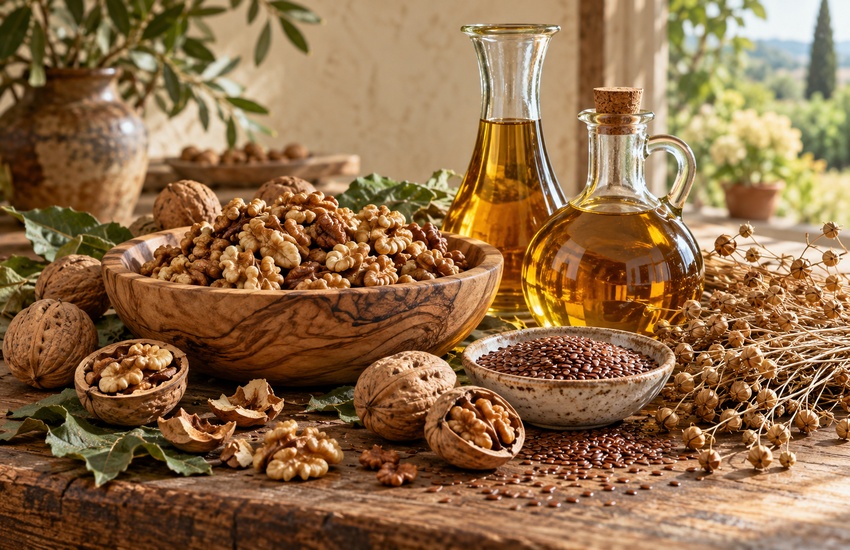
October is walnut month. The green husks split on the branches, the nuts drop into the grass, and anyone who has tried to peel them bare-handed knows they will walk around with brown fingers for the next week. In attics and airy sheds across Europe, walnuts dry spread out on paper, ready to go into cakes and festive dishes in November and December - and, increasingly, into the press.
Walnut oil has a secret, though, that most of us never think about as we drizzle it over a salad. Left in a thin layer in the open air, after a few days it stops being liquid. First it thickens, then it turns tacky, and finally it becomes a flexible, transparent film that can no longer be washed off with water or dissolved back into oil. This is not rancidity, though it has a great deal in common with it. It is the phenomenon that made possible the paintings of Leonardo da Vinci, Dutch still lifes, the protective finishes on wooden window frames and the floors our grandparents walked on.
We are talking about drying oils - a group of vegetable oils that form a solid film on contact with oxygen. They include linseed oil, walnut oil and poppy seed oil, and to a lesser extent hemp and grape seed oil. In this article we explain what actually happens inside a drop of oil as it "dries", why painters argued for centuries about which oil was best, and what all of this means for anyone who presses walnuts or linseed themselves.
The Tree That Poisons Its Neighbours
Before we get to the oil, it is worth pausing over the tree itself, because the walnut (Juglans regia) has some unusual properties. It originates in the mountains of Central Asia and reached Europe through the Persians, Greeks and Romans, who spread it throughout the Mediterranean. The Romans called it "Jupiter's acorn", which says a great deal about the esteem in which it was held.
The brown fingers you get from peeling walnuts are the work of juglone - a compound found in the green husk, the leaves and the roots. Juglone stains skin, but it has a more serious effect too. It is toxic to many plants, and the walnut releases it into the soil to suppress competition. That is why grass grows poorly under an old walnut tree, and why tomatoes or blueberries planted nearby can wither for no obvious reason. Botanists call this allelopathy - chemical warfare between plants.
The nut itself, or more precisely its kernel, is one of the fattiest raw materials you can put into a press. Fat makes up around two thirds of its weight. And it is a very special kind of fat.
What Does It Mean for an Oil to "Dry"?
The word "drying" is misleading when it comes to oils. Water evaporates from watercolour paint and the paint dries. A drying oil loses nothing - quite the opposite, it gains. A layer of linseed oil actually becomes heavier as it dries, because it absorbs oxygen from the air. Painters and chemists have long known that if you weigh a glass slide coated with oil, you can watch its mass increase by a few percent over several days before the process levels off.
Weak Links in the Chain
To understand what is going on, we need to look inside the fat molecule. Vegetable oil consists mainly of triglycerides - three fatty acid chains attached to a molecule of glycerol. These fatty acids differ in the number of double bonds they contain. Oleic acid has one, linoleic acid two and alpha-linolenic acid three.
The key lies in what happens between the double bonds. A carbon atom sitting exactly between two double bonds holds its hydrogen atoms unusually weakly. Oxygen from the air, or more precisely free radicals, can strip them off easily. Linoleic acid has one such site, linolenic acid two. That is why an oil rich in linolenic acid, such as linseed oil, reacts with oxygen far faster than an oil dominated by oleic acid, such as olive oil.
From Droplet to Network
When oxygen attacks a weak site, a radical forms, and then a peroxide. Peroxides are unstable and break down into new radicals that attack neighbouring molecules. A chain reaction begins. In oil sitting in a bottle, it ends with molecules breaking into small, volatile fragments with an unpleasant smell - that is rancidity. In a thin layer exposed to air, however, something more happens. The radicals start linking triglyceride molecules together with oxygen and carbon bridges.
Each triglyceride has three chains, and each chain can have several connection points. After a few days a three-dimensional network forms - a polymer in which millions of oil molecules are cross-linked together. Such a network does not flow, does not dissolve in oil and is flexible. Chemists call it linoxyn. It is the same material that forms the paint layer on old pictures, and it was the basis of linoleum.
The Iodine Value - a Thermometer for Drying
How can you tell whether an oil will dry? For more than a century, the iodine value has been used for this purpose. It measures the amount of iodine that 100 grams of oil can take up, and since iodine attaches to double bonds, the value tells you how unsaturated the oil is.
By the traditional classification, oils with an iodine value above roughly 150 are considered drying, those from about 100 to 150 semi-drying, and those below 100 non-drying. Linseed oil reaches values of about 170-200 and is the textbook drying oil. Walnut oil and poppy seed oil sit around 140-150, on the border between the two groups. Sunflower oil is semi-drying, rapeseed oil markedly less unsaturated, and olive oil, with an iodine value below 90, barely dries at all - which is why, since antiquity, it was an oil for lamps and the kitchen rather than for painting.
Oil Painting - the van Eyck Myth and the Caves of Bamiyan
For centuries it was repeated that oil painting was invented by the Flemish master Jan van Eyck in the early fifteenth century. The story was popularised in the sixteenth century by the Italian biographer of artists Giorgio Vasari and long passed for fact. The real history is older and far more interesting.
The World's Oldest Oil Paintings
In 2008, a team of scientists studying the murals in the caves of Bamiyan in Afghanistan, near the site of the famous Buddha statues destroyed in 2001, announced a surprising discovery. Analysis of samples using synchrotron radiation showed that some of the seventh-century murals had been made with oil-based binders. That was several hundred years before van Eyck and several thousand kilometres east of Flanders. Which oil the Buddhist painters used is not known for certain, but walnut and poppy oil, among others, were available in the region.
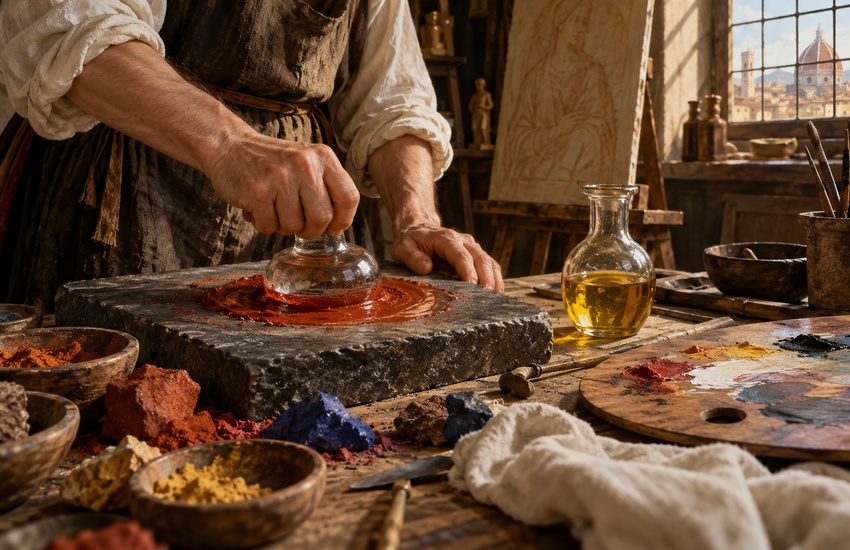
In Europe, drying oils were already described in the twelfth century by the monk Theophilus Presbyter in his treatise on the arts, which gave a recipe for preparing linseed oil for mixing with pigments. The problem was that oil paints of the time dried very slowly, and painters preferred the quicker technique of egg tempera. What van Eyck and his contemporaries achieved, then, was not so much inventing oil painting as perfecting the technique - preparing oil so it dried faster, and applying paint in thin, transparent layers that gave unprecedented depth and luminosity.
The Quarrel Between Walnut and Linseed
This is where the story begins to concern oil pressers directly. Flemish and Dutch painters used mainly linseed oil. Flax was common in northern Europe, and its oil dries quickly and forms a strong, flexible film. It has one drawback, however - it yellows over time. In paintings with blue skies and white robes, yellowing oil was a problem painters noticed within their own lifetimes.
Italians, especially in Tuscany and Lombardy, where walnut trees were common, often turned to walnut oil. It dries more slowly than linseed but yellows noticeably less, making it ideal for light passages, flesh tones and whites. Leonardo da Vinci is considered one of the artists who favoured walnut oil, and Renaissance workshop sources contain detailed instructions on preparing it. The most important of them sounds strikingly modern - before pressing, remove the brown skin from the kernels, because it is the skin that stains the oil and makes the painting darken over time.
Anyone who has pressed walnuts will confirm this observation. The brown membrane around the kernel is full of tannins and phenolic compounds that give the oil a darker colour and an astringent taste. The Renaissance painter and the modern oil presser are grappling with exactly the same problem, only for different reasons - one cares about the whites on the canvas, the other about a mild flavour.
Oil in the Sun
Painters also devised a way to improve the properties of their oils that some conservators and makers of artists' paints still use today. The oil was poured into shallow glass vessels, covered so that dust could not get in but air could, and set out in the sun for several weeks. The light bleached the pigments, and oxygen began a preliminary polymerisation. The result was a paler, thicker and faster-drying oil known as sun-thickened oil.
Another method was to heat the oil to a very high temperature without access to air. The molecules then link in a different way than during oxidation, and the oil becomes as thick as honey. This is how stand oil is made, prized for forming smooth, flexible films that yellow very little.
Poppy - the Painters' Third Oil
Alongside linseed and walnut, a third oil appeared in painters' studios, one with deep roots in Central European tradition. Poppy seed oil, pressed from tiny blue-grey poppy seeds, has an iodine value similar to walnut oil and is the palest of the classic drying oils. It hardly yellows at all, which is why in the nineteenth century it was the preferred medium for grinding lead and zinc whites and delicate blues.
Poppy has its price, though. It dries slowly, and the film it forms is less flexible than linseed. Paintings laid on thickly in pure poppy oil can, after some years, be covered in a network of fine cracks. That is why many painters combined the two - linseed for underpainting and dark passages, poppy for whites and the final, luminous layers.
In Central European cooking, from Poland and Czechia to Hungary and Austria, poppy seed oil was known for centuries as a fasting oil, especially around Christmas, when poppy seeds filled festive cakes, noodle dishes and sweet pastries. Freshly pressed poppy seed oil has a delicate, slightly sweet, nutty taste and was once a prized table oil. Today it is making a comeback in small oil presses, and pressing it is a reminder that the line between the painter's studio and the pantry was once very thin.
What Happens to Oil Over the Centuries
The cross-linked film of oil on a painting is not dead. Art conservators have spent years studying how it changes over the centuries, and they are discovering processes that resemble a slow chemical life. Free fatty acids, released from the triglycerides, react with metal ions in the pigments - lead from lead white or zinc from zinc white - to form what are known as metal soaps.
These soaps can gather into tiny lumps that eventually push through the surface of a painting like miniature eruptions. Under the microscope they look like grains of sand embedded in the paint. The discovery changed the way conservators look at old pictures - it turned out that some changes previously taken for dirt or mechanical damage are in fact the result of the chemistry of the oil itself, pressed centuries ago by some miller from linseed, walnuts or poppy seeds.
This perspective gives oil pressing a whole new dimension. A drop of oil from the press can land on a salad and disappear within minutes. But it can also land on a canvas and survive for half a millennium, changing slowly, layer by layer, in ways we still do not fully understand.
Boiled Linseed Oil - the Oil That Protects Wood
Painting is only one side of the story of drying oils. A far more widespread use, for centuries, was protecting wood. Boiled linseed oil - linseed oil cooked with metal compounds that speed up drying - was a household basic across Europe, in town and country alike. It was used on windows, doors, floors, furniture, tools and even wooden boats.
The added metals - formerly lead, later manganese and cobalt - act as catalysts. Metal ions speed up the breakdown of peroxides into radicals, so a chain reaction that takes several days in pure oil runs its course in boiled oil within a dozen or so hours. Hence the traditional "oil boiling" of old workshops, a craft in its own right that called for experience and considerable care.
Fire From a Rag
Drying oils carry a hazard that everyone who works with linseed or walnut oil should know about. Oil oxidation is a reaction that gives off heat. In a thin layer on a painting or a board, that heat dissipates at once. But a rag soaked in oil and crumpled into a ball is a completely different situation. A huge surface area of oil is in contact with the air inside the fabric, and the heat has nowhere to go. The temperature rises, and with it the rate of reaction, until eventually the rag can burst into flame on its own, without any spark.
Spontaneous combustion of rags soaked in linseed oil has caused many fires in joinery and painting workshops. That is why used rags from working with drying oils should be laid out flat on a non-combustible surface to dry, soaked in water, or stored in a sealed metal container. The same rule applies to cloths used in an oil pressing room to wipe down the press after pressing linseed or walnuts.
Linoleum - a Floor Made of Oil
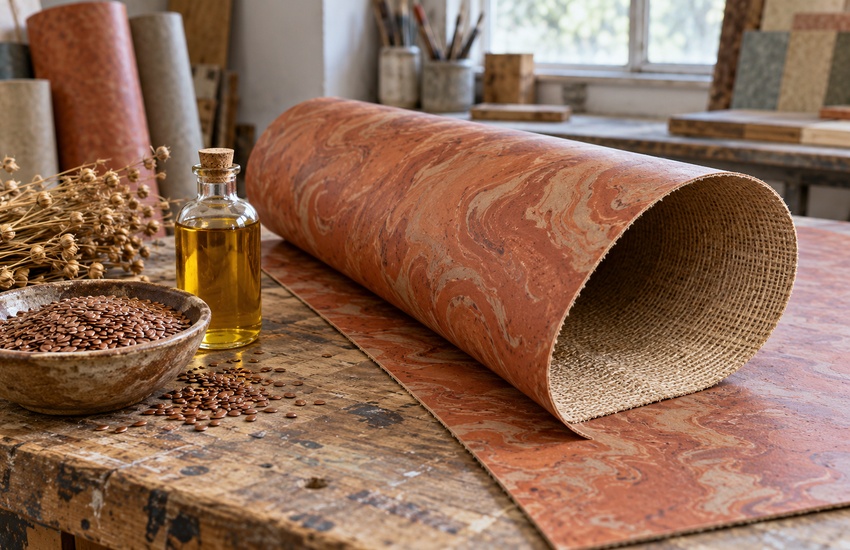
Perhaps the most surprising product of drying oils is linoleum. Its name gives away its origins - Latin linum means flax and oleum means oil. It was invented in the 1860s by the English inventor Frederick Walton, who noticed that a flexible, rubbery skin formed on the surface of a tin of oil paint. He decided to exploit the phenomenon on a large scale.
Walton oxidised linseed oil by spraying it onto suspended fabric or blowing air through it until it turned into a thick, elastic mass. He then mixed this with resins, cork or wood flour, fillers and pigments and pressed it onto a jute backing. The result was a durable material, warm to the touch, easy to clean and - as we would say today - fully biodegradable. For decades linoleum was one of the most popular floor coverings in Europe and beyond, and kitchens, schools, hospitals and ships were routinely laid with it.
Plastics later pushed linoleum aside, but in recent years it has enjoyed a revival precisely because it is made from renewable materials. Genuine linoleum still smells faintly of linseed oil, and its surface continues to oxidise and harden slowly for the first months after it is laid. It is a floor that is, quite literally, still drying.
Walnut Oil in the Kitchen - Beautiful and Fleeting
Let us return to walnuts and the kitchen. Walnut oil is one of the most aromatic of all edible oils. It has a delicate, buttery, slightly sweet taste with a distinct note of fresh nuts that goes beautifully with salads, goat's cheese, beetroot, pears, honey and baking. In France, in the Périgord region, it has been pressed for centuries, often from walnuts ground to a paste and gently warmed before pressing, which gives it a deeper, toasted character.
The same chemistry that made it valuable to painters, however, makes it a very unstable oil in the kitchen. Linoleic acid dominates decisively, and it also contains a noticeable amount of alpha-linolenic acid. An iodine value of around 140-150 means walnut oil readily reacts with oxygen - including in an opened bottle in the kitchen cupboard. A few weeks after opening it begins to lose its freshness, and after a few months it may taste distinctly rancid.
That is why walnut oil is best pressed in small batches, kept in the fridge in a dark, full bottle and used quickly. It is a seasonal oil in the best sense of the word - October walnuts, dried for a few weeks, give an oil that tastes its finest in winter.
An Oil for Boards and Bowls
An interesting practical use that links the kitchen with the world of drying oils is the care of wooden kitchenware. Walnut oil, as an edible oil with drying properties, has traditionally been used to treat wooden boards, bowls and spoons. It soaks into the wood, oxidises in its pores and forms a thin, water-resistant finish that is not sticky and does not go rancid the way non-drying oils do.
Sunflower or rapeseed oil are less suited to the job - they never fully polymerise, remain in the wood as a liquid, turn rancid over time and can give boards an unpleasant smell. It is yet another example of how fatty acid chemistry translates into everyday experience. People with nut allergies should of course choose a different product, such as raw linseed oil.
Pressing Walnuts - How to Tame the Fattiest Raw Material
Walnuts are a challenge for any screw press. Their kernels contain so much fat and so little fibre that under the pressure of the screw they turn into a smooth paste, rather like peanut butter. Such a paste offers no resistance, does not form a firm cake and tends to squeeze out through the gap together with the oil. Many press designs need a special screw with a different geometry for pressing nuts.
Preparing the Raw Material
Before walnuts go into the press, they must be thoroughly dried. Freshly gathered nuts contain a lot of water and need several weeks of drying in their shells in an airy place, and then a few more days once the kernels have been extracted. Damp kernels go mouldy and, in the press, give a cloudy oil with a lot of sediment.
The next decision concerns the skin. Kernels with their brown skin on give a darker, more astringent and - paradoxically - slightly more stable oil, because tannins and phenols act as antioxidants. Blanched, peeled kernels give a pale, mild, buttery oil that is more prone to oxidation. A Renaissance painter would choose the second option; cooks often prefer the first.
Many pressers also add a small amount of crushed walnut shell or another dry, fibrous material to the kernels. It acts as a skeleton that lets the meal resist the screw and creates drainage channels for the oil. It is an old trick that the millers of Périgord knew well.
Drying in the Attic in October
The way walnuts dry after harvest has a direct effect on the flavour of the oil. Nuts gathered from the ground should be cleaned of any remaining green husk as soon as possible, because juglone and moisture beneath it encourage mould and darken the shell. In the past walnuts were rinsed in water, and those that floated were set aside as incompletely filled or damaged by pests.
They are then spread in a single layer on racks or in shallow crates, somewhere dry, airy and shaded. Direct sun and high temperatures are best avoided, because they warm the oily kernel and start oxidation before the nut ever reaches the press. A well-dried walnut rattles slightly when shaken, and the kernel is brittle and crunchy rather than rubbery when broken.
A curious aside - freshly gathered, undried walnut kernels, known as wet walnuts, are a delicacy in their own right in France and Germany, eaten raw once peeled of their bitter skin. They are entirely unsuitable for pressing, though. Too much water creates an emulsion in the press, and the oil is cloudy and spoils quickly. A few weeks of patient drying matter as much as the press itself.
A Press Built for Demanding Raw Materials
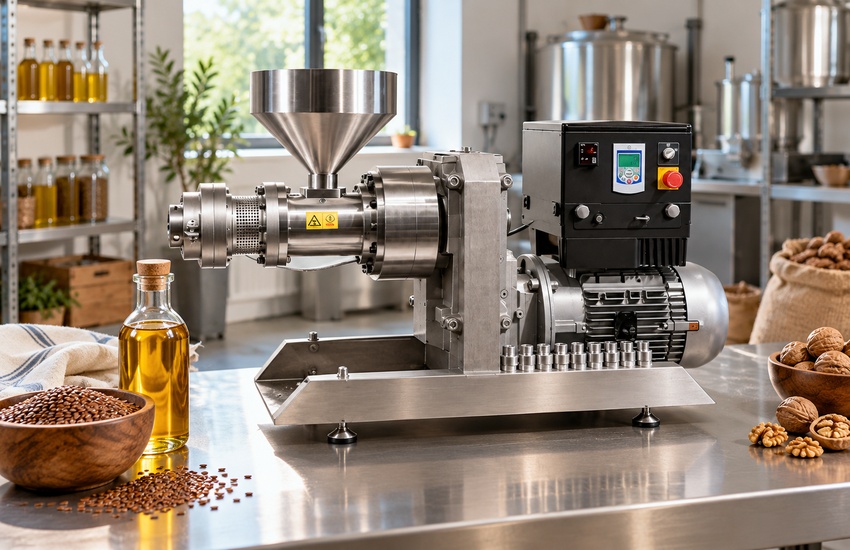
This is where the design of the machine really counts. For small producers working with nuts, a hot and cold oil press with a capacity of up to 25 kg/h in stainless steel offers the kind of control that pasty, oily walnut meal demands. A heated press head lets you choose between gentle cold pressing, which preserves the fresh, buttery aroma, and light warming in the Périgord style, which gives a deeper, toasted character. A stainless steel construction makes a real difference with a raw material that leaves behind so much oily residue, because the parts that touch the meal can be cleaned thoroughly between batches - essential with an oil that turns rancid as readily as walnut oil does.
Linseed Oil - the Drying Oil Benchmark
No story of drying oils would be complete without linseed oil. For centuries it was Europe's most important technical oil, and its properties shaped the look of European painting, architecture and interiors. To this day, makers of artists' paints, wood finishes and natural floor coverings seek out high-quality linseed oil - cold-pressed, clean and made from well-ripened seed.
For producers who want to make linseed oil for technical and conservation purposes - supplying restoration studios, joiners, painters or manufacturers of natural linoleum - scale and continuous operation become crucial. This is where a continuous-duty screw oil press with a capacity of 3 tonnes per 24 hours comes into its own, with a three-stage pressing system and a 5.5 kW motor built to run around the clock. Linseed with its natural husk is an ideal raw material for it, since the manufacturer states that it gives the best results with seeds that keep their husk, and residual oil in the cake of up to 8 percent means most of the fat is recovered from the seed. Linseed cake, rich in protein and mucilage, has valued uses of its own as animal feed.
What Separates Edible From Technical Linseed Oil
Many people are surprised to learn that linseed oil for painting and linseed oil for eating are essentially the same product at the start of their journey. Both are made by pressing flaxseed. They differ in what happens next. Edible oil must be as fresh as possible, protected from light and oxygen, kept in the fridge and used quickly - its whole value lies in not oxidising. Technical oil is often deliberately exposed to oxygen, light or high temperatures to accelerate polymerisation - its value lies in oxidising as well as possible.
It is a beautiful illustration of how the same molecule can be a virtue for some and a flaw for others. The three double bonds of alpha-linolenic acid make linseed oil valuable in the diet and at the same time make it go rancid so quickly. Those same three double bonds made European oil painting possible and covered millions of kitchen floors with linoleum.
A Small Experiment Worth Trying
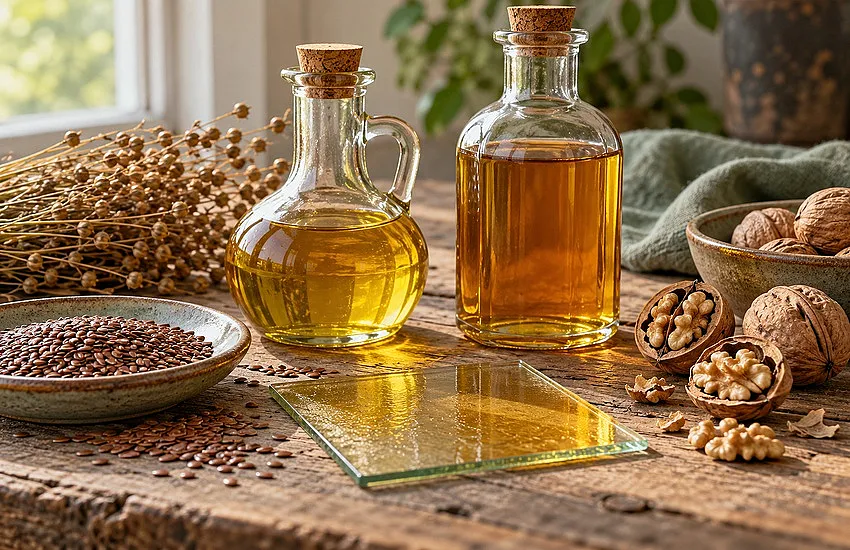
If you press oil, you can easily see the difference between drying and non-drying oils with your own eyes. All you need are three glass plates or pieces of glass from old picture frames, a small brush and three oils - linseed, walnut and rapeseed or sunflower. Brush a thin layer of each oil onto its own plate and leave them somewhere bright and airy, away from dust.
After a few days the linseed oil will already be tacky and matt, and after a week it will have turned into a hard, flexible film. The walnut oil will dry more slowly, but after a couple of weeks it too will form a film, paler and more transparent than the linseed. The rapeseed or sunflower oil will still be greasy and sticky after the same time, and will eventually start to give off the smell of rancid fat. This simple experiment works wonderfully at oil pressing workshops or in a science lesson - it shows that oils that look alike in the bottle have completely different personalities.
Frequently Asked Questions
What are drying oils?
Drying oils are vegetable oils rich in polyunsaturated fatty acids, mainly linoleic and alpha-linolenic acid, which polymerise on contact with oxygen in the air and form a solid, flexible film. The most important are linseed oil, walnut oil and poppy seed oil.
Why does walnut oil go rancid so quickly?
Walnut oil contains a lot of linoleic acid and a noticeable amount of alpha-linolenic acid. These fatty acids have sites in their chains from which oxygen can easily strip hydrogen atoms, setting off a chain reaction of oxidation. That is why walnut oil is best kept in the fridge in a dark bottle and used within a few weeks of opening.
Can walnut oil be used for painting?
Yes. Walnut oil has been used by painters since the Middle Ages, especially in Italy. It dries more slowly than linseed oil but yellows less, which is why it was prized for light passages, flesh tones and whites. For artistic use, oil from kernels peeled of their brown skin works best.
What is the iodine value of an oil?
The iodine value measures how unsaturated an oil is - the number of grams of iodine that 100 grams of fat can take up. The higher the iodine value, the more double bonds there are in the fatty acids and the faster the oil dries. Linseed oil has an iodine value of about 170-200, walnut oil about 140-150 and olive oil below 90.
Can a rag soaked in linseed oil catch fire?
Yes. The oxidation of drying oils gives off heat, and in a crumpled rag that heat cannot escape. The temperature rises until the rag ignites spontaneously. That is why rags used with linseed or walnut oil should be laid flat to dry, soaked in water or kept in a sealed metal container.
How do you press walnuts in a screw press?
Walnuts must be thoroughly dried, and their kernels are so oily that they easily turn into paste. It helps to add a small amount of dry, fibrous material, choose the right nozzle and control the temperature of the press head. Many presses need a dedicated nut screw, and a stainless steel press that is easy to clean is a big advantage with such an oily raw material.
Where does the name linoleum come from?
The name linoleum comes from the Latin words linum, meaning flax, and oleum, meaning oil. The material was invented in the 1860s by Frederick Walton, who oxidised linseed oil, mixed it with resins, cork flour and pigments, and pressed it onto a jute backing.