
Table of Contents
- Halloween Began With a Turnip
- Winter Evenings Over the Seeds
- What Actually Changed in the Seed
- Thirty Pumpkins to a Litre
- The Traditional Method - Grinding, Kneading, Roasting
- The Oil That Changes Colour
- Pumpkin Seeds in a Screw Press
- The Composition of Pumpkin Seed Oil - a Few Surprises
- How to Judge Good Pumpkin Seed Oil by Your Senses
- A Taste of Styria - the Oil in the Kitchen
- Naked-Seeded Pumpkins in Your Own Garden
- What Remains After Pressing
- A Lantern That Could Have Been a Bottle of Oil
- Frequently Asked Questions
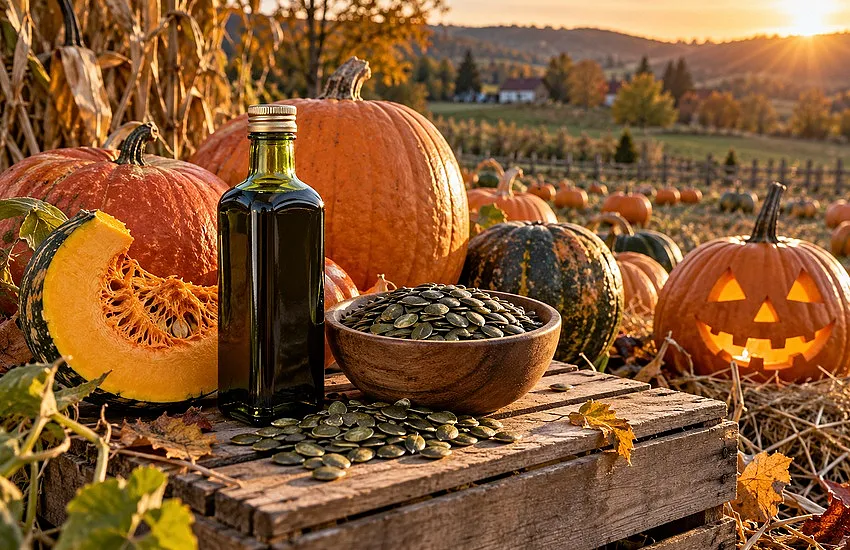
The last day of October belongs to the pumpkin. We carve eyes and jagged grins into it, set a candle inside and put it on the windowsill, while the insides - the flesh and the seeds - all too often end up in the bin. It is a small irony, because inside this autumn lantern lies one of the most remarkable oil raw materials in the world. Pumpkin seeds yield an oil of a colour no other edible oil possesses, with an aroma of roasted nuts and a history that begins with a quirk of nature in a small Austrian village.
We are talking about the Styrian oil pumpkin, a variety whose seeds have no hard white shell. That single trait, caused by a change in one gene, turned pumpkin seed oil from a regional curiosity into the emblem of an entire region. It has its own protected geographical indication, and for the people of south-eastern Austria it is what olive oil is to Italians. In this article we explain how that happened, what actually changed inside the seed, why Styrian oil is as green as a leaf, and what happens to pumpkin seeds inside a screw press.
Halloween Began With a Turnip
Before we turn to the oil, a short digression that shows how recent a newcomer the pumpkin is in Europe. The Irish custom of carving lanterns with faces, which gave rise to today's Halloween pumpkins, originally had nothing to do with pumpkins at all. People carved turnips, swedes and beets - whatever vegetables were at hand. It was Irish emigrants in North America who discovered that the large orange fruits growing there were far better suited to the job.
The common pumpkin (Cucurbita pepo) comes from the Americas. Its domestication began in Mexico around ten thousand years ago, making it one of the oldest crops in the world - older than maize. Interestingly, the first farmers probably did not grow it for its flesh, which in wild forms was thin and bitter. They grew it for its seeds - nutritious, oily and delicious once baked. You could say the pumpkin was an oilseed crop before it ever became a vegetable.
The pumpkin reached Europe in the sixteenth century, after the voyages of Columbus, and quickly spread through gardens from Spain to Hungary. In Styria, a region in the south-east of present-day Austria, it was grown as fodder for cattle and pigs, and its seeds were pressed for oil. The problem was that the seeds had to be shelled first - by hand, one at a time.
Winter Evenings Over the Seeds
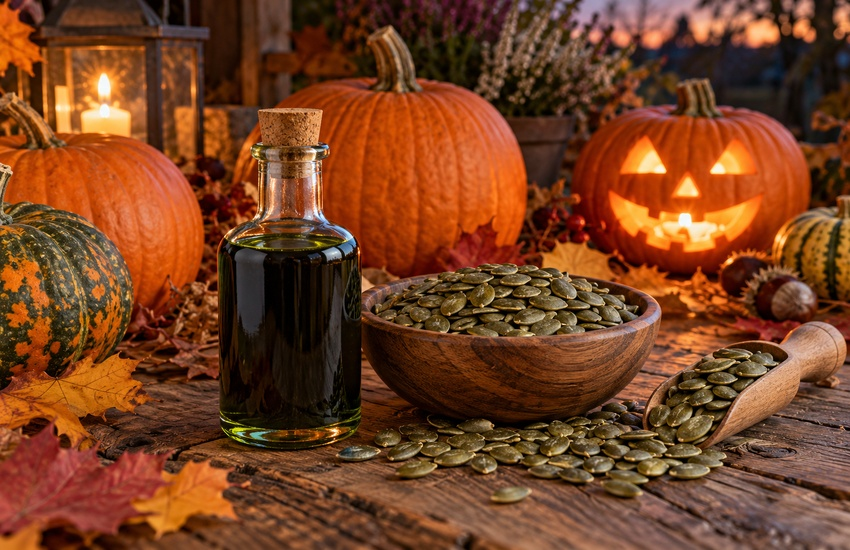
An ordinary pumpkin seed, the kind we know from the Halloween lantern, has a hard white or cream-coloured shell. Beneath it lies a flat green kernel that holds almost all of the fat. The shell is lignified, thick and rigid, and it clings tightly to the kernel. If such seeds were fed into a press whole, the shell would soak up a good share of the oil and give it an astringent, woody taste.
Styrian farmers dealt with this in the only way available. On long winter evenings, whole families sat around the table shelling seeds by hand. It was tedious, monotonous and slow work, yet it was woven into the rhythm of the year - much like plucking feathers or shelling beans in other parts of Europe. A few kilograms of kernels made a litre of oil, a precious store for the whole winter.
The Accident That Changed Everything
Some time between 1870 and 1880, a pumpkin appeared in a Styrian field whose seeds looked different. They had no white shell. Instead, the kernel was wrapped only in a thin, dark green membrane through which the inside showed. Someone - history has not preserved the farmer's name - noticed that such seeds did not need shelling. They could be dried, ground and pressed straight away.
It was a spontaneous mutation in a single gene, and a recessive one at that. This detail matters. A recessive trait only appears when a plant inherits the altered gene from both parents. If a pumpkin with naked seeds was pollinated by an ordinary pumpkin from the next field, the trait would vanish in the following generation. Styrian farmers therefore had to deliberately select seed from the fruits that produced green seeds and gradually build a population in which the change was fixed. Generations that had spent their winter evenings shelling understood perfectly what a gift this was.
The process took a long time. The first reports of growing naked-seeded pumpkins appear only after the First World War. In 1940 systematic work to increase oil content began at the Lamberg breeding station, and after the war further varieties followed - including a bush form developed by the Viennese professor Tschermak by crossing the vining Styrian pumpkin with a compact, short-vined squash. The first Austrian oil pumpkin variety based on local material, Gleisdorfer Ölkürbis, was registered in 1970 and remains one of the most widely grown to this day.
What Actually Changed in the Seed
To understand what the mutation did, we need to look inside the shell. The seed coat of a pumpkin consists of several layers of cells. In an ordinary seed, the outer layers fill with lignin as they mature - the same polymer that gives wood its hardness. Lignin is what makes the shell hard, white and impermeable.
In the Styrian pumpkin, lignification simply does not happen. The layers of the seed coat form but remain thin and soft. All that is left is a delicate membrane, and beneath it you can see the innermost layer of the seed coat, which contains pigments. That is why Styrian pumpkin seeds are dark green, almost olive, rather than white. The colour does not come from the kernel itself but from this thin, pigmented layer, which in a normal seed is hidden under the shell.
Geneticists searched for decades for the exact location of this change in the pumpkin genome. In recent years several research teams have narrowed it down to a specific region of one chromosome and to genes involved in lignin synthesis. It is a fine example of how modern molecular biology can explain something Styrian farmers exploited intuitively a century and a half ago.
Why Naked Seeds Are Better for Pressing
From the oil presser's point of view, the absence of a shell has several consequences. First, almost the entire mass of the raw material is kernel, which contains around half its dry weight in fat. The latest Austrian varieties reach an oil content of 46-48 percent. Second, there is no ballast to soak up oil in the press. Third - and most intriguingly - the pigments from the thin membrane pass into the oil and give it its characteristic deep colour.
There is a price, however. Naked seeds are far more delicate than shelled ones. They oxidise more easily, absorb moisture faster and are prone to mould. They also lack the natural structure that helps a screw press build a firm cake. More on that shortly.
Thirty Pumpkins to a Litre
Styrian pumpkin seed oil has a number every local knows. A litre of oil requires around 2.5 kilograms of dry seed, which corresponds to roughly 30-40 pumpkins. A ripe oil pumpkin typically weighs 8-10 kilograms, so several hundred kilograms of fruit yield barely a bottle of oil. That simple arithmetic explains why pumpkin seed oil has always been treated with respect.
Harvest takes place in autumn, usually from September to October, when the leaves have withered and the fruits lie in the field, yellow-orange with green stripes. In the past they were split by hand and the seeds picked out with fingers. Today machines do the work, travelling across the field, crushing the pumpkins and extracting the seeds from the flesh, while the rest of the fruit is left behind as fertiliser. The sight of an autumn Styrian field covered in smashed orange pumpkins surprises visitors - it looks as if someone has staged a gigantic vegetable fight.
A Race Against Time
Freshly extracted seeds are wet and sticky with remnants of flesh, and their moisture content runs to several tens of percent. They must be washed and dried very quickly, ideally the same day, because in a warm, damp mass moulds and bacteria can start to develop within hours. They are dried in warm air down to a moisture content of a few percent, at which they are stable and suitable for storage and pressing.
This is one of the moments when the quality of the oil is decided long before it reaches the press. Seeds dried too slowly at too low a temperature can turn musty, and those dried too hot can scorch on the surface and give a bitter oil. Well-dried seeds are hard and brittle, have a clean dark green colour and smell fresh and slightly grassy.
The Traditional Method - Grinding, Kneading, Roasting
Classic Styrian pumpkin seed oil is made by a process that is part kitchen and part craft. The dried seeds are ground into a coarse meal, which is then kneaded with a little water and salt into a moist, pliable mass. This mass goes into large flat pans fitted with stirrers, where it is roasted for several tens of minutes. In small family oil mills the roasting is still sometimes done over a wood fire.
Roasting is the heart of the whole process. At elevated temperatures, Maillard reactions between sugars and amino acids produce pyrazines, furans and dozens of other volatile compounds responsible for the aroma of roasted nuts, bread and a faintly caramel sweetness. At the same time, the proteins in the mass coagulate and the cells rupture, making it easier to release the oil. The water added during kneading evaporates, and its presence ensures the mass roasts evenly and does not burn.
The hot mass then goes into a press, traditionally hydraulic, where under enormous pressure it gives up a thick, dark oil. The oil is settled, filtered and bottled. Since 1996, the original product from the designated region of Styria has carried a European protected geographical indication, and passing off imitations as the real thing is treated in Austria as serious fraud.
The Oil That Changes Colour
Anyone who has seen pumpkin seed oil in a glass bottle knows its strange property. Held up to the light in a thin layer, it is green. In a thick layer or a dark bottle it looks almost black or deep red. Spread thinly on a plate it is bright green again, and swirled into yoghurt it leaves jade-coloured streaks. This phenomenon is called dichromatism, and it arises because the pigments in the oil absorb light in such a way that the colour we see depends on the thickness of the layer.
The colour comes mainly from protochlorophyll and protopheophytin - precursors and derivatives of chlorophyll from the green membrane around the seed - together with carotenoids that add yellow and red tones. It is a direct consequence of the mutation. Oil from shelled seeds contains far fewer of these pigments, because the green layer is hidden beneath the lignified shell and removed along with it.
A Stain the Sun Removes
The pigments also come with a practical piece of household lore that every Styrian cook knows. Pumpkin seed oil leaves stains on fabric that are very hard to wash out in the usual way. The best remedy turns out to be sunlight. Hang the stained item in full light, and the pigments gradually break down until the stain fades.
The same property is why the oil must be protected from light. Chlorophyll pigments are photosensitisers - they absorb light energy and pass it to oxygen, which then attacks the fatty acids. That is why pumpkin seed oil, despite being rich in antioxidants, is always kept in dark bottles, somewhere cool and away from the window.
Pumpkin Seeds in a Screw Press
The traditional method of roasting and hydraulic pressing is not the only way. Pumpkin seeds can be pressed very successfully in a screw press - both cold and with heat. The two approaches give completely different oils, and comparing them is one of the most fascinating lessons for anyone interested in pressing.
Cold-Pressed - an Oil Styria Does Not Know
Oil from raw pumpkin seeds pressed cold is lighter, greener rather than reddish-brown, and its aroma recalls fresh seeds, grass and cucumber. There are no roasted notes, but a delicate sweetness and a light bitterness come through more clearly. It has its devoted followers, although to a Styrian it is something quite different from "real" pumpkin seed oil.
Naked seeds need attention in the press, though. They are very oily and have no shell to give the meal structure. With too wide a nozzle, the press may push the mass out instead of building a firm cake. That is why the ability to change nozzles and control the temperature of the press head is so important. Adding a small proportion of shelled-type seeds, or warming the press head for a few minutes before starting, also helps.
With Heat - Closer to Tradition
Pressing with a heated head, especially using seeds lightly roasted in a pan beforehand, brings you closer to the character of Styrian oil. The aroma becomes fuller, nutty and bready notes emerge, and the colour deepens. Higher temperature also helps the oil flow more freely, and the cake comes out drier and more compact.
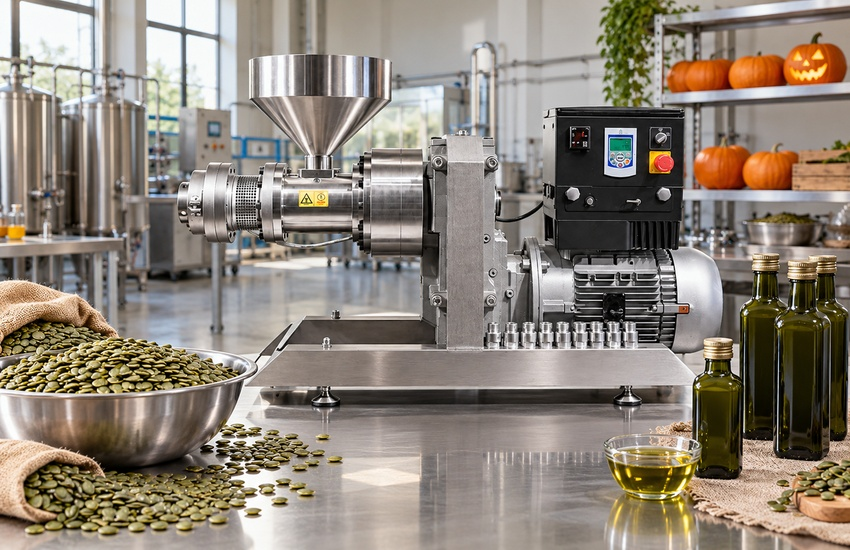
For small-scale producers and farm shops, a robust hot and cold oil press with a capacity of up to 25 kg/h in stainless steel is a natural fit for this kind of work. With pumpkin seeds, controlled heating of the press head is a real advantage, because it lets you hold precisely to the line between a cold-pressed oil and one with a more roasted character, and a stainless steel build makes cleaning far easier after working with such an oily, sticky raw material. A throughput of this order means a whole autumn harvest from a few hectares of oil pumpkins can be processed within days of drying - while the seeds are still at their freshest.
For those who first want to find out what oil from their own garden pumpkins tastes like, a home oil press for hot and cold pressing with an output of 5-7.5 kg/h is the ideal starting point. Pumpkin seeds are among the raw materials the manufacturer lists as suitable, and the adjustable heater lets you move from gentle cold pressing to warm pressing. Given that it takes 30-40 pumpkins to make a litre of oil, the harvest from a backyard patch is exactly the scale such a press handles best - a few kilograms of seed in about an hour.
Clarifying the Green Oil
Freshly pressed pumpkin seed oil is thick and opaque, full of fine particles of meal that give it a matt, dark appearance. In traditional Styrian oil mills it is left undisturbed for several days until the suspension settles to the bottom. With pumpkin, this sediment is unusually abundant, because naked seeds have no shell, which in other seeds acts as a natural filter and holds some of the particles back in the cake.
Settling is best done somewhere cool and dark. Cold slows oxidation, and darkness protects the pigments from the breakdown we saw with stains on fabric. After a few days the clear oil is gently decanted off the sediment without stirring, and only then filtered if necessary. The sediment need not be wasted - it is a thick, aromatic paste that can be added to bread, sauces or vegetable pâtés.
After working with pumpkin seeds, the press must be cleaned thoroughly, because the oily green meal quickly coats the screw and the inside of the head. A good habit is to run a small batch of a drier, less oily raw material - such as rapeseed or sunflower - through the press at the end, which pushes out the remaining pumpkin mass and makes dismantling easier.
The Composition of Pumpkin Seed Oil - a Few Surprises
At first glance, the fatty acid profile of pumpkin seed oil is unremarkable. Linoleic acid dominates, usually making up around half, with oleic acid in second place. There is very little alpha-linolenic acid. The real curiosities lie in the minor components.
Gamma-Tocopherol and Sterols That Break the Pattern
Pumpkin seed oil is rich in vitamin E, but in an unusual form. Instead of alpha-tocopherol, which dominates in sunflower oil, it contains mainly gamma-tocopherol - in the best oils up to several hundred milligrams per kilogram. Gamma-tocopherol is a particularly effective antioxidant within the oil itself, which partly offsets the effect of the photosensitising pigments.
The plant sterols are even more interesting. Most edible oils contain phytosterols with a double bond in a particular position in the molecule, such as beta-sitosterol. Plants of the gourd family, however, produce sterols with a slightly different structure, with the double bond shifted to another position in the ring. They are so characteristic that laboratories checking the authenticity of Styrian oil use them as a kind of fingerprint. If someone stretches an expensive pumpkin seed oil with cheaper sunflower oil, the sterol profile gives it away immediately.
Minerals and Unusual Body
Pumpkin seed oil also contains surprisingly large amounts of minerals for a fat - sodium, potassium, magnesium, calcium and phosphorus have been detected in it, along with traces of selenium. They come from solid particles and phospholipids that pass into the oil during pressing. This is one of the reasons the oil is thick, slightly viscous and has a pronounced body in the mouth.
How to Judge Good Pumpkin Seed Oil by Your Senses
Before you start comparing your own oil with a shop-bought one, it is worth knowing what to look for. Pumpkin seed oil lends itself exceptionally well to tasting, because its faults and virtues are so distinct.
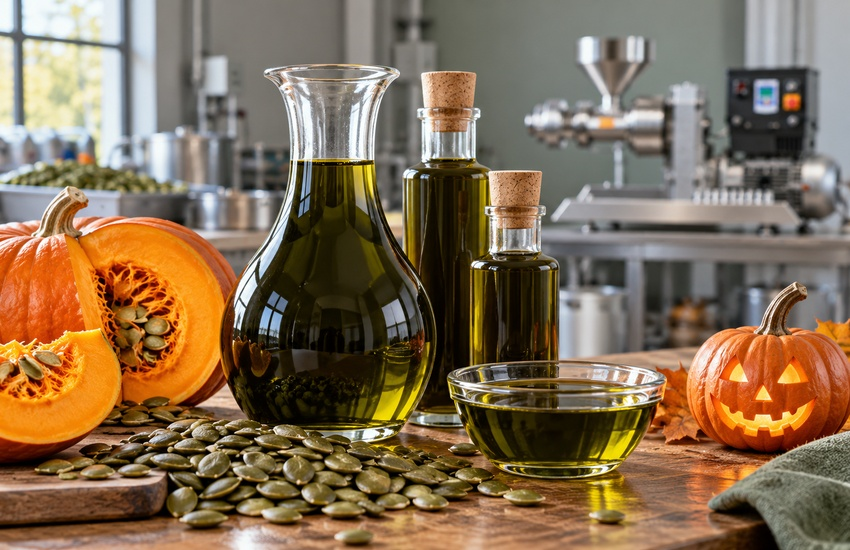
The first test is colour in a thin layer. A drop spread on a white plate should be a clean, intense green with a faintly yellowish tinge at the edges. A brownish, dull colour may indicate over-roasting, or that the oil has been exposed to light for a long time and its pigments have begun to break down. A markedly paler, almost straw-coloured tone suggests the oil may have been blended with another oil or comes from shelled seeds.
The second test is aroma. A good roasted oil smells of nuts, dark bread, sometimes a hint of coffee or cocoa. A cold-pressed oil smells of fresh seeds and greenery. Notes of burning, bitter smoke or a musty cellar signal that something went wrong - in roasting, or earlier, in drying. A smell of paint, glue or stale nuts means the oil has begun to go rancid.
The third test is taste and texture. Pumpkin seed oil is thick, coats the tongue and leaves a long, nutty finish. A slight bitterness at the end is natural but should not dominate. Emulsion is another good check - whisk the oil with cider vinegar in roughly a three-to-one ratio, and you should get a thick, matt dressing of an olive-brown colour that does not separate immediately.
What About Ornamental Pumpkins?
The seeds from Halloween pumpkins are not worthless. Once scooped out, rinse them, pat them dry and roast them in the oven with a pinch of salt - a classic snack that is itself a small lesson in how heat transforms the aroma of seeds. They are less suited to pressing, because the hard shell makes up a large part of their mass and absorbs oil, but they work very well as a "structural" addition to naked oil pumpkin seeds. Adding ten to fifteen percent of shelled-type seeds to the raw material helps the press build a firm cake and stabilise, especially at the start of a run. It is a nice way to let the Halloween lantern contribute to an autumn bottle of oil.
A Taste of Styria - the Oil in the Kitchen
In Styria, pumpkin seed oil is above all an oil to use raw. Nobody fries with it, because high heat destroys its aroma and turns it bitter. Instead it is added to almost everything served cold, or hot straight off the stove.
The most famous dish is a salad of large scarlet runner beans dressed with cider vinegar and pumpkin seed oil, with a little onion. Equally classic are potato salads and green salads in which the oil and vinegar combine into an emulsion of unmistakable green-brown colour. The oil goes into pumpkin and potato soups, scrambled eggs, herbed fresh cheese and roast root vegetables.
The real surprise for visitors, however, is vanilla ice cream drizzled with pumpkin seed oil and scattered with roasted seeds. It sounds odd, but it works beautifully - the sweetness of the vanilla and the chill of the ice cream bring out the oil's nutty, slightly bitter aroma, and the dark green streaks on a white background look like a work of art. It is worth trying at least once, ideally in autumn, when the oil is at its freshest.
Naked-Seeded Pumpkins in Your Own Garden
The good news for pressing enthusiasts is that the naked-seeded oil pumpkin grows well across most of temperate Europe and in many other temperate regions. It needs a warm, sunny spot, fertile soil and moderate water - not unlike the conditions of Styria, where annual rainfall is relatively modest. Seed of naked-seeded varieties is available from seed suppliers and can be sown outdoors once the risk of frost has passed.
Growing them has one catch worth knowing, and it follows directly from the genetics described earlier. The naked-seed trait is recessive, and pumpkins cross easily, because bees and bumblebees pollinate them as they move from flower to flower. If ordinary pumpkins or courgettes - which belong to the same species - grow nearby, seeds saved from an oil pumpkin may produce plants with ordinary hard-shelled seeds next year. If you want to save your own seed for the following season, grow your oil pumpkins away from other varieties or buy fresh seed each year.
What Remains After Pressing
Pumpkin seed press cake is one of the most valuable by-products in the oil world. It is very rich in protein - in the defatted mass the protein content can exceed half - and it has a pleasant nutty taste and a beautiful green colour. Ground, it makes a protein flour that can be added to bread, pasta, smoothies or breadcrumb coatings. In Styria the cake is also used as animal feed and as an ingredient in cakes.
Cake from cold-pressed seeds is paler with a milder flavour, while cake from warm pressing is darker and more toasted. Both are best ground right after pressing and stored in an airtight container somewhere cool, because the residual oil in the cake oxidises over time.
A Lantern That Could Have Been a Bottle of Oil
Let us return, finally, to the Halloween pumpkin on the windowsill. Most pumpkins sold for Halloween are ornamental varieties with thick-shelled seeds, bred for colour and shape rather than seed. Their seeds can still be roasted and eaten, and even pressed - although the oil will be different from Styrian oil, and the shell will claim a good share of it.
But the story of the Styrian oil pumpkin reminds us of something more important. The plants we grow are the result of thousands of small decisions by farmers who noticed something unusual and chose to keep it. Some Styrian farmer at the end of the nineteenth century looked at a green seed without a shell and did not throw it away. Thanks to that, today we can enjoy an oil that changes colour with the depth of the layer, smells of roasted nuts and turns a simple bean salad into a small celebration.
So if you have pumpkins in the garden this October, take a look inside before you carve your lanterns. You may be holding the first step towards your own bottle of green gold.
Frequently Asked Questions
How does the Styrian pumpkin differ from an ordinary pumpkin?
The Styrian pumpkin is a variety of the common pumpkin whose seeds have no hard, lignified shell. Instead, the kernel is wrapped in a thin, dark green membrane. This trait results from a spontaneous mutation in a single recessive gene that appeared in Styria in the late nineteenth century and was fixed by farmers through selection.
Why is pumpkin seed oil green?
The colour comes from pigments in the thin membrane around the naked seeds, mainly protochlorophyll and protopheophytin, complemented by carotenoids. Depending on the thickness of the layer, the oil looks green or deep red, a phenomenon known as dichromatism.
How many pumpkin seeds does it take to make a litre of oil?
A litre of oil requires about 2.5 kilograms of dry oil pumpkin seed, which corresponds to roughly 30-40 fruits. The exact amount depends on the variety, the oil content of the seeds and the pressing method.
Can ordinary pumpkin seeds be pressed for oil?
Yes, but the hard shell absorbs part of the oil and gives it a woodier, more astringent taste. The best results come from naked-seeded oil pumpkins or from seeds that have been shelled beforehand. Ordinary shelled-type seeds can also be a useful addition that improves the structure of the meal when pressing naked seeds.
Can pumpkin seed oil be cold-pressed?
It can, and the result is a lighter, greener oil with a fresh, slightly grassy aroma. Traditional Styrian oil, however, is made from seeds that are ground, kneaded with water and salt, and then roasted, which gives it a darker colour and the aroma of roasted nuts. A press with an adjustable heater can produce both styles.
Why should pumpkin seed oil be kept away from light?
Its chlorophyll pigments act as photosensitisers - they absorb light and pass its energy to oxygen, which begins to oxidise the fatty acids. That is why pumpkin seed oil is kept in dark bottles in a cool place. The same property explains why pumpkin seed oil stains on fabric fade in sunlight.
Can I grow naked-seeded pumpkins in my own garden?
Yes. The oil pumpkin grows well in most temperate climates in a warm, sunny spot with fertile soil. Keep in mind that the naked-seed trait is recessive and is easily lost when plants cross with ordinary pumpkins and courgettes, so if you want to save your own seed, grow oil pumpkins away from other varieties.