
Table of Contents
- What exactly distinguishes these two solutions?
- Key Technical Differences That Matter in Practice
- Performance in Numbers and Real Production
- When a Single-Head Filler Is a Smart Choice
- Two-Head Filler – Who It’s For and Why It’s Worth the Extra Cost
- Cost Analysis – It’s Not Just About the Purchase Price
- Space, Installation, and Workplace Ergonomics
- Production Flexibility and Future-Proofing Your Investment
- Practical Scenarios – Real-Life Examples
- Maintenance, Service, and Longevity
- Legal and Safety Considerations
- Summary – How to Make the Right Decision
- Frequently Asked Questions (FAQs)
The decision to purchase a filling machine is similar to choosing a delivery van for a growing business. You can opt for a smaller model that works perfectly at the start, or invest in a larger one, thinking about future growth. For fillers handling thick products—pastes, creams, mousses, or mayonnaise—this choice directly affects your daily efficiency and overall production profitability.
Let’s take a closer look at two specific solutions available on the Polish market: the semi-automatic single-head filler and its two-head version, both designed for dispensing thick substances in the range of 100 to 1000 ml. At first glance, the difference seems obvious—one has a single head, the other has two. But is the choice really that simple? Does an extra head always mean a better investment?
What exactly distinguishes these two solutions?
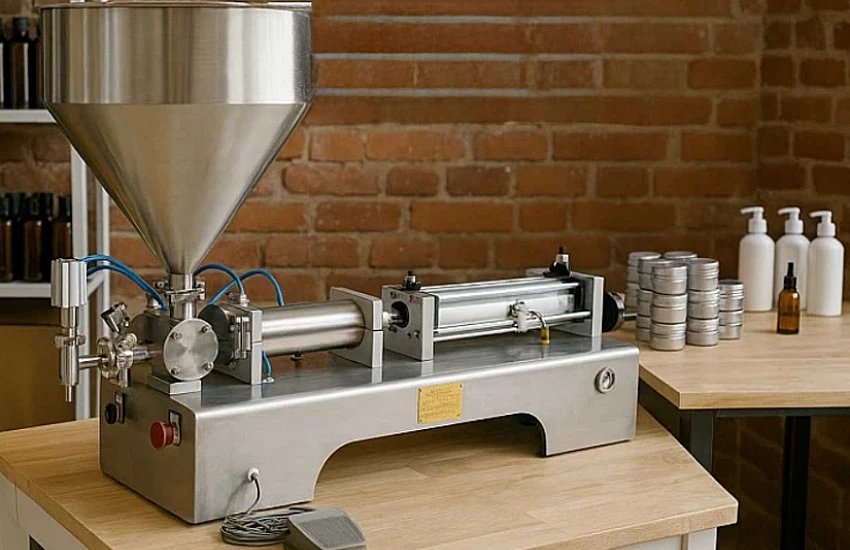
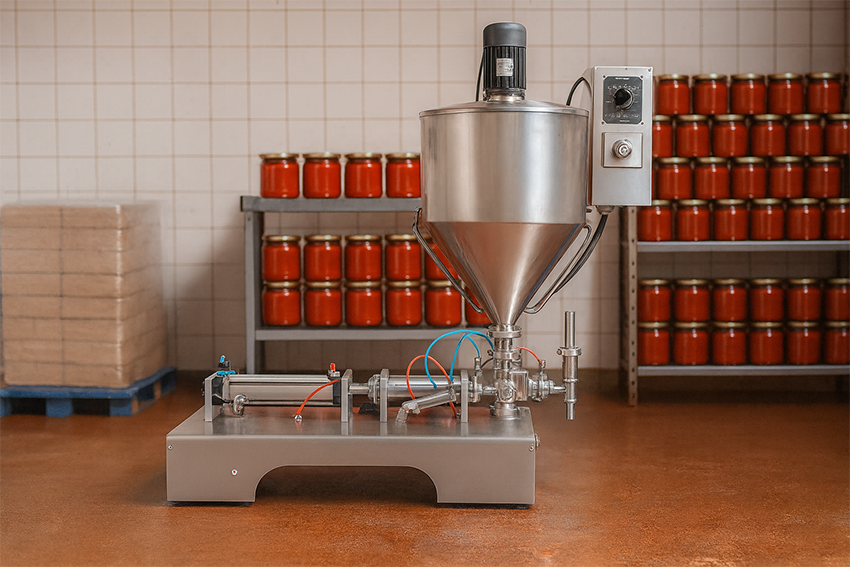
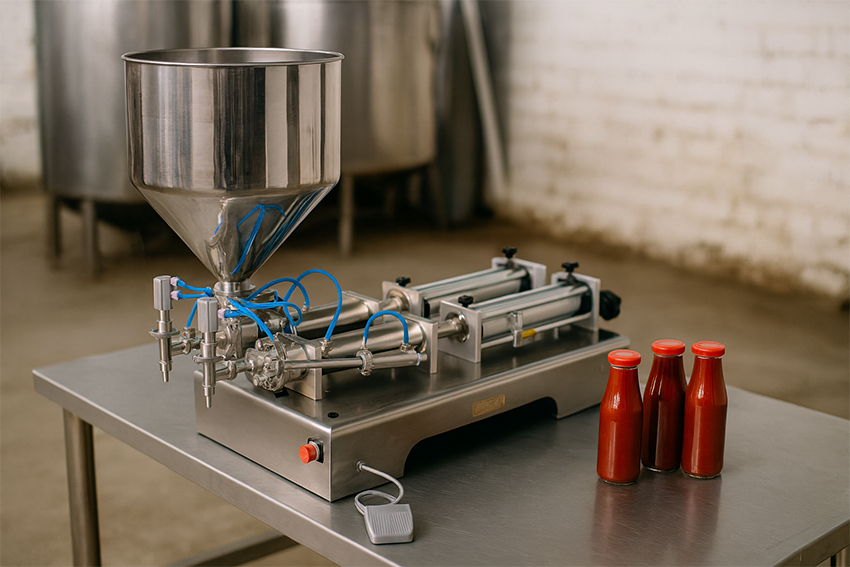
Before diving into details, it’s worth understanding the basic structural difference. Both fillers are semi-automatic piston machines that operate on compressed air and require connection to a compressor with a minimum power of 1.3–1.5 kW. Both offer the same dosing range, a 30-liter hopper capacity, and can operate in automatic mode or with foot pedal control. The dispensers are made of stainless steel, ensuring compliance with hygiene standards for food production.
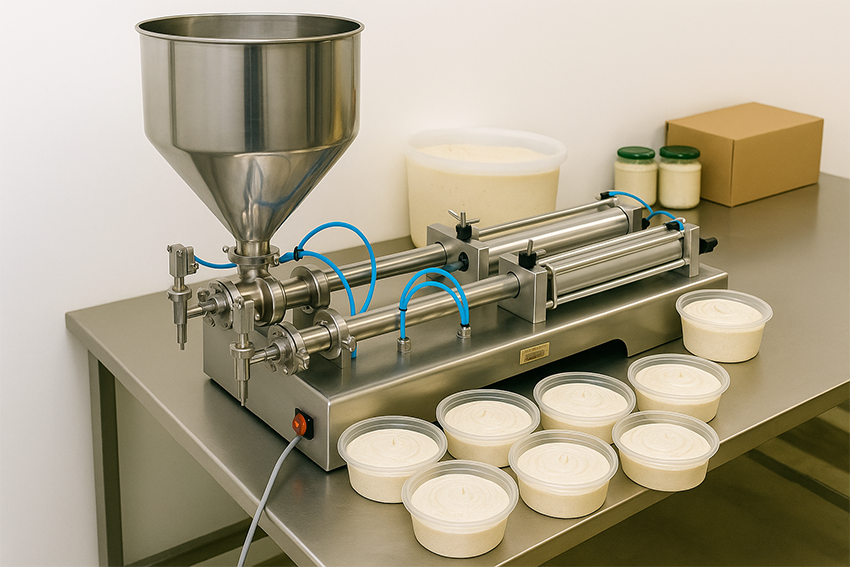
The single-head filler is the classic solution, capable of filling 10 to 25 containers per minute, depending on product viscosity and dosage volume. The two-head version doubles this capacity, reaching 20 to 50 units per minute. It’s not just about having two heads—it represents a fundamental difference in production philosophy.
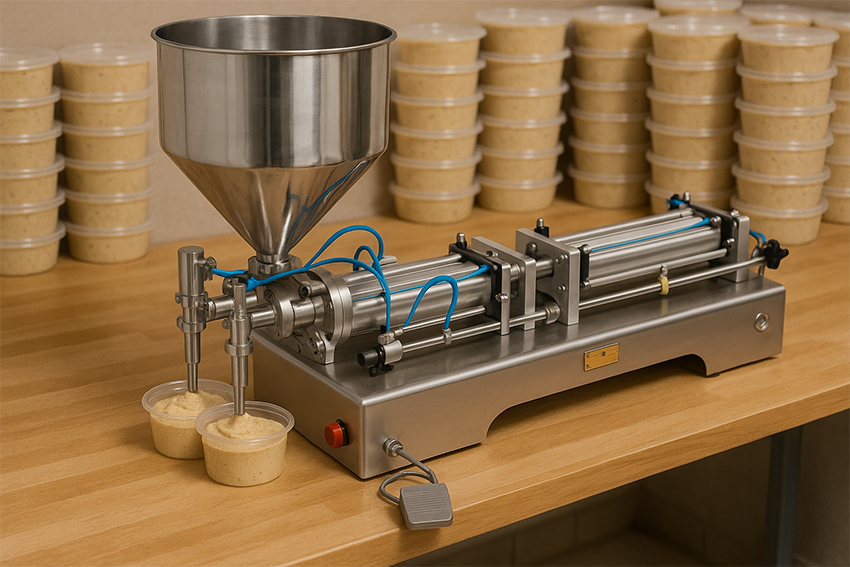
When using a single-head filler, the process is linear: place the container, the machine dispenses the product, remove the filled container, and place the next one. With the two-head version, you can fill two containers simultaneously.
Key Technical Differences That Matter in Practice
Let’s now look at specific parameters that affect daily operation. The single-head filler measures 92 x 30 x 82 cm and weighs 35 kilograms. The two-head version is 42 cm wide instead of 30, weighs 45 kilograms, and consumes 20 W of power instead of 10 W. On paper, these differences seem minor, but in practice, their impact often becomes apparent only after a few weeks of use.
An extra 12 centimeters of width may not seem like much, but in a small production room where every square meter counts, it can be significant. However, it’s worth noting that the increase in width is proportionally smaller than the increase in output—the two-head version is not twice as wide, yet it can potentially double productivity.
The weight matters mainly during installation and possible relocation of the machine. A ten-kilogram difference isn’t critical, but combined with the dimensions, it means the two-head version requires slightly more careful positioning and a sturdier work surface. Both machines also need access to compressed air at 0.8 MPa, which requires a suitable compressor and a well-planned pneumatic installation.
Performance in Numbers and Real Production
Theoretical output is one thing, but how does it translate to everyday practice? Under optimal conditions, a single-head filler can fill 25 containers per minute. Sounds impressive, right? Theoretically, that’s 1,500 units per hour. In reality, however, maximum output is rarely sustained throughout an entire shift. You must account for hopper refills, machine cleaning, dosage adjustments between batches, potential downtime, and the operator’s natural need for breaks.
In practice, a realistic output for a single-head filler during an eight-hour shift is about 600–800 filled containers, assuming medium-viscosity products and 500 ml packaging. This is quite a respectable result for a small workshop or a startup producing natural cosmetics, creams, or sesame pastes.
The two-head filler changes the game. Its theoretical maximum is 50 units per minute, but more importantly, in practice it allows better utilization of the operator’s time. As a result, during the same eight-hour shift, you can realistically fill 1,300–1,600 containers, sometimes even more.
When a Single-Head Filler Is a Smart Choice
Not every company needs maximum output from day one. There are many situations where investing in a single-head filler is not only justified but actually wiser than hastily choosing a larger machine.
Think of a small factory producing organic cosmetics, mainly sold through its online store and a few retail points. Production happens in batches—face creams today, body butters tomorrow, coffee scrubs the day after. Daily demand rarely exceeds 300–400 containers. In this case, a single-head filler is more than sufficient, and the savings from a smaller purchase can be invested in higher-quality raw materials, marketing, or additional packaging options.
The same applies to small catering companies producing artisanal sauces, sandwich spreads, or hummus for local events. Production is seasonal, volumes fluctuate, and flexibility is key. A single-head filler is ideal—easy to operate, quick to adjust, and compact enough for a multifunctional workspace.
Financial considerations for startups also matter. If you’re just starting out with a limited budget, it’s more sensible to invest in a reliable single-head machine and gradually scale production, rather than taking on a bigger loan for equipment whose full capacity may go unused for months or even years.
Two-Head Filler – Who It’s For and Why It’s Worth the Extra Cost
There comes a point in a company’s growth when a single-head filler becomes a production bottleneck. Larger orders come in, contracts with retail chains arrive regularly, and you notice that your operator spends eight hours a day at the machine and still can’t keep up. That’s the signal to consider expanding your production capacity.
A two-head filler is ideal for companies exceeding about 800–1,000 containers per day or planning to reach that level in the coming months. It’s also a good option if you produce several different products but one has significantly higher volumes. For example, if your classic hummus sells much better than flavored variants, the two-head filler allows you to efficiently produce a large batch of the main product and then quickly switch to smaller batches of niche products.
Cost Analysis – It’s Not Just About the Purchase Price
When discussing investment costs, most entrepreneurs focus on the catalog price of the machine. This is understandable, but it’s an incomplete approach. The true cost of ownership is the sum of many components that only reveal themselves over longer-term use.
Let’s assume the price difference between a single-head and a two-head filler is around 20% (a typical ratio for this type of equipment). If the single-head costs, for example, 6,800 PLN, the two-head will cost about 8,800 PLN. That’s an extra 2,000 PLN that you need to find in your investment budget.
But let’s look at it from the perspective of operating costs. The operator’s labor is usually the largest expense in a monthly production budget. If the operator earns 25 PLN per hour (including employer costs), a full-time employee costs the company roughly 52,000 PLN per year. A two-head filler allows the same operator to produce nearly twice as much, which in practice means the labor cost per container is almost halved.
If your company produces 1,500 containers per day, the productivity difference between a single-head and a two-head filler could save one to two working hours daily. Over a month, that’s 20–40 hours, equating to several thousand PLN. From this perspective, the additional investment in a two-head version can pay off within just a few months of intensive production.
Energy and compressed air costs should also be considered. The two-head filler consumes 20 W instead of 10 W, but this is almost negligible—only a few PLN extra per month. Compressed air is not a significant differentiator either, as both machines have similar requirements.
Space, Installation, and Workplace Ergonomics
When planning to purchase a filler, you need to realistically assess your available production space. The single-head version occupies 92 x 30 cm of floor space, which in practice requires about one square meter of clean working area, including room for the operator and temporary storage of containers. The two-head version requires 92 x 42 cm, giving about 1.2–1.3 square meters with appropriate safety margins.
In a small production room, where every centimeter counts, that extra 30–40 cm of width can be significant. You need space not only for the machine itself but also convenient access to the hopper, a pallet with empty containers, and a place to set filled products. Good production practice recommends that the operator shouldn’t have to move unnecessarily—everything should be within arm’s reach.
Installation is similar for both types of fillers, but the two-head version requires slightly more careful planning. First, due to its higher weight (45 kg vs. 35 kg), you need a sturdier worktable or a stable pedestal. Second, you must ensure even air supply to both heads, which may require an additional air splitter with pressure adjustment.
From an ergonomic standpoint, a two-head filler can be both an advantage and a challenge. Operating two heads simultaneously requires initial coordination and practice. You need to establish an optimal workflow—placing containers, starting the dosing, removing filled products—all smoothly, to fully utilize the machine’s potential. Some operators quickly master this rhythm and consider it a natural workflow, while others prefer the simpler, more linear process of a single-head machine.
Production Flexibility and Future-Proofing Your Investment
One thing you can be sure of in business is that plans change. A company producing 500 containers per week today may need 2,000 next year. Conversely, ambitious expansion plans may face market realities.
A single-head filler is a safe choice for a stable, predictable business model. If you know production will stay at a similar level for the coming years, don’t plan aggressive growth, and focus on quality and niche markets, this machine will serve you well. It also has the advantage that if your needs significantly increase in the future, you can simply purchase a second single-head filler and set up two production stations. This is sometimes better than a single two-head machine, especially if you produce two completely different products requiring separate settings.
The two-head version, on the other hand, is an investment with growth in mind. If you plan expansion, discussions with larger clients, or broader distribution, it’s better to secure sufficient production capacity from the start. Nothing is more frustrating than having a large order and equipment that physically cannot keep up. A two-head filler provides a safety buffer and room for growth without another major investment.
An interesting aspect is residual value. Filling machines, especially those with stainless steel components and well-maintained, retain good resale value. A two-head filler, being more versatile and efficient, may be easier to sell if you decide to change your business focus or upgrade to more advanced equipment.
Practical Scenarios – Real-Life Examples
To better illustrate when each type of filler is the optimal choice, let’s look at a few real business scenarios.
Scenario 1: Small natural cosmetics manufacturer
Anna runs a company producing eco-friendly creams and balms. She sells through her own online store, has a steady customer base, and produces an average of 200 containers per week, with peak sales before holidays reaching about 600 units. Her production room is a converted part of a garage, around 20 square meters. For Anna, a single-head filler is a perfect choice. It comfortably handles her regular production, and during peak periods she can work intensively for two days to catch up. The machine takes up very little space, which is crucial in a small production area, and the money saved was invested in organic certification and higher-quality raw materials.
Scenario 2: Rapidly growing food company
Marek started a business producing hummus and other legume-based spreads. He began with local health food stores, but after a year secured a contract with a regional supermarket chain. Production jumped from 300 to 1,500 containers per week, and negotiations with additional chains were already underway. Marek chose a two-head filler from the start, and he believes it was the best decision. Despite the higher upfront cost, the machine easily handles the increased demand. Moreover, Marek can accept larger contracts without worrying about meeting deadlines. The operator can handle the entire weekly production in just three days of intensive work, allowing flexibility for producing other flavor variants.
Scenario 3: Contract filling company
Tomasz runs a company providing bottling services for small food producers. Each client has different requirements—different products, volumes, and containers. Tomasz owns both single-head and two-head fillers. He uses the single-head for small test batches, new client products, and unusual containers that require frequent adjustment. The two-head works on large batches for regular clients with repeat orders. This setup gives him maximum flexibility and allows him to optimize operator time effectively.
Maintenance, Service, and Longevity
When investing in production equipment, you want to be confident it will serve you for many years. Both single-head and two-head fillers have stainless steel components, which is excellent for durability and hygiene. With proper maintenance, these machines can operate for a decade or more.
Daily upkeep is similar for both types—after production, you need to thoroughly clean the heads, tank, and dosing system. For food products, it’s especially important not to leave any residue that could become a source of microbiological contamination. The two-head version naturally takes more time to clean, but with an organized process, the difference is minimal—15 minutes vs. 25 minutes.
Regular maintenance primarily involves caring for the pneumatic system. Checking pressure, inspecting seals, and lubricating moving parts are identical for both versions and should be done according to manufacturer recommendations. In practice, a more thorough quarterly inspection and an annual full-service check by a technician are advisable.
Regarding reliability, it’s hard to declare a clear winner. The single-head filler has fewer components, so theoretically fewer things can break. On the other hand, if one head of a two-head filler requires repair, the other can still operate, minimizing production downtime. Preventive maintenance is key—a well-cared-for machine rarely causes issues, regardless of the number of heads.
Legal and Safety Considerations
Both fillers meet basic safety standards for machines used in the food industry. Stainless steel contact parts ensure compliance with hygiene requirements, and the pneumatic design eliminates risks associated with direct electrical contact in the filling area. This is particularly important when working with liquids and semi-liquids, where spills are always a potential hazard.
Operators should be trained in the use of pneumatic machinery and understand basic occupational safety principles. The two-head version requires slightly more attention, as the operator must coordinate work at two filling points simultaneously. It’s worth investing in proper procedures and ensuring the operator has comfortable working conditions—appropriate station height, good lighting, and easy access to all machine components.
Noise levels are minimal for these machines—the pneumatic system operates relatively quietly, especially if the compressor is in a separate room. The main source of noise is the compressor itself, which periodically switches on to replenish tank pressure. This is not a problem specific to either version of the filler.
Summary – How to Make the Right Decision
Choosing between a single-head and a two-head filler isn’t about picking a “good” or “bad” solution. It’s about matching the tool to your specific needs, financial capacity, and growth plans.
If your company is at the startup stage or has stable, moderate production—up to 700–800 containers per day—works in a limited space, and your investment budget is tight, a single-head filler is an excellent choice. It offers reliability, ease of operation, and flexibility at a reasonable initial cost.
On the other hand, if you plan for dynamic growth, handle or anticipate larger contracts, produce over 1,000 containers daily, or expect to reach that level soon, the two-head version is a smart investment. Higher productivity, lower labor costs per unit, and greater flexibility in production planning provide a tangible competitive advantage.
Remember, you can approach this gradually. Many entrepreneurs start with a single-head filler, and as the business grows, they either add a second machine or upgrade to a two-head model. This organic growth minimizes financial risk and allows you to gain operational experience before making a larger investment.
Ultimately, the key is an honest assessment of your real needs and capabilities. Don’t buy a bigger machine “just in case” if you don’t have concrete growth plans—this wastes capital that could work elsewhere in your business. But don’t underinvest either if you see your production already pushing the limits of a single-head filler’s capacity.
Frequently Asked Questions (FAQs)
Can I upgrade a single-head filler to a two-head version in the future?
In theory, upgrading is possible, but in practice it rarely makes economic sense. Manufacturers offer both versions as separate models due to differences in frame construction, pneumatic layout, and control systems. The cost of modification often approaches the price of a new machine, and you would likely lose the warranty. If you anticipate needing higher output within a year or two, it’s more sensible to invest in a two-head model from the start or purchase a second single-head machine as a separate production station.
Which type handles very high-viscosity products better?
Both versions are identical in this regard—they use the same piston system and have the same dosing specifications. For very thick products, like tahini or dense nut butters, output will be proportionally lower on both machines. A two-head filler still delivers roughly double the productivity, even if absolute numbers are lower. Proper air pressure adjustment and, if necessary, preheating the product before filling are key considerations for both machines equally.
How long does it take to switch the machine from one product to another?
Switching time depends mainly on the difference between products. Moving from one cream to another of similar consistency and color requires a basic system rinse, taking about 10–15 minutes for a single-head and 15–20 minutes for a two-head machine. If the product change is more drastic—e.g., from a dark chocolate sauce to white coconut cream—a full system cleaning is required, taking 30–45 minutes regardless of the machine type. Planning production in batches of similar products minimizes downtime.
Does a two-head filler require two operators?
No, a two-head filler is designed for a single operator. It requires some coordination and establishing an optimal workflow, but most operators adapt within a few days. For very intensive production, a second operator can further increase efficiency, but it’s not mandatory.
Can both machines be used interchangeably for food and cosmetic products?
Yes, both machines have food-grade stainless steel components and can be used for both food and cosmetic products. Proper cleaning procedures between different product categories are essential. Many companies prefer to separate production—one machine for food, another for cosmetics—to minimize cross-contamination risks and maintain certification compliance. If using the same machine for both categories, document cleaning procedures and validate cleaning efficacy, which may require periodic microbiological testing of equipment surfaces.
What happens if one head of a two-head filler breaks down?
This is one of the main advantages of the two-head version. If one head requires repair or adjustment, the other can usually continue working. Production does not stop completely—output drops to a level comparable to a single-head machine. This provides time to arrange repairs without the pressure of a full production halt. In contrast, any issue with a single-head filler completely stops production until the problem is resolved. The two-head model therefore offers an additional safety buffer, which can be crucial for meeting tight deadlines.