
Table of Contents
- What is Slow Food and Why is it Capturing Hearts Worldwide
- Own Oil Production as a Manifestation of Slow Production
- New Year's Resolution: Starting a Small Oil Mill
- Semi-Industrial Press - Heart of Local Oil Production
- From Hobby to Brand: Building Business on Local Oils
- Practical Aspects of Starting Production
- Press Cakes - Added Value of the Oil Mill
- Seasonality and Production Planning
- Questions and Answers
- Summary
Early January is traditionally the time for New Year's resolutions. Most of us plan to exercise more, eat healthier, or spend more time with family. However, in recent years we've been observing a new trend among people wanting to change their lives – a resolution connected to slow food and producing their own food. Instead of another diet or gym membership, more and more people are deciding to start a small oil mill and produce their own, local cold-pressed oils. This is not only a return to roots and traditional food processing methods, but also the beginning of a business adventure that can transform into a profitable local products brand.
What is Slow Food and Why is it Capturing Hearts Worldwide
The Slow Food Philosophy in Practice
The slow food philosophy was born in Italy in the 1980s as a response to the expansion of fast food and taste uniformization. This movement promotes local, traditional food, produced by methods that respect nature and the culinary culture of the region. The slow food idea finds particularly fertile ground in communities where memories of homemade preserves, farm-fresh eggs from neighbors, or dark bread baked in local bakeries still live.
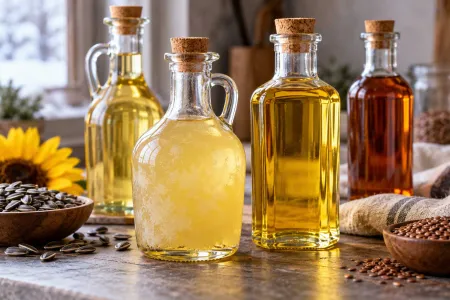
Slow food is much more than a culinary trend. It's a life philosophy that assumes a conscious approach to what we eat, where our food comes from, and how it was produced. In the context of oils, this means rejecting refined industrial products in favor of cold-pressed oils full of nutritional value, which preserve natural taste, aroma, and richness of biologically active ingredients.
Technology in Service of Tradition
It's worth noting that the slow food movement is not opposed to technological progress. On the contrary – modern oil presses allow today for production on a scale that just a dozen years ago was available only to large industrial plants. The difference lies in the approach to the production process. Instead of maximizing efficiency at all costs, priority becomes quality, locality, and product authenticity.
Growing Market for Local Products
We observe a real renaissance of interest in local products. Farmers' markets, regional flavor festivals, food cooperatives – all these are manifestations of growing consumer awareness. People increasingly ask about product origins, want to know the producer, know what and how was made what they eat. This tendency opens a market niche for small, local cold-pressed oil producers who can offer something we can't buy in any supermarket – authenticity, freshness, and full production process transparency.
Oil Pressing Traditions
Traditional oil pressing methods date back to medieval times, when small hemp or flax oil mills operated in larger households. Oils were used not only in cooking, but also as preservatives, raw material for paint production, or as lamp fuel. Today this knowledge returns in a new version, enriched by possibilities of contemporary technology, which allows pressing a wide range of oils – from classic sunflower and rapeseed, through increasingly popular flax and pumpkin, to exotic ones like cashew or avocado oil.
Own Oil Production as a Manifestation of Slow Production
Conscious Manufacturing Instead of Mass Production
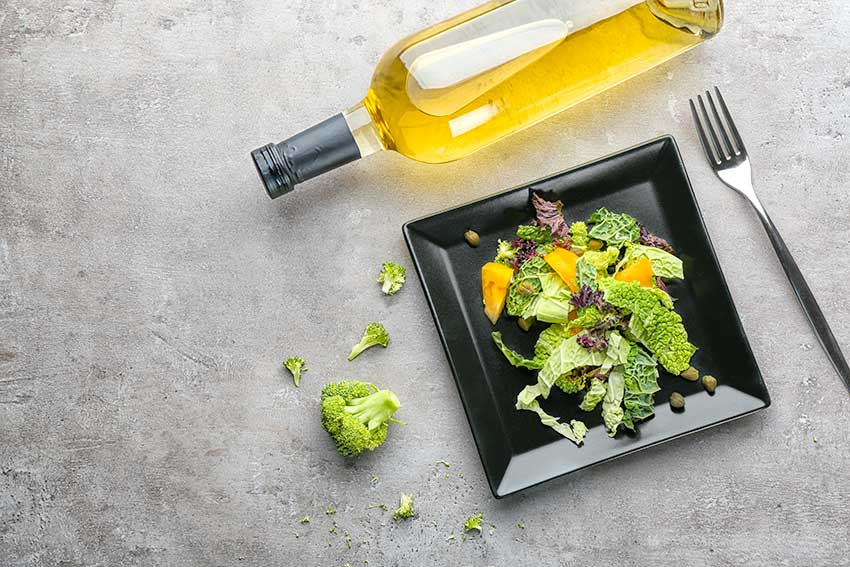
The slow production idea is a natural extension of slow food philosophy to the production area. It's about conscious, non-industrial manufacturing of high-quality products at a pace that allows preserving their authentic character and value. In the case of cold-pressed oils, this means a process where raw material quality, execution precision, and care for every detail matter, not just maximizing the amount of produced oil.
Step-by-Step Pressing Process
Traditional oil production is a multi-stage process requiring patience and knowledge. Before seeds reach the press, they must be properly prepared – cleaned of impurities, sorted, sometimes roasted to enhance aroma. Pressing itself requires appropriate pressure and temperature control. Too low pressure means low efficiency and raw material waste, too high can lead to oil overheating and loss of valuable ingredients. The process doesn't end with extraction – raw oil must still be separated from fine solid particles through sedimentation or filtration.
Preserving Natural Oil Character
Unlike industrial production, where oils are refined, decolorized, and stripped of natural taste and smell, the slow production process focuses on preserving these features that give oil its unique character. Cold-pressed oil from roasted sunflower seeds smells intensely nutty, flax oil has a characteristic note reminiscent of freshly cut grass, pumpkin oil amazes with dark, greenish color and dense consistency.
Flexibility and Customer Adaptation
Small-scale pressing also allows flexibility in raw material selection. The producer can experiment with different seed varieties, press seasonal oils, respond to local harvests, or special customer orders. This very diversity and ability to adapt production to specific recipients' needs constitutes the main advantage of small, local oil mills over industrial giants.
Production Chain Transparency
It's also worth noting that own oil production is an excellent response to growing demand for transparency in the food chain. Consumers want to know what they eat, where raw materials come from, what production methods were used. A small oil mill can offer full transparency – from the field where seeds come from, through the pressing process that can often be observed personally, to the finished product poured into bottles. This directness of contact between producer and consumer builds trust and loyalty that can't be achieved with anonymous industrial products.
New Year's Resolution: Starting a Small Oil Mill
Determining Scale of Activity
The decision to start your own oil mill is a serious step requiring consideration of many aspects. This is not an "off the cuff" venture, but when well-planned it can bring both personal satisfaction and real income. The beginning of the year is an excellent moment to prepare a solid action plan and begin implementing this ambitious goal.
The first step is determining the scale of activity. Is this to be a home oil mill where we produce oils mainly for personal use and friends? Or perhaps we plan immediate sales at local markets or health food stores? The answer to these questions determines the choice of appropriate equipment and the need to meet specific legal and sanitary requirements.
Legal and Sanitary Requirements
If we intend to sell oils commercially, we must familiarize ourselves with regulations regarding business activity in the food industry. Food production and sales are subject to health authority supervision. Obtaining appropriate permits, ensuring appropriate hygienic conditions at the production site, and proper product labeling are necessary. Although this may seem complicated, in reality for small businesses the requirements are not overly restrictive, and the ability to use help from health inspectorates significantly facilitates procedures.
Production Facility and Infrastructure
Another issue is the production facility. Small presses don't require large space – a room of several square meters is enough to start. It's important that it be dry, airy, and easy to keep clean. Temperature should be constant, without sudden fluctuations, which will allow maintaining stability of produced oils' quality. It's also worth thinking about seed storage and space for storing finished oils.
Raw Materials and Their Procurement
Raw material purchase is another piece of the puzzle. Fortunately, there's no shortage of suppliers of high-quality oil seeds. You can buy directly from farmers, which not only lowers costs but also allows building relationships and having certainty about raw material origin. It's worth starting with the most popular seeds – sunflower, rapeseed, or flax – and gradually expanding the offer with more niche oils that can become a market distinguisher.
Financial Plan and Profitability
The financial plan is of course crucial. Investment in a semi-industrial oil pressing machine is an expense in the range of several thousand euros, plus costs of possible facility renovations, purchase of packaging, labels, and initial raw material batch. Current costs must also be considered – electricity, raw materials, transport. On the other hand, margins on cold-pressed oils are attractive – good quality oil can be sold at a price several times higher than the cost of seeds alone.
Combining with Other Activities
Importantly, oil mill activity can be excellently combined with other occupations. Many people start oil production as an additional income source, running it on weekends or evenings. The pressing process is not particularly time-consuming – contemporary presses work largely automatically, and the operator's role is mainly process control and raw material preparation. Over time, when the business develops and a stable customer base appears, transforming the oil mill into the main income source can be considered.
Semi-Industrial Press - Heart of Local Oil Production
Golden Mean Between Home and Industrial Production
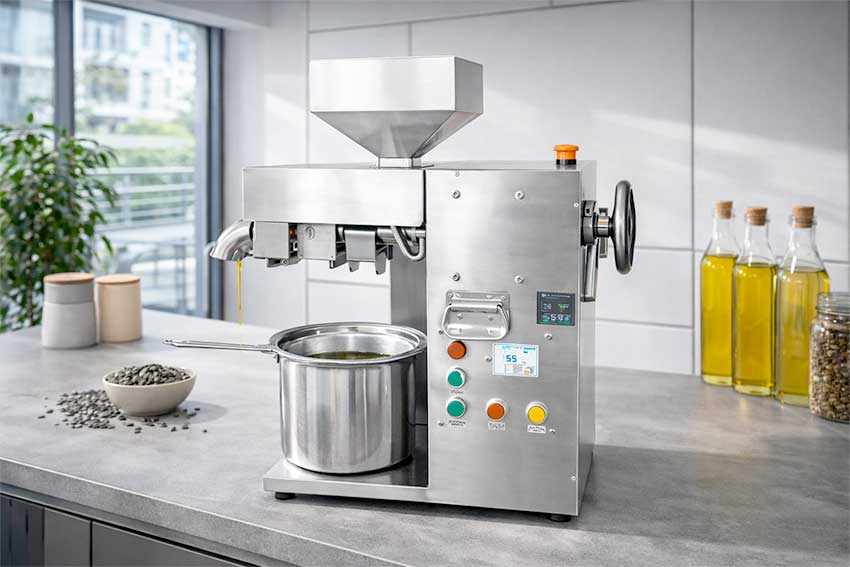
Choosing the right press is the most important decision for anyone planning to start oil production. Small home presses, although relatively inexpensive and easy to operate, have too low efficiency to build a profitable business. On the other hand, large industrial lines exceed the financial and spatial possibilities of most beginning producers. The ideal solution turns out to be a semi-industrial press, which combines compact size with efficiency allowing commercial production.
Efficiency and Compact Dimensions
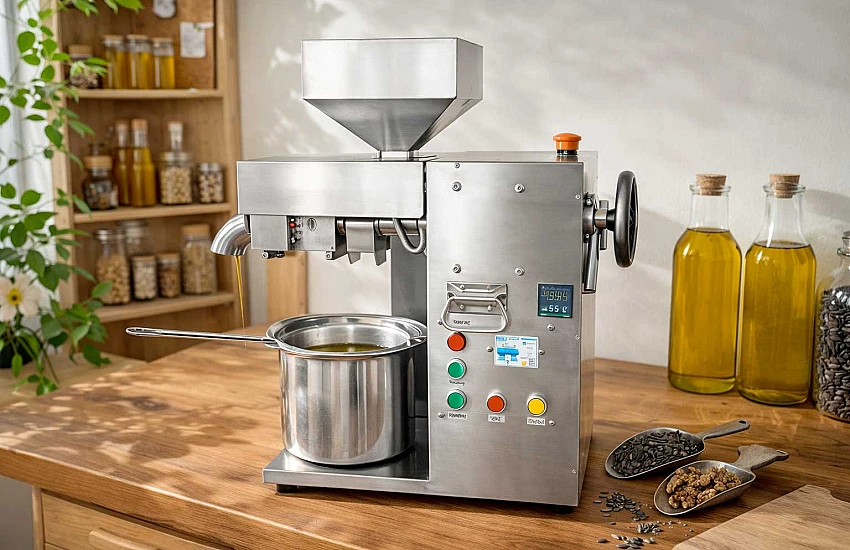
A semi-industrial press with a capacity of 15-20 kilograms of processed seeds per hour represents a golden mean between home device capabilities and professional oil mill requirements. Such efficiency means that during several hours of work, dozens of liters of oil can be obtained, which is enough to supply local sales points or serve regular customers. At the same time, the device remains compact enough to fit in a small production facility with dimensions of only 70 by 30 centimeters and height of less than 75 centimeters.
Cold and Hot Pressing
A key advantage of modern semi-industrial presses is their versatility. Thanks to the ability to press both hot and cold, the producer can adapt the process to the specific raw material and customer expectations. Cold pressing, where temperature doesn't exceed 40 degrees Celsius, allows preserving full nutritional value, natural aroma, and intense oil color. This method is preferred by customers aware of health properties of oils, especially rich in omega-3 and omega-6 fatty acids, which are sensitive to high temperature.
On the other hand, hot pressing, where seeds are heated to 120-200 degrees Celsius, increases process efficiency and allows extracting oil from more demanding raw materials. With this method, more oil is obtained from the same portion of seeds, and additionally heating enhances aroma, which is especially appreciated by lovers of intense flavors. Some seeds, such as hulled sunflower or coconut flakes, practically require hot pressing to obtain satisfactory efficiency.
High-Class Construction Materials
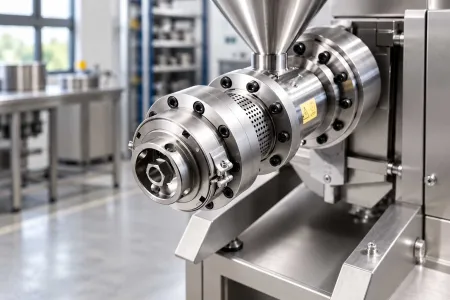
An important element of semi-industrial press construction is the use of stainless steel in elements having contact with food. Class 304 and 420 materials used in the pressing chamber and screws guarantee not only process hygiene but also equipment longevity. Stainless steel doesn't enter into chemical reactions with pressed oils, doesn't change their taste or smell, and at the same time is easy to clean and maintain in appropriate sanitary condition.
Precise Temperature Control
Contemporary semi-industrial presses are also equipped with heating systems allowing precise temperature control of the process. A 500-watt heater ensures gradual and even heating of the pressing chamber, which allows avoiding local overheating that could adversely affect oil quality. The control panel enables easy temperature setting and real-time process parameter monitoring.
An important aspect is also oil extraction efficiency. Modern presses can leave only about five percent of oil in press cakes, which means very high process efficiency. This is important not only from an economic point of view but also ecological – maximum use of raw material means smaller losses and more sustainable production.
Interchangeable Screws and Low Operating Costs
Screw replacement is another functionality that increases the device's utility value. Different seeds require different pressure and different screw shapes for optimal oil extraction. Having a set of interchangeable screws allows adapting the press to specific raw material and maximizing efficiency for each seed type.
The energy aspect is also significant. A 1.5-kilowatt motor is relatively low power consumption for the device's efficiency, which translates to low operating costs. The device powered by standard 230-volt voltage doesn't require special electrical installations and can be connected to a regular household outlet, which significantly simplifies technical issues related to starting the oil mill.
A hopper capacity of 4-5 kilograms allows continuous work without the need for frequent seed addition. This is particularly important during longer pressing sessions, when the producer can focus on process quality control and preparing next raw material batches, instead of constantly pouring seeds into the machine.
Recommended semi-industrial press: https://www.pureoilpress.com/en/product/semi-industrial-oil-press-15-20-kgh
From Hobby to Brand: Building Business on Local Oils
Defining Brand Identity
Transforming the passion for pressing oils into a profitable business requires not only good equipment but above all a thoughtful marketing strategy and understanding of market needs. The local regional products market is a place where authenticity and quality count more than aggressive advertising or low prices. Customers seeking cold-pressed oils are typically aware people who value health and are willing to pay more for a truly high-class product.
Brand building should begin by defining what distinguishes our oils from the competition. Are these oils from local, organic farms? Do we use traditional seed roasting methods? Or perhaps we specialize in niche oils that can't be bought in supermarkets? Each of these paths can become the foundation of brand identity. The history of the oil mill's creation, production philosophy, care for quality – all these are elements that build a relationship with the customer and distinguish us from mass industrial production.
Packaging and Product Presentation
Packaging is hugely important. Cold-pressed oils should be stored in dark glass bottles protecting against light, which destroys delicate nutrients. Aesthetic, carefully designed labels with clear description of raw material origin, pressing method, and nutritional values add professionalism and build trust. It's also worth considering different packaging sizes – from small trial bottles to one-liter ones, adapted to different customer needs.
Distribution Channels
Distribution channels for local oils are very diverse. Traditional farmers' markets and fairs are an excellent place for direct contact with customers, product presentation, and building a base of regular recipients. Cooperation with health food stores, delicatessens, or restaurants seeking high-quality ingredients are further possibilities. Online sales are also becoming increasingly popular, especially in a subscription model where customers regularly receive fresh oil batches.
Marketing and Social Media
Social media are a powerful tool for local producers. Showing production backstage, sharing recipes using our oils, educating consumers about different oils' properties – all this builds an engaged community around the brand. Authenticity and transparency are key here – people want to see real production, a real producer, real stories.
Cooperation with Gastronomy
Cooperation with local restaurants and caterers is a particularly interesting niche. Chefs seeking unique ingredients can become ambassadors of our oils, showing their use in professional cooking. Organizing tastings, culinary workshops, or oil pressing demonstrations are activities that not only promote the product but also educate the market and build awareness of cold-pressed oils' value.
Certificates and Product Range Development
Certificates and awards can significantly increase brand credibility. Organic certification for oils from ecological farms, awards from regional product competitions, or entry into the register of traditional products are elements that distinguish our offer and allow justifying higher prices. It's also worth considering membership in organizations promoting local food or the slow food movement, which provides access to a network of contacts and joint marketing activities.
Product range development should occur gradually, in response to signals from the market. Perhaps it's worth introducing flavored oils with herbs or garlic additions? Or perhaps oil blends with specific health properties? Some producers also develop derivative product offerings – press cakes as animal feed, press cake flours for culinary applications, or natural cosmetics based on their own oils.
The key to long-term success is consistency and constant pursuit of highest quality. Every oil bottle bearing our name is a brand ambassador and recommendation for next customers. In a world where consumers increasingly value locality, authenticity, and transparency, a well-run small oil mill has a chance not only to survive but actually thrive, building a loyal customer base appreciating truly valuable products.
Practical Aspects of Starting Production
Location and Space Organization
Starting your own oil mill is a venture requiring attention to many practical details that can determine the success or failure of the entire undertaking. A thoughtful approach to production process organization saves time, money, and frustration in the future.
Choosing the production facility location is crucial. Ideal space should be dry, well-ventilated, and easily accessible. Moisture is the enemy of both oil seeds and the equipment itself, so a basement or other damp place is a bad idea. Temperature should be relatively constant – sudden fluctuations can affect the quality of stored seeds and finished oils. Access to water facilitates maintaining cleanliness, which is crucial in food production.
Workspace organization should ensure smooth raw material flow through successive production stages. Seed reception and storage zone, cleaning and sorting place, press station, sedimentation and bottling area – each of these stages requires thoughtful management. It's worth investing in appropriate seed containers, preferably hermetic ones, protecting against moisture and pests. Shelves for finished oils should be in the darkest and coolest place.
Raw Material Preparation and Press Work
The pressing process begins with seed preparation. Even if we buy cleaned raw material from a trusted supplier, it's worth sifting it once more and making sure there are no impurities. Pebbles, stem pieces, or damaged seeds can not only worsen oil quality but also damage the press. Some seeds, like sunflower or flaxseed, can be pressed immediately, others require roasting. Roasting enhances aroma and facilitates oil extraction but requires precise temperature and time control. Over-roasted seeds will give oil a bitter taste, under-roasted won't release full aroma.
Press work itself requires some practice. Beginning producers should start with easier-to-press seeds like sunflower or rapeseed before moving to more demanding ones like flax or pumpkin. Each seed type has its optimal pressing conditions – temperature, feeding speed, pressure. It's worth keeping notes from each pressing session, recording parameters and results, which allows gradually perfecting the process and finding optimal settings for specific raw materials.
Sedimentation and Bottling
Freshly pressed oil contains fine solid particles and requires sedimentation. This process involves leaving the oil undisturbed so suspended particles settle to the bottom under gravity. Depending on oil type, sedimentation can take from several days to several weeks. During this time, oil should be stored in a dark, cool place in tightly closed containers. After sedimentation, oil can be gently decanted, leaving sediment at the bottom, or filtered through dense fabric.
Bottling is the last but no less important stage. Cold-pressed oils are delicate and easily oxidize under the influence of light and oxygen. Dark glass bottles, preferably filled to the brim to minimize air contact, are the industry standard. Corks or caps must ensure tightness. Each bottle should be labeled containing product name, production date, minimum durability date, net weight, and producer information. Basic nutritional value information and storage method are also useful.
Hygiene and Documentation
Cleanliness and production hygiene are the foundation of quality. The press should be cleaned after each pressing session, especially when switching between different seed types. Remains of previous raw material can change the taste and smell of the next oil batch. The production facility requires regular cleaning, and all surfaces in contact with food should be disinfected. Good hygiene practices are not only a legal requirement but also care for consumer health and brand reputation.
Stock management is another aspect worth considering. Oil seeds lose freshness over time, so it's not worth buying them in excessive quantities. It's better to order smaller batches of fresh raw material more often than keep seeds in storage that sit for months. On the other hand, a safety buffer should be ensured so raw material doesn't run out at the sales season peak. Similarly with packaging – bottles and labels should always be in a certain stock, but without exaggeration.
Production documentation is not only a legal requirement but also a valuable quality management tool. It's worth keeping a production log where we note pressing dates, types and quantities of processed seeds, obtained efficiencies, noticed problems. Such documentation allows tracking quality changes over time, identifying problems, and optimizing the process. It's also invaluable in case of complaints – we can accurately trace the history of each product batch.
Press Cakes - Added Value of the Oil Mill
Traditional Use in Animal Feeding
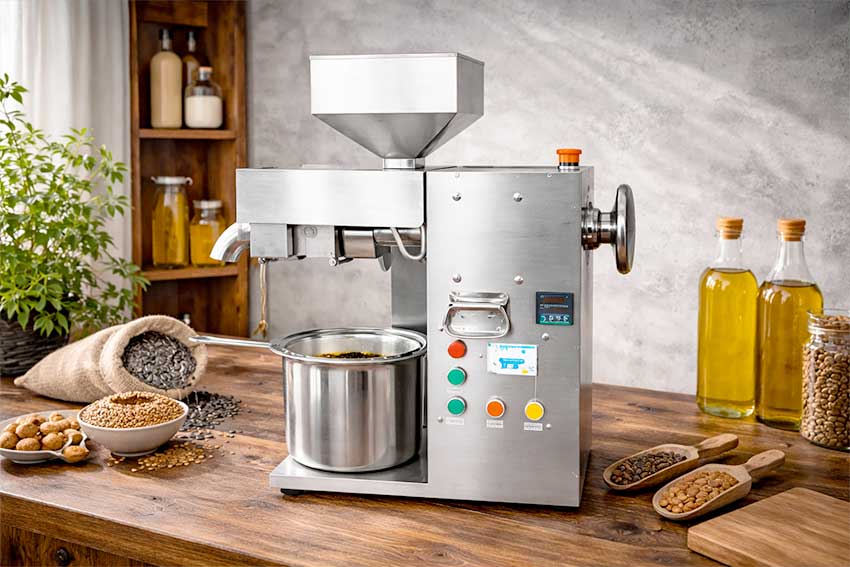
Oil production is not just pressing itself. An important by-product, often underestimated, are press cakes – residues after oil extraction. In a well-conducted process, press cakes contain only about five percent of oil and constitute valuable raw material with many applications.
Traditionally, press cakes were used as feed for farm animals. Their high content of protein, fiber, and residual fatty acids makes them an excellent supplement to the diet of horses, cattle, or poultry. Flax press cakes are particularly valued in feeding sport horses, as they favorably affect skin condition and coat shine. Sunflower press cakes are a valuable addition to feed for dairy cattle, improving milk quality.
Culinary Applications of Press Cakes
However, that's not the only application. The use of press cakes in cooking is becoming increasingly popular. After grinding to fine powder, they constitute a valuable addition to cakes, bread, muffins, or cookies. Sunflower press cakes add nutty taste and aroma, flax ones are a treasury of fiber and omega-3, pumpkin ones bring characteristic, slightly sweet aftertaste. Many people following a gluten-free diet appreciate press cakes as an alternative to traditional flours.
Press Cakes as Premium Product and Ecological Aspect
In the premium segment, some producers package press cakes as a separate product – a healthy snack, smoothie addition, or source of plant protein for athletes. Properly packaged and promoted, they can constitute an additional income source for the oil mill. Press cakes can also be used to produce natural cosmetics – scrubs, masks, or soap, which opens another business development possibility.
From a practical point of view, effective press cake management is also an ecological issue. Instead of treating them as waste, finding applications for them, we close the production loop and maximize raw material use. This is also an excellent marketing argument – consumers increasingly appreciate producers who think in zero-waste terms and responsibly manage resources.
Seasonality and Production Planning
Harvest Cycles and Raw Material Availability
Oil production, although possible year-round, has its seasonality resulting from both raw material availability and consumer demand. Understanding these cycles allows better planning of purchases, production, and marketing activities.
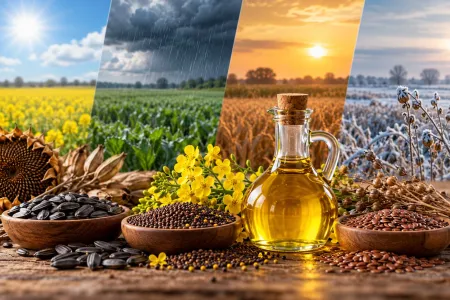
Oil seed harvests mainly fall in the period from July to October. This is the best time to buy fresh raw material directly from farmers, often at attractive prices. Sunflower is usually harvested in August and September, rapeseed in July, flax in September. Seeds bought directly after harvest are freshest and have the best pressing parameters. It's worth stocking up on larger quantities then, remembering of course about appropriate storage conditions.
Demand Peaks During the Year
In terms of demand, clear peaks are visible. The holiday period, especially before Christmas and Easter, is a time of increased interest in high-quality food products, including oils. Customers then look for gifts, ingredients for holiday dishes, premium products. The beginning of the year, as already mentioned, is a moment of New Year's resolutions and interest in healthy eating. Spring brings growth in demand for oils used in natural cosmetics, and autumn is the season for oils supporting immunity, rich in vitamins A and E.
Production and Seasonal Offer Strategy
Production planning should consider these fluctuations but also oil durability. Cold-pressed oils, although healthy, are relatively short-lived. They're best consumed within a few months of production. Therefore, the "production for storage" strategy has limited sense – it's better to press smaller batches of fresh oil more often than accumulate large stocks that may lose freshness.
It's also worth thinking about seasonal specials. Walnut oil available in autumn, pumpkin seed oil before Halloween, limited series of oils from organic farms in harvest season – such products not only diversify the offer but also create a sense of uniqueness and encourage regular following of our offer.
Questions and Answers
Is Own Oil Production a Profitable Business?
The profitability of oil production depends on many factors, but with the right approach it can constitute a profitable source of income. Key are margins on cold-pressed oils, which can be several times higher than raw material costs. For example, from one kilogram of sunflower seeds you can obtain about 400 milliliters of oil, and raw material costs are about 5-7 dollars per kilogram. Finished cold-pressed oil sells at a price of 40-60 dollars per liter, which gives an attractive margin. Of course, energy costs, packaging, labels, labor time, and equipment amortization must be considered. Most small oil mills start achieving profit after 6-12 months of activity, when a stable customer base stabilizes and optimal production processes are developed. Important is a realistic approach to development pace – immediate large profits shouldn't be expected, but consistent work and care for quality bring results.
Which Seeds Work Best for Beginning Producers?
For people starting their adventure with oil pressing, the best choice is sunflower and rapeseed. Sunflower, especially in hulled version, is relatively easy to press, gives decent efficiency, and results in oil with pleasant, slightly nutty taste that enjoys great popularity among consumers. Rapeseed is also technically uncomplicated and allows obtaining universal oil with wide culinary application. After gaining confidence and experience, it's worth expanding the offer with flaxseed, which gives oil extremely valuable in health terms, rich in omega-3 fatty acids. Pumpkin seeds are the next step – they require slightly more attention, but the result in the form of aromatic, dark green oil will certainly delight customers. Exotic oils from nuts, avocado seeds, or black cumin are already proposals for experienced producers who have mastered the basics well and want to distinguish their offer in the market.
Are Special Permits Needed for Commercial Production?
Yes, food production and sales, including oils, require meeting specific legal requirements. First, business activity must be registered and appropriate codes related to oil production must be selected. Then activity notification to health authorities is necessary, which will assess production conditions. The facility must meet sanitary standards – appropriate wall and floor finishing, access to running water, proper ventilation. Inspectors will also check cleanliness maintenance procedures and food safety assurance. Each product must be properly labeled – the label should contain product name, producer information, composition, net weight, production date and minimum durability, and storage method. For small producers, procedures are usually simplified, and health inspectorate staff gladly advise how to meet all requirements. Organic certification is also worth considering if planning to use ecological raw materials – although it requires additional formalities, it significantly raises product value in consumers' eyes.
How Long Do Cold-Pressed Oils Keep and How to Store Them?
Cold-pressed oils are a relatively short-lived product compared to refined industrial counterparts. It's precisely the presence of natural nutrients that give them exceptional health properties that makes them more sensitive to the effects of time, light, and oxygen. Durability depends on oil type – flax is most delicate and should be used within 2-3 months of opening, sunflower and rapeseed maintain freshness for 4-6 months, and more stable oils like from pumpkin seeds can remain fresh even up to a year. The key is proper storage. Oil should be kept in a dark, cool place, preferably in the refrigerator after opening. Dark glass bottles protect against harmful light action. Minimizing contact with air is also important – bottles should be filled maximally, and after opening it's worth pouring oil into smaller containers to reduce the amount of air inside. Oil freshness can be recognized by intense aroma and lack of bitter-rancid aftertaste that appears in aging oils.
How Much Can You Earn from a Small Oil Mill?
Income from a small oil mill depends on many variables, but realistic estimates can be presented. A semi-industrial press with capacity of 15-20 kilograms of seeds per hour allows producing during a four-hour session about 60-80 kilograms of processed raw material, which translates to approximately 25-35 liters of finished oil depending on seed type. At an average wholesale price of 35-40 euros per liter, a single pressing session can generate revenue in the range of 900-1400 euros. Subtracting raw material costs (about 400-500 euros), energy, packaging, and other current expenses, the margin from such a session can be 400-700 euros. With regular production twice a week, this gives potential monthly income at the level of 3500-6000 euros. Of course, these are indicative values – actual earnings depend on the local market, sales efficiency, seasonality, and brand building skills. Some producers specializing in premium oils can achieve significantly higher margins, others betting on larger scale and lower unit prices balance this with greater volume. The key is finding your niche and consistently building a base of loyal customers.
Can Oil Mill Be Combined with Other Activities?
Absolutely yes, and many people develop their oil pressing exactly this way. Production doesn't require continuous presence – oil can be pressed on weekends or designated weekdays, and remaining time devoted to other work. The oil mill combines perfectly with agricultural activity – a farmer can process own harvests and additionally offer pressing services for other farms. It also combines excellently with production of other food products – honey, preserves, bread – creating a comprehensive offer of local products. Many people run an oil mill as an additional income source alongside employment, gradually developing the business and over the years transforming it into main activity. Important is realistic time planning – production, sales, customer service, social media promotion require regular engagement, but with good organization this can be combined with other obligations. Some entrepreneurs develop a model where production occurs periodically, for example intensively during harvest season and periods of increased demand, and during the remaining part of the year they focus on other projects.
How to Build a Base of Regular Customers?
Building a loyal customer base for local oils is a process requiring time and consistency, but achievable with the right approach. Most important is product quality – if oil is truly good, fresh, and tasty, customers themselves become brand ambassadors and recommend it to friends. Direct contact with consumers at markets or festivals allows for tastings, product discussions, and building personal relationships. Many people value the possibility of getting to know the producer, seeing how they work, asking questions about raw material origin. Social media are an excellent tool for maintaining regular contact – showing production backstage, sharing recipes using our oils, educating about different oils' properties engages customers and builds community around the brand. A subscription system where customers regularly receive fresh oils ensures financial stability and allows production planning. Loyalty programs, discounts for regular customers, seasonal promotions are proven methods for encouraging regular purchases. It's also worth investing in packaging that customers will want to keep and show others – a beautiful bottle with aesthetic label is not only packaging but also a kitchen decoration element and brand business card.
Summary
Starting the new year with a resolution to launch your own oil mill is an ambitious but achievable goal for people wanting to combine passion for high-quality food with building their own business. The slow food trend and growing interest in local products create excellent market conditions for small cold-pressed oil producers. A semi-industrial press is an ideal tool, combining efficiency allowing commercial production with compact size and accessible price. With the right approach to quality, thoughtful marketing strategy, and consistency in action, your own oil mill can become not only a source of income but also a way of life consistent with slow food values and sustainable production. The beginning of the year is an excellent moment to transform dreams into a concrete action plan and take the first step on the path to your own business based on authentic, local products.