

Table of Contents
- Return to Local Roots in an Era of Global Uncertainty
- Why Local Oil Presses Are the Future of the Oil Industry
- Technology Empowering Small Entrepreneurs
- Business Model of a Local Oil Mill
- Practical Tips for Future Oil Mill Owners
- The Future of the Local Oil Mill Market
- Frequently Asked Questions (FAQ)
In an era of global supply chain disruptions and rising fuel prices, local oil pressing is becoming not only a profitable business alternative but also an economic necessity. While large oil corporations struggle with logistics issues and fluctuations in raw material prices, small local oil mills are gaining a competitive advantage thanks to their proximity to both raw material sources and customers. Modern semi-industrial presses now make it possible to start a profitable business with relatively low investment, democratizing access to the oil production industry. Consumers are increasingly seeking local products with transparent origins, while restaurants and food producers value the reliability of continuous supplies of high-quality oil. Could a local oil press be the business of the future — one capable of thriving independently of global economic turbulence?
Return to Local Roots in an Era of Global Uncertainty
In times when supply chains are disrupted and agricultural commodity prices swing like a pendulum, more and more entrepreneurs are discovering the potential of local oil mills. This is not a return to the past, but a thoughtful response to the challenges of the modern world. A local oil press combines tradition with innovation, offering energy independence, food security, and attractive profitability.
The supply chain disruptions that have affected many industries in recent years have revealed just how fragile global production networks can be. In this context, local oil pressing is emerging not only as a profitable business alternative but also as a guarantee of supply continuity for local communities.
Does this mean that the time has come for a revolution in the oil production industry?
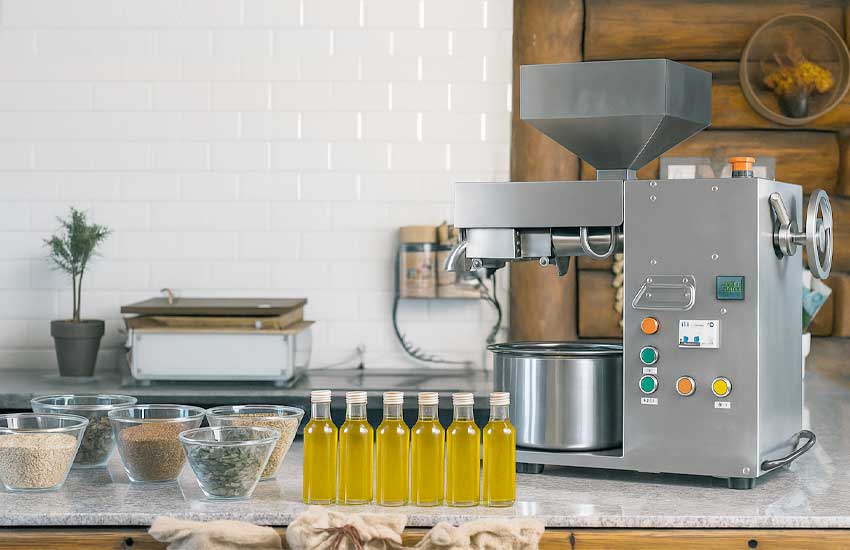
Why Local Oil Presses Are the Future of the Oil Industry
Challenges of the Global Oil Market
The modern vegetable oil market faces numerous challenges. The concentration of production in only a few regions of the world means that any geopolitical conflict, weather anomaly, or epidemic can disrupt supply chains. Prices of sunflower, rapeseed, and soybean oils fluctuate dramatically, making business planning difficult for both producers and consumers.
Additionally, long transport routes generate high logistical costs and a significant carbon footprint. In an era of growing environmental awareness among consumers, local oil production is becoming not only economically viable but also ethically desirable.
Benefits of Local Oil Production
A local oil mill offers a range of invaluable advantages.
First, it provides full control over product quality — from the seeds to the finished oil. The owner knows exactly where the raw materials come from, how they were grown, and how they were processed. This ensures the highest quality and transparency for end consumers.
Second, local production eliminates long supply chains, resulting in lower costs and greater pricing flexibility. A local producer can quickly respond to changes in demand and tailor their product range to the needs of the local market.
Third, running an oil press is a relatively low-entry business compared to other sectors of food processing. Modern semi-industrial presses allow entrepreneurs to start small, with the option to gradually expand production as demand grows.
Technology Empowering Small Entrepreneurs
The Evolution of Oil Pressing Machines
For decades, oil pressing was the domain of large industrial plants equipped with expensive production lines. Today, the situation has changed dramatically. Modern semi-industrial oil presses combine the efficiency of large-scale production with the affordability and accessibility needed by small business owners.
Today’s oil pressing machines are characterized by high efficiency, low energy consumption, and user-friendly operation. The automation of processes means that operating a press no longer requires specialized technical knowledge, while advanced monitoring systems ensure consistent quality control.
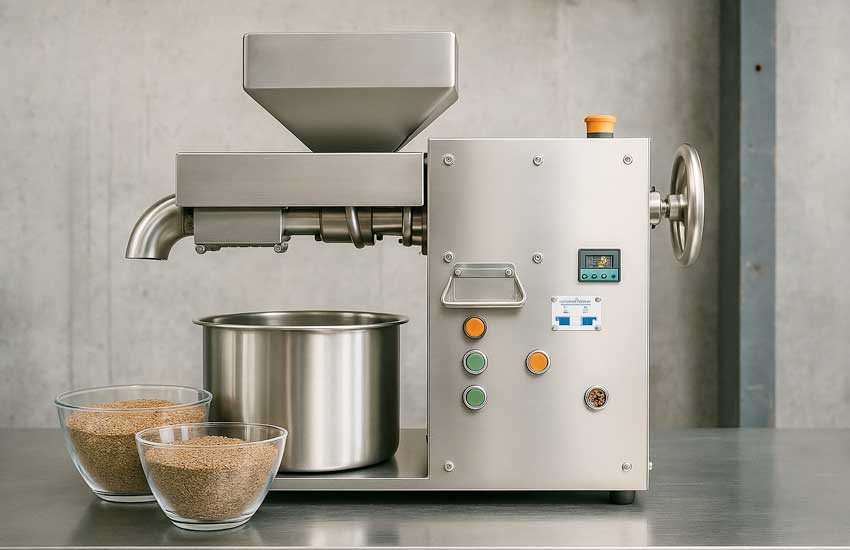
Semi-Industrial Oil Press – The Ideal Solution for Local Oil Mills
The semi-industrial oil press is particularly noteworthy as it represents the perfect solution for small oil mills and agricultural farms. This machine combines all the advantages of professional industrial-grade equipment with a price point accessible to small entrepreneurs.
Technical Specifications and Capabilities
The semi-industrial press is designed to meet the needs of medium-scale production, offering impressive performance parameters. The device can process 15 to 20 kg of seeds per hour, which translates to 4–7 liters of oil per hour, depending on the type of seeds used.
It is equipped with a 1.5 kW motor, providing optimal pressing pressure while maintaining low energy consumption. The heating system with precise temperature control allows for cold pressing (below 40°C), preserving all valuable nutrients — including vitamins, antioxidants, and unsaturated fatty acids.
Advanced Features and Automation
A modern control panel with an LCD display enables full monitoring and regulation of the pressing process. The operator can easily adjust temperature, pressure, and working time, ensuring consistent results and maximum yield.
Design and Durability
The robust construction ensures long-term operation under industrial conditions. All components that come into contact with oil are made of stainless steel, ensuring product safety and purity.
For enhanced efficiency, the press is equipped with two interchangeable screw augers.
The compact dimensions (approx. 70 × 30 × 74 cm) make it easy to install even in small facilities — a crucial advantage for small farms. Additionally, its low weight (around 53 kg) simplifies transport and setup.
Raw Material Versatility
The semi-industrial press handles a wide range of oilseeds, including rapeseed, sunflower, soybean, flaxseed, black cumin, sesame, and pumpkin seeds. Each type of seed requires specific parameter adjustments — easily achieved thanks to the machine’s advanced control system.
Performance is particularly impressive when pressing rapeseed, yielding 35–40% oil content, or about 7–8 liters of oil from 20 kg of seeds. For sunflower seeds, the yield can reach up to 45%.
Economic Aspects of Operation
This press allows for oil production both for personal use and small-scale commercial sales, making it an excellent choice for farmers seeking to diversify income sources.
With an estimated 4 hours of daily operation, 5 days a week, monthly output can reach 300–550 liters of oil.
Operating costs remain low — limited primarily to electricity, filter replacement, and routine maintenance. Given current market prices for high-quality oils, operational expenses typically represent only 15–20% of the oil’s retail value, leaving an attractive profit margin for small-scale producers.
Technical Support and Service
The manufacturer provides comprehensive technical support, including operator training, spare parts supply, and both warranty and post-warranty service.
Service availability within Poland ensures quick response times, minimizing downtime and maximizing productivity.
The sturdy design guarantees long-lasting and reliable operation, while the intuitive interface makes the machine easy to use even for individuals with no prior experience in oil pressing.
This is an investment that can pay for itself within the first year of use, especially when paired with smart sales management and the development of a loyal customer base.
Business Model of a Local Oil Mill
Market Segmentation and Target Groups
A local oil mill can serve multiple market segments, each with distinct needs and expectations.
The primary target group includes households seeking high-quality oils of known origin.
An increasing number of consumers are willing to pay more for local, eco-friendly products with verified quality and traceable sourcing.
The second key segment consists of local restaurants, bakeries, and confectioneries that require a steady supply of oil for culinary purposes. For these clients, quality, consistency of deliveries, and flexible cooperation terms are crucial.
The third segment includes agricultural farms that can bring their own seeds for pressing under the “from your own raw material” model.
This approach is particularly popular among organic farmers who want full control over the production process — from cultivation to the finished product.
Pricing Strategies and Distribution Channels
A local oil mill can implement flexible pricing strategies tailored to different customer segments.
For individual customers, prices can reflect a premium for local origin and superior quality.
For business clients, wholesale pricing can be offered for larger and recurring orders.
Distribution channels should emphasize the local nature of the business:
- Direct sales from the mill,
- Local markets and fairs,
- Health food stores,
- Online sales to reach a broader regional audience.
Building a strong local brand that emphasizes quality, sustainability, and community connection is key to long-term success.
Legal Requirements and Certification
Operating an oil mill requires compliance with specific legal and sanitary standards.
Necessary steps include obtaining official permits, registering the business, and implementing a HACCP (Hazard Analysis and Critical Control Points) system to ensure food safety.
For those processing organically grown seeds, obtaining organic certification is highly recommended.
Quality certifications not only build trust but also significantly increase the market value and attractiveness of the final product.
Modern consumers are increasingly attentive to transparency, health benefits, and ecological responsibility, which makes certified oils a desirable choice in today’s marketplace.
Profitability and Growth Prospects
Profitability Analysis
A local oil mill can achieve attractive profitability even at a relatively small production scale. The key lies in accurately estimating investment, operational, and marketing costs. Investment in a professional semi-industrial press usually pays off within 2–3 years, assuming consistent effort in building a solid customer base.
Profit margins on locally produced oils can be significantly higher than for mass-produced products. Consumers are willing to pay a premium for locality, freshness, and verified quality. Additionally, eliminating intermediaries in the distribution chain allows producers to retain a larger share of the profit margin.
Opportunities for Business Expansion
Starting with a small oil mill does not limit growth potential. Success at the local level can serve as a foundation for expansion into the wider regional market. It is also possible to broaden the product range to include other oil-based goods such as specialty oils, oilseed cakes for animal feed, or natural oil-based cosmetic products.
Collaboration with other local producers can lead to the creation of a distribution network for regional products. The oil mill can become a local agricultural processing hub, offering pressing services for other farmers within the community.
Challenges and Ways to Overcome Them
Seasonality of Production
One of the main challenges for a local oil mill is the seasonality of raw material supply. Most oilseeds are available only after harvest, which can lead to periods of shortage. Solutions include building seed storage facilities and diversifying raw materials—pressing different types of seeds at various times of the year.
It is also important to establish long-term contracts with local farmers to ensure a steady supply of raw materials. Contract farming can also be considered, financing seeds and production inputs in exchange for a guaranteed purchase of the harvest.
Competition with Large Producers
A local oil mill cannot compete on price with large producers, but it can offer values that they cannot provide. Freshness of the product, known origin, local customer service, and flexibility in customizing the product to individual needs are advantages that can tip the balance in favor of the local producer.
Building a brand and customer loyalty is a long-term process, but it can secure a stable market position. Consistent investment in quality and customer service is crucial.
Technical and Logistical Aspects
Running an oil mill requires basic technical knowledge and organizational skills. It is necessary to understand pressing processes, quality control, storage, and distribution. Fortunately, modern semi-industrial presses are designed for ease of use and do not require specialized training.
Logistics for raw material supply and distribution of the finished product must be carefully planned. Building a network of local suppliers and customers ensures smooth operations.
Sustainable Development and Environmental Considerations
Ecological Aspects of Local Production
A local oil mill is inherently environmentally friendly. Short transport routes mean low CO2 emissions, and using local raw materials supports sustainable agriculture. By-products of pressing, such as oil cakes, can be used as feed or fertilizers, creating a closed-loop system in the local economy.
Control over the entire production process allows for the implementation of eco-friendly solutions, such as the use of renewable energy sources and waste minimization.
Supporting the Local Economy
A local oil mill is an investment in the development of the local economy. It creates jobs, supports local farmers by providing a market for their products, and contributes to the growth of entrepreneurship in the region.
Building local value chains strengthens the economic resilience of communities against external shocks. This is especially important in times of economic uncertainty.
Future Technologies in Local Oil Mills
Automation and Digitization
The future of local oil mills will be shaped by technological advancements. Automation of processes, real-time quality monitoring systems, and digital management of inventory and sales will become standard even in small mills.
Modern semi-industrial presses already offer advanced automation features that significantly ease the operator’s work and ensure consistent product quality.
Innovations in Processing
Technological development allows for the introduction of innovative pressing methods that maximize oil extraction efficiency while preserving its nutritional properties. Cold-pressing technologies, filtration, and oil stabilization are becoming increasingly accessible to small producers.
It is also possible to introduce new products, such as functional oils enriched with vitamins or antioxidants, which can occupy a niche in the premium market segment.
Support and Financing
Government and EU Programs
The growth of local entrepreneurship, including oil mills, is supported by various financial programs. EU funds, grants for young farmers, rural development programs—these are just some of the available funding sources.
It is important to monitor available programs and actively apply for support. Professionally prepared funding applications can significantly reduce initial investment costs.
Collaboration with Financial Institutions
Banks are increasingly willing to finance investments in the agri-food sector, particularly those with innovative and ecological aspects. A local oil mill, as a low-risk business with predictable revenue, can benefit from favorable loan conditions.
Alternative forms of financing, such as crowdfunding or private investors interested in supporting the local economy, are also worth considering.
Practical Tips for Future Oil Mill Owners
Choosing the Location and Equipment
The location of an oil mill should be convenient for both raw material suppliers and product buyers, but it doesn’t have to be situated in a city center. It is important to ensure adequate storage space and access to utilities such as electricity, water, and sewage systems.
Choosing the right equipment is a crucial business decision. The semi-industrial presses available on the Polish market offer an optimal solution for those starting their operations. They combine professional capabilities with affordability and ease of use.
Building a Brand and Customer Relationships
The success of a local oil mill largely depends on the ability to build a strong brand and lasting customer relationships. Local identity, quality, and tradition are the key values that should be consistently communicated. Social media, a company website, and participation in local events are effective channels for reaching potential customers.
Equally important is building trust through transparency in production processes. Allowing customers to visit the mill, observe the pressing process, and meet the producer creates an authentic connection that fosters customer loyalty.
Financial Planning and Risk Management
Every business involves risk, and a local oil mill is no exception. Fluctuating raw material prices, seasonal demand, and competition are factors that can impact profitability. Careful financial planning and maintaining reserves for challenging periods are essential.
Diversifying income sources can significantly reduce business risk. In addition to selling oil, the mill can offer pressing services for other farmers, sell by-products, or expand into other food production activities.
The Future of the Local Oil Mill Market
Trends and Forecasts
All trends point toward the growing importance of local food production. Consumer awareness, climate change, and geopolitical uncertainty are key drivers increasing demand for locally produced oils. Experts predict dynamic growth in the local oil mill segment over the coming years.
Technological advancements will continue to empower small producers, giving them access to tools once reserved for large corporations. This could lead to the democratization of the oil industry and the rise of many small, independent local producers.
Global Challenges as Local Opportunities
Paradoxically, global challenges can become opportunities for local oil mills. Disruptions in international supply chains increase the value of local production, while rising transportation costs make locally produced oils more price-competitive.
Climate change may also benefit local production by shortening crop cycles and enabling greater diversification of raw materials.
Frequently Asked Questions (FAQ)
What are the startup costs for a local oil press?
The startup costs for a local oil press depend on the scale of production and the equipment selected. For a small oil mill equipped with a professional semi-industrial press, total costs typically range between 50,000 and 150,000 PLN, including the cost of the press, facility setup, required permits, and working capital for the first months of operation.
It’s worth noting that various funding programs and grants are available, which can significantly reduce the initial investment costs.
Which seeds are best suited for pressing in a small oil mill?
In Polish climate conditions, the best results are achieved with rapeseed, sunflower, flax, and soybeans.
Rapeseed is particularly attractive due to its high oil content (around 40%) and wide availability.
Sunflower seeds also yield a high percentage of oil and are gaining popularity among consumers.
Flaxseed produces oil with exceptional health benefits, often commanding premium prices on the market.
The choice of seeds should be adjusted to local growing conditions and consumer preferences.
How long does it take to recover the investment?
The return on investment (ROI) for a local oil press typically ranges from 2 to 4 years, depending on production scale, sales efficiency, and profit margins.
Building a stable customer base and establishing long-term supply contracts are key success factors.
With consistent business development and cost management, some oil mills achieve profitability within the first year.
Does running an oil press require specialized qualifications?
Modern semi-industrial oil presses are designed for simplicity and do not require advanced technical expertise.
Basic training in machine operation, oil quality control, and hygiene standards is sufficient to start production.
Most equipment suppliers offer comprehensive training for new owners.
Business and marketing skills are often more important than technical knowledge for long-term success.
What is the shelf life of oil produced in a local press?
The shelf life of cold-pressed oil typically ranges from 3 weeks to 6 months, depending on storage conditions.
It must be protected from light, oxygen, and heat to preserve its quality.
Oil should be stored in dark glass bottles or containers in a cool environment.
Local production has the advantage of delivering oil to customers shortly after pressing, ensuring maximum freshness and nutritional value.
What are the main sales channels for a local oil press?
A local oil mill can sell through a variety of channels, including:
- Direct sales from the mill,
- Partnerships with health food stores,
- Supplying restaurants and bakeries,
- Local markets and fairs,
- Online sales, and
- Home delivery or subscription models, where customers receive fresh oil regularly.
Diversifying sales channels and building long-term customer relationships are key to business stability.
Summary: Time for a Local Oil Revolution
A local oil mill is not only a profitable business opportunity but also a response to modern economic and environmental challenges.
In an era of supply chain uncertainty, rising transportation costs, and increasing consumer awareness, local oil production is becoming both economically viable and strategically necessary.
Technological progress — especially in semi-industrial oil presses — makes this business model accessible to small entrepreneurs and farmers.
An investment in professional equipment can become the foundation for a sustainable and profitable enterprise.
The future belongs to those who can combine local tradition with innovation.
A local oil mill can thrive independently of global disruptions, delivering high-quality products to the community and strengthening the foundation of a resilient local economy.
Are you ready to join the local oil revolution?
Opportunities are within reach — the market is waiting for visionary entrepreneurs ready to turn global challenges into local success stories.