
Table of Contents
- From the Press to the Shelf – a Journey That Ends with a Label
- What Must Appear on a Vegetable Oil Label
- Why Manual Labelling Stops Being Worthwhile
- LST-150 Labeller with Date Coder – a Semi-Automatic Solution for Small and Medium Producers
- The Labelling Process Step by Step
- Choosing Labels for Oil – Material, Size, and Print
- Seasonal Production and Labelling Planning
- Labelling as Part of Building Your Own Oil Brand
- Frequently Asked Questions
Pressing oil at home or on a small scale is an increasingly common practice – both on farms set up for food processing and in small local oil mills supplying a regional market or an online shop. When the oil press is running smoothly and the seeds arrive on time, it can feel as though the hardest part is already behind you. For many producers, however, the real challenge begins at the packaging stage – when a bottle of freshly pressed oil needs a label that meets food law requirements, carries a best-before date, and looks professional enough to earn customer trust.
The difference between oil sold with a label printed on a home inkjet printer and stuck on by hand, and a product bearing a neatly applied, properly printed label with a production date is striking – and it shows the moment a sale is made. A consumer standing in front of a shelf in a health food store, or browsing product images in an online shop, makes a buying decision in a matter of seconds. At that moment the label is the only available information about the product and the person behind it. If it is crooked, smudged, or uneven, it raises doubt – even when the oil itself is excellent, pressed from the best seeds, according to a proven recipe.
This article explains what must appear on a vegetable oil label, why manual labelling quickly becomes a production bottleneck, how to choose labels that withstand oily packaging, and how a semi-automatic labelling machine with a date coder can solve all these problems at once – without investing in an expensive production line.
From the Press to the Shelf – a Journey That Ends with a Label
The entire production cycle of cold-pressed oil can be divided into several distinct stages: raw material preparation, pressing, filtration or sedimentation, bottling, and finally – labelling and capping. Each stage has its own pace and rhythm. An oil press may process several tens of kilograms of seeds per hour. A modern filling machine can fill bottles at the rate of several dozen units per minute. If labelling is done entirely by hand, and only one or two people work in a small oil mill, this stage is usually the first to cause delays.
Scale matters here. When production runs to a few dozen bottles a week, manual labelling can still be absorbed into the normal work routine. When output reaches several hundred bottles per shift, the time spent applying each label individually, straightening it on the bottle, and then date-stamping it with a hand stamper adds up to many working hours a month. Hours that could go toward pressing the next batch of oil, serving customers, or growing sales are consumed by a task that is repetitive and prone to error.
It is also worth looking at this stage from the perspective of the whole process. A producer who has invested in an efficient oil press, a good filter, and a precise filler builds their entire production capacity only to hit a manual labelling bottleneck at the very last step. Mechanising the labelling stage is therefore a logical move for anyone who treats oil production as a business or semi-business activity.
The labelling stage has another dimension, often overlooked in conversations about production optimisation: a legal one. Every bottle of oil sold on the market must meet specific labelling requirements, and failing to comply can have serious consequences.
What Must Appear on a Vegetable Oil Label
Before a producer chooses labelling equipment, it is worth understanding exactly what information must appear on the label. Polish and EU legislation on food labelling is unambiguous, and non-compliance can result in an administrative decision from the Sanitary or Trade Inspection, a recall order for a batch, and in more serious cases, financial penalties.
The main piece of legislation is Regulation (EU) No 1169/2011 of the European Parliament and of the Council of 25 October 2011 on the provision of food information to consumers. This Regulation applies directly in all EU Member States and sets out precise requirements for the labelling of food products, including vegetable oils.
Mandatory information on an oil label
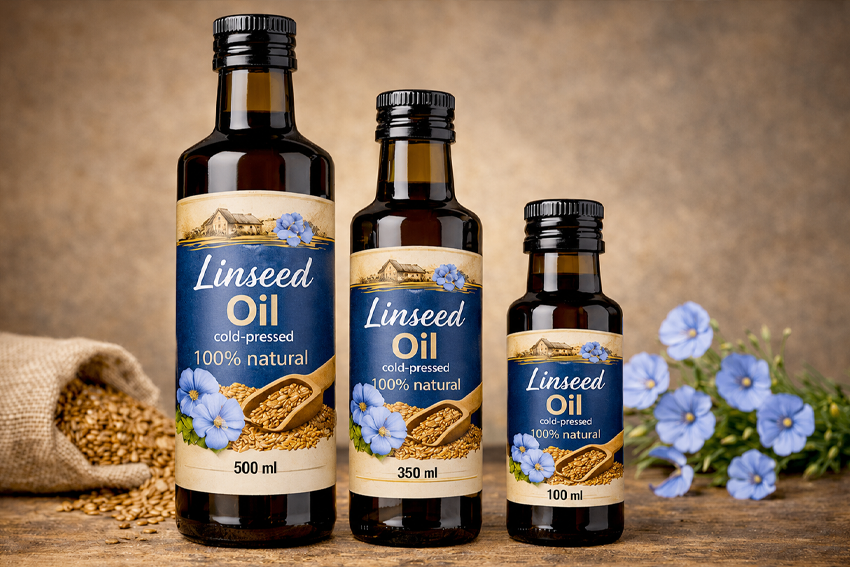
Every bottle of vegetable oil intended for sale must carry a name that is unambiguous and does not mislead the consumer. The word "oil" alone is not enough – the raw material must be specified (e.g. linseed oil, pumpkin seed oil, rapeseed oil) and the processing method should be indicated where it is relevant to the product's characteristics (e.g. cold-pressed, unrefined). For single-variety oils consisting of one type of seed only, an ingredient list may be omitted, but it is mandatory for blended oils.
Other compulsory elements include the net quantity expressed in millilitres or litres, the best-before date preceded by the phrase "best before", storage conditions (e.g. "store in a cool, dark place; refrigerate after opening"), and the name and address of the producer or distributor. The country or place of origin must be stated where its omission could mislead the consumer about the product's true origin. A mandatory nutrition declaration is also required, covering energy, fat, saturates, carbohydrate, sugars, protein, and salt.
Font size requirements are equally strict: the minimum character height for mandatory information is 1.2 mm on packaging with a surface area greater than 80 cm². All mandatory information must be clearly visible, legible, and indelible.
Best-before date vs. use-by date – a distinction that matters
In everyday language both dates are often confused, but food law draws a clear distinction. A use-by date (marked "use by") applies to highly perishable products where consumption after that date poses a health risk – fresh meat, certain dairy products, and similar goods. A best-before date ("best before") is used for products that may lose flavour, aroma, or nutritional quality after that date but pose no health risk. Vegetable oils fall into this second category.
The producer sets the best-before date based on their own testing or industry data. For cold-pressed, unrefined oils, shelf life typically ranges from six to twelve months from the pressing date, depending on the type of oil and storage conditions. Oils rich in polyunsaturated fatty acids – linseed oil and walnut oil, for example – oxidise faster than those dominated by monounsaturated fats, such as rapeseed or olive oil. The best-before date may be printed directly on the packaging or on the label itself – the latter is more common in small-scale production, since it allows a single label design to be used for many different production batches. This is precisely where a date coder becomes essential: instead of printing separate labels with a different date for each batch, the producer uses one label design and prints the date thermally at the moment of application.
Why Manual Labelling Stops Being Worthwhile
For the owner of a small oil mill starting out with a few hundred bottles a month, investing in specialist equipment can seem unnecessary. The problem is that this perspective shifts dramatically as production grows.
Time is the primary argument. Applying a single label by hand – straightening it on the bottle, pressing it down, and stamping the date – takes an experienced worker an average of fifteen to thirty seconds. At a thousand bottles, that adds up to four to eight hours of work devoted solely to labelling. At the throughput of a labelling machine running at up to forty units per minute, the same thousand bottles takes about twenty-five minutes – with one operator, no fatigue, and no errors born of monotony.
The second argument is quality and consistency. A hand-applied label will never be as straight as one applied mechanically to an accuracy of half a millimetre. A label tilted a few degrees, with a slight air bubble beneath the film, or with a unevenly stamped date, undermines confidence in the product's quality – even when the oil itself is superb. For a producer who wants to build a brand and sell oil through an online shop or to health food stores, the appearance of the bottle is part of the marketing communication.
The third argument is labour cost. Hours spent on manual labelling are hours that could be devoted to pressing, customer service, sales, or developing the product range. The return-on-investment calculation for a labelling machine must therefore include not only the price of the machine, but also the value of the working time it frees up.
A fourth, often overlooked argument is ergonomics. Hours of repetitive manual labelling strain the wrists, back, and eyes. Automating this stage improves both the pace of work and the wellbeing of those doing it.
LST-150 Labeller with Date Coder – a Semi-Automatic Solution for Small and Medium Producers
The market offers labelling machines in a very wide range of configurations – from fully automatic conveyor lines to simple hand-held applicators. For an oil producer handling between a few hundred and a few thousand bottles per month, the optimal choice is a semi-automatic model: one that requires an operator, but applies the label and prints the date mechanically, quickly, and consistently.
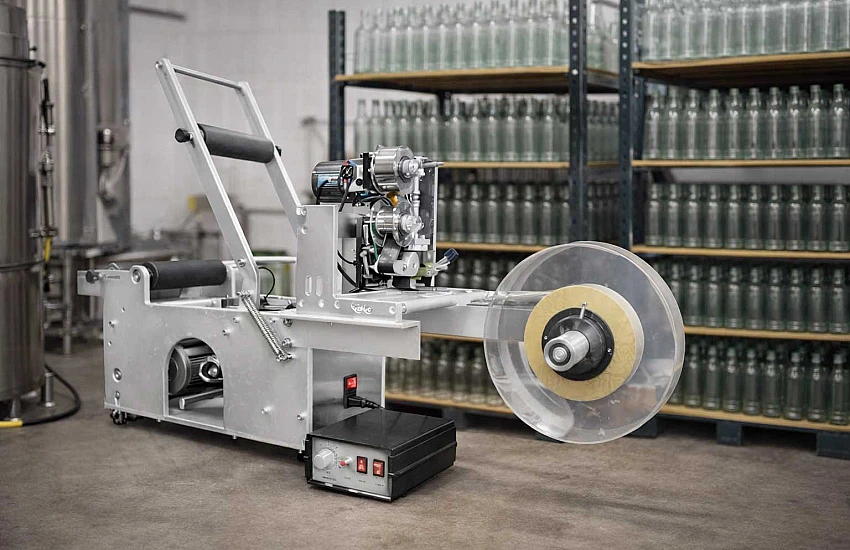
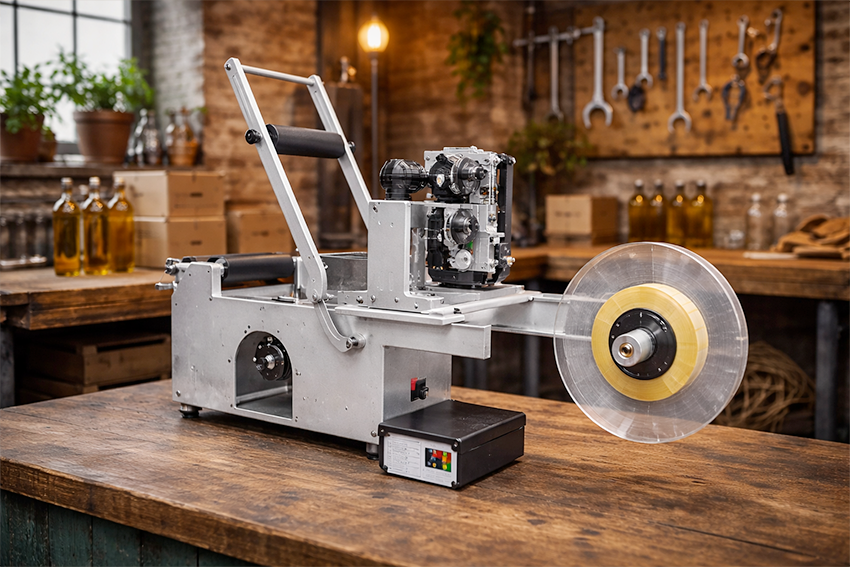
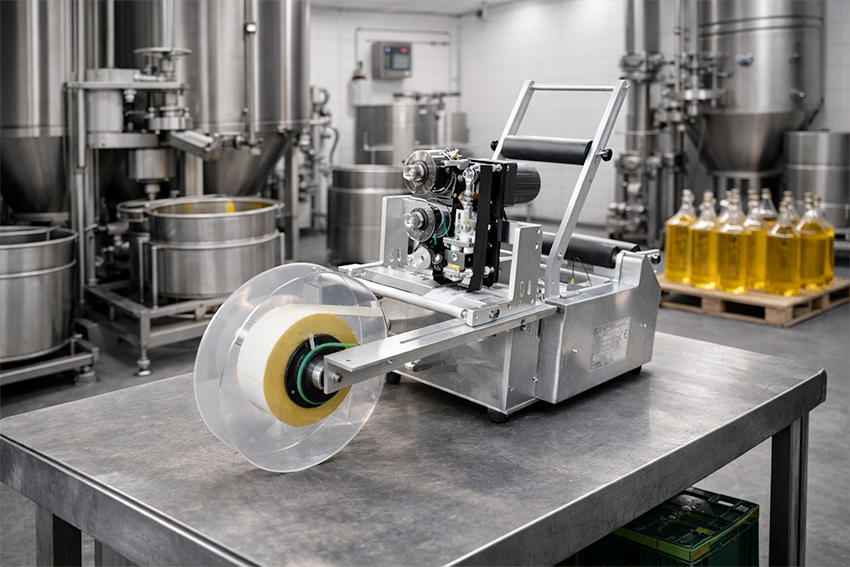
One such machine is the Semi-Automatic Round Bottle Labeling Machine with Date Coder available at pureoilpress.com. The machine is designed for cylindrical packaging – glass and PET bottles, jars, cans – and combines two functions in one: precise application of self-adhesive labels and thermal date coding at the moment of application. This combination eliminates the need for two separate operations and significantly speeds up the entire packaging process.
Technical specifications and capabilities
The LST-150 handles containers with a diameter of 15 to 120 mm, meaning it works equally well with narrow bottles for flavoured or speciality oils (50–100 ml) and large jars or litre-sized bottles. Labels may be 26 to 150 mm wide and 25 to 300 mm long, giving considerable flexibility when designing labels for different container formats. In practice, one machine can handle an entire range of packaging used by an oil producer – from small bottles to large jars.
The machine's rated throughput is up to 40 units per minute, which translates to approximately 2,000–2,400 bottles per hour with an efficient operator. Label placement accuracy is ±0.5 mm – a level of precision impossible to achieve by hand. The machine operates in semi-automatic mode: the operator presents the bottle, the machine draws a label from the roll, prints the date, and applies the label to the container. One movement from the operator – one finished, labelled product.
The label roll has an outer diameter of up to 275 mm with a 75 mm core – the standard used by most self-adhesive label suppliers. No specialist materials are needed; a standard label printer's offering is sufficient. The machine's footprint is modest: 87 × 28 × 34 cm (length × width × height), and it weighs 25 kg, so it can be installed on a standard workbench. Power consumption is just 120 W at 230 V / 50 Hz – a standard socket is all it needs.
Hot stamp date coder – what it means in practice
The feature that sets the LST-150 apart from basic labelling machines is its built-in date coder operating on hot stamping technology. In practice, this means the machine contains a mechanism with interchangeable numeric characters that are electrically heated to a temperature that transfers the impression to the label surface by thermal pressure – without the use of ink in the conventional sense, and with no ink ribbons to replace on a regular basis.
The date coder can imprint any combination of digits and letters on the label – production date, best-before date, batch number, serial number, shift code – in a single-line or three-line layout. Numbers can be separated by spaces or grouped as the operator requires. A wide range of character sets is supplied with the machine, allowing configuration without any additional purchases from day one.
From a practical standpoint, a thermal date coder has several advantages over a conventional stamp pad. The impression is positioned precisely in the same place on every label, it does not smear after application, and it does not fade on contact with moisture or oil that may appear on a bottle during storage or transport. Crucially, the whole process happens at the moment of label application – with no separate stamping operation. For a producer selling oil to shops or through an online store, this is a significant aesthetic advantage: every bottle looks tidy and identical, which communicates professionalism.
Who is this machine for
The LST-150 is aimed primarily at small and medium food producers who have crossed, or are crossing, the threshold at which manual labelling stops making sense. In the context of oil production, this means mills pressing between a few hundred and a few thousand bottles per month – supplying a local network of health food stores, selling through their own online shop, attending farmers' markets and regional food fairs, or delivering oil to restaurants and cafés.
The machine works equally well for labelling bottles of vinegar, fruit and vegetable juices, tinctures, syrups, and other products in cylindrical containers. If an oil mill also produces apple cider vinegar or fermented vegetable juice, the same machine handles the whole product range without investing in several separate pieces of equipment. Leasing and instalment purchase options are available directly through pureoilpress.com, making it possible to spread the investment over time.
The Labelling Process Step by Step
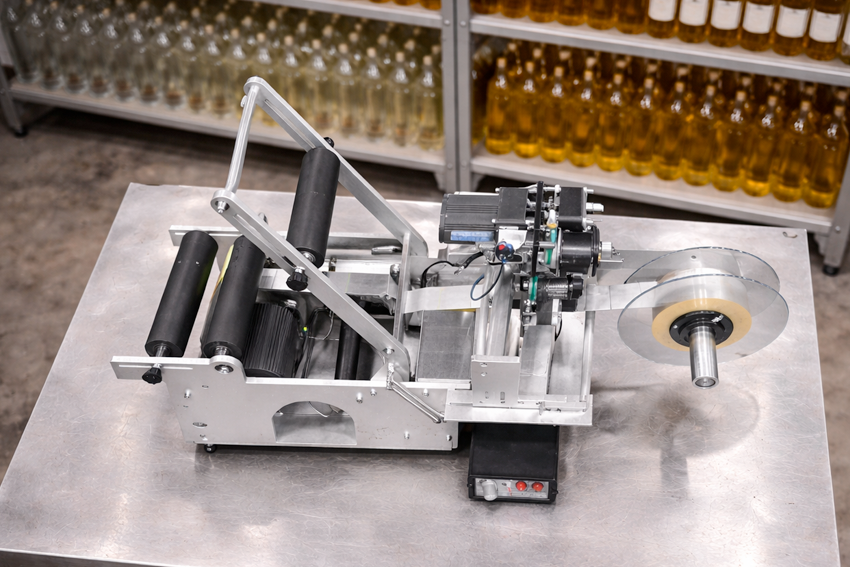
Operating the LST-150 requires no specialist training. After loading the label roll, setting the date coder to the correct date, and adjusting the guides to match the bottle diameter, the machine is ready for work. Configuring the machine for a new container format typically takes a few minutes and requires no specialist tools.
The work rhythm is simple and repeatable. The operator picks up a bottle or jar, positions it against the machine's guide, and the mechanism draws a label from the roll, passes it through the thermal date coder – printing the configured combination of digits and/or letters – and applies it to the outer surface of the container. The finished product is immediately and precisely labelled, with no further steps needed.
Switching between different bottle formats or label sizes requires only adjustment of the guides and possibly the roller spacing. For a producer offering oil in several size variants – 250 ml, 500 ml, and 1,000 ml, for example – this flexibility is important: one machine handles the entire range. Machine maintenance is minimal: regular cleaning of the date coder head to remove thermal residue, checking the condition of the guide rollers, and keeping the label web properly tensioned – all tasks that take a few minutes without calling a technician.
Positioning the labelling station sensibly within the overall production workflow matters too. It is best placed after filling and capping, before final packing or palletising. With a well-organised layout, one person can comfortably manage both the filling machine and the labeller, using a small buffer of bottles between the two machines to maintain continuous flow.
Choosing Labels for Oil – Material, Size, and Print
The labelling machine is only part of the picture – choosing the right self-adhesive labels is equally important. Vegetable oil is a product that can spill onto the outer surface of a bottle during filling, transport, or consumer use. The label must be resistant to grease. If the adhesive loses its grip or the print begins to smear on first contact with an oily surface, the entire visual effect is ruined.
Self-adhesive labels for vegetable oils
For labelling vegetable oils, film-based self-adhesive labels on a polypropylene (PP) or polyethylene (PE) substrate with a permanent adhesive resistant to oils and moisture are strongly recommended. Film labels are far more durable than paper ones: they do not absorb grease, they maintain print legibility throughout the product's entire shelf life, and they look better on glass bottles. Some suppliers also offer a no-label look – transparent labels that give the impression of print applied directly to the glass. This is a popular aesthetic choice for premium oils and olive oil.
When designing a label, it is worth aligning the dimensions to the machine's parameters from the outset – width between 26 and 150 mm, length between 25 and 300 mm. Standard labels on 75 mm core rolls are available from many domestic and international suppliers. For producers making oil from several different seeds, or introducing seasonal varieties, the ability to print short label runs quickly – on an in-house label printer or through a digital label printer – adds significant production flexibility without the need to hold large inventories of printed labels.
The label design should incorporate all legally required information as well as graphics consistent with the producer's visual identity. A label is a marketing tool, and its design deserves careful attention. A well-designed label tells a brief story about the oil: where it comes from, how it was pressed, and why it is worth buying. For a producer with a strong regional identity, the label is often the first and only point of communication with the buyer.
Seasonal Production and Labelling Planning
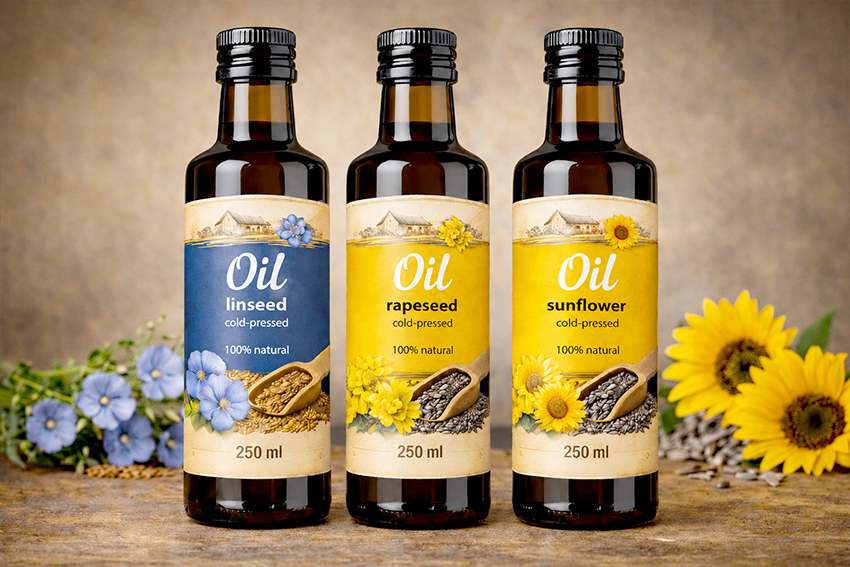
Oil producers know that pressing has its season. Rapeseed, sunflower, and flaxseed harvests fall in specific months; pressing happens after the harvest; and the oil stock sells through over the rest of the year. Within this cycle, labelling is not evenly distributed across the year – there are periods when thousands of bottles need labelling in a short time, followed by quieter stretches. This very unevenness is one argument for investing in a labelling machine: the machine waits for its moment, and when the season comes, it is ready to run at full capacity.
When planning the labelling of a seasonal batch, it is also worth ordering labels well in advance. Label printing typically takes several business days, and lead times may be longer during peak season. A producer who plans the labelling stage at the time of sowing or seed purchase will not be caught short of packaging materials on the eve of a bottling run. A well-stocked label inventory – two or three rolls for each bottle format – allows work to proceed without interruption.
It is also worth bearing in mind that labelling requirements can change. EU food law is subject to revision, and a producer who keeps label artwork in an editable format and maintains a good relationship with their label printer can react quickly to new requirements without writing off a stock of pre-printed labels. A thermal date coder, which applies the date and batch number only at the moment of production, adds further flexibility: one label design can serve for an entire year, with no need to print a separate version for each batch.
Labelling as Part of Building Your Own Oil Brand
In recent years there has been a clear increase in interest in oils from local mills. Consumers are looking for products that have a concrete story, a specific region, and a specific producer behind them. Oil from your own press – cold-pressed, unrefined, made from seeds grown locally – can be a premium product commanding a significant price premium over refined oil from a discount supermarket. The prerequisite is consistent, professional communication, of which the label is one visible expression.
A label that meets legal requirements, looks good, holds up on the bottle, and carries a neatly printed date builds trust at the exact moment a buying decision is made. A producer who invests in packaging quality from the outset is simultaneously building their reputation. The word-of-mouth opinion about the product – passed from consumer to consumer, and written in online reviews – is the most powerful marketing tool a small oil mill has. And the first impression is built by the label.
It is also worth remembering that labelling is subject to inspection by the Trade Inspection and Sanitary Inspection authorities. A missing date, illegible producer information, or an incorrectly stated oil type can result in a recall order and administrative penalties. Investing in equipment that ensures precise and consistent date coding is therefore not merely a matter of convenience, but a risk management measure for the business.
A machine like the LST-150 takes up relatively little space and requires no changes to the workbench – it is a tabletop unit, powered by a standard socket, ready for work after a few minutes of setup. For an oil producer who wants to maintain the highest quality from pressing through to the shop shelf, it is a natural extension of the equipment line-up – one that closes the production loop at a worthy level.
Frequently Asked Questions
Is the LST-150 labeller suitable for glass oil bottles?
Yes, the machine is designed specifically for cylindrical containers, including glass, PET, and HDPE bottles with a diameter of 15 to 120 mm. Bottles used for vegetable oils – most commonly 50 to 80 mm in diameter – fall comfortably within this range. Glass bottle surfaces accept film-based self-adhesive labels with oil-resistant permanent adhesive very well, and the label placement accuracy of ±0.5 mm ensures a neat, consistent result on every single bottle.
How does the thermal date coder in the LST-150 work, and is ink required?
The date coder in the LST-150 operates on hot stamping technology – instead of ink it uses heated metal character dies that transfer the impression to the label surface by thermal pressure. No separate ink or replacement ink ribbons are required for normal operation. A wide range of interchangeable numeric and alphabetic character sets is included with the machine, allowing any combination of dates, batch numbers, or codes to be configured without additional purchases from the start.
How many labels per hour can the LST-150 apply?
The rated throughput is up to 40 units per minute, which translates to a maximum of 2,400 bottles per hour with an efficient operator running a standardised process. In practice, accounting for bottle-feeding time, brief pauses, and the occasional label roll change, realistic throughput is in the range of 1,200 to 1,800 bottles per hour. This is still many times what manual labelling can achieve: an experienced worker applying labels by hand can typically manage 120 to 240 bottles per hour, which quickly becomes a limiting factor as production grows.
Can the machine label jars or other non-bottle cylindrical containers?
Yes, provided the container has a cylindrical or near-cylindrical cross-section with a diameter within the 15–120 mm range. Glass jars with a cylindrical side wall are handled without difficulty, as long as the label is to be applied to the side surface. The machine is not designed for flat surfaces, square containers, or lids – these require a different type of label applicator.
What self-adhesive labels are suitable for cold-pressed oil?
For labelling vegetable oils, film-based self-adhesive labels on a polypropylene (PP) or polyethylene (PE) substrate with a permanent, oil- and moisture-resistant adhesive are strongly recommended. Paper labels in contact with oil lose their adhesion and may peel or be damaged. Labels should have a 75 mm core and fall within the dimensions: width 26–150 mm, length 25–300 mm. Standard film self-adhesive labels on rolls are available from many domestic and international suppliers.
Does a small-scale home oil producer need to date-stamp their product?
Yes. Any vegetable oil sold as a food product – regardless of the scale of production – must carry a best-before date in accordance with Regulation (EU) No 1169/2011. The date is preceded by the words "best before" and is mandatory on every container intended for commercial sale, whether sold at a market, online, or direct from a farm. The absence of a date constitutes a violation of food law and can result in an administrative recall order and financial penalties.
Is the LST-150 available on a leasing or instalment basis?
Yes – the machine can be purchased on a leasing or instalment plan, available directly through pureoilpress.com. This is a particularly attractive option for small producers who want to invest in labelling automation without committing the full purchase price at once. Leasing allows the cost of the machine to be treated as an operating expense and spread across monthly payments matched to the oil mill's current cash flow.