
Table of Contents
- Cold-Pressing Technology and Its Significance for Gastronomy
- Freshness as a Differentiator in the Competitive Gastronomic Market
- Home Production Versus Semi-Industrial Approach
- Multifunctionality in Gastronomic Practice
- Practical Applications in Different Types of Establishments
- Economic Aspects and Return on Investment
- Technical Aspects of Equipment Selection for Small Gastronomy
- The Pressing Process and Work Organization
- Seasonality and Production Planning
- Marketing and Customer Communication
- Common Challenges and How to Solve Them
- The Future of Own Pressing in Gastronomy
- Is It Worth Pressing Your Own Oil in Small Gastronomy?
- How to Start Pressing Cold Oil in Your Gastronomic Kitchen?
- Why Fresh Oils Are the Future of Small Gastronomy?
- FAQ
Modern gastronomy is undergoing a consciousness revolution. Customers increasingly ask not only about the taste of dishes but also about the origin of ingredients, their preparation methods, and nutritional value. In this context, cold-pressed oils become not just a trend but a real competitive advantage. The ability to boast that the oil used in dish preparation was produced on-site, just hours before serving, is an argument that no distribution chain can offer.
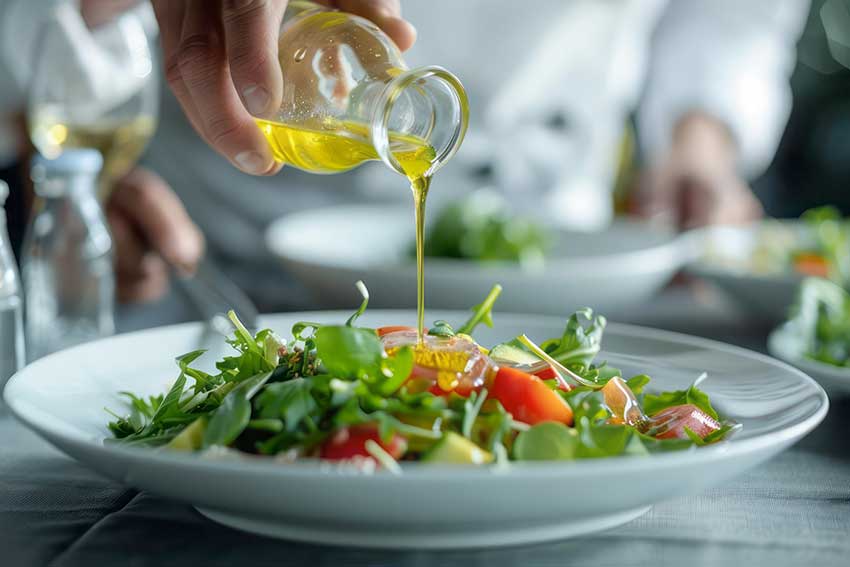
Freshness in the kitchen has many meanings. We talk about it in the context of vegetables delivered directly from local farms, bread baked every morning, or herbs picked to order. Fresh cold-pressed oils belong to the same category, although they are still a rarity in small-scale gastronomy. Meanwhile, their culinary and marketing potential is enormous. Sunflower oil pressed in the morning has a completely different flavor profile than one sitting on the shelf for weeks. It has a more intense aroma, more vivid color, and retains all the delicate notes that the cold-pressing process allows to capture.
The decision to press oil in-house is no longer the domain of Michelin-starred restaurants. Technological development has made compact semi-industrial presses available to medium-sized restaurants, bistros, food trucks, and food manufactures. These devices combine professional efficiency with dimensions that allow installation in a typical kitchen or small back room.
Cold-Pressing Technology and Its Significance for Gastronomy
What Is Cold Pressing
Cold pressing is the process of oil extraction from seeds at temperatures not exceeding forty degrees Celsius. This is a key parameter because higher temperatures, while increasing process efficiency, destroy sensitive nutrients. Unsaturated omega-3 and omega-6 fatty acids, natural antioxidants, fat-soluble vitamins - all these substances remain intact only when the temperature during extraction is strictly controlled.
Flavor Profiles of Different Oils
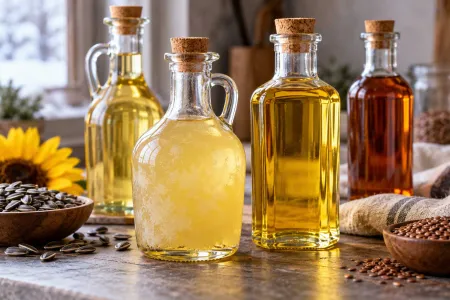
In the gastronomic context, what matters is not only nutritional value but above all the flavor profile. Cold-pressed sunflower oil has a delicate, nutty aftertaste with a note of freshness. Flaxseed oil is intensely grassy with characteristic bitterness. Rapeseed oil presents mildness with a slightly cabbage-like accent. All these nuances disappear during high-temperature pressing and industrial refining. For a chef, this is a palette of flavors that can be composed similarly to spices or herbs.
Mechanism of Modern Presses
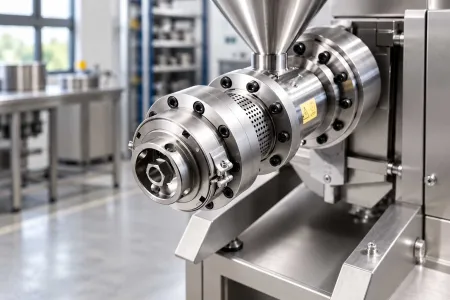
The cold-pressing process is relatively simple technically but requires appropriate equipment. Modern presses use a screw mechanism that extracts oil from seeds through controlled compression. The key is maintaining a constant process temperature. Too slow pressing extends working time, too fast can lead to overheating. Good devices have a precise control system that automatically adjusts working parameters to the type of seeds being pressed.
Efficiency and Working Time
For a gastronomic establishment, the practical aspect also matters - the duration of the process. Pressing cannot take up half the kitchen's working day. An efficiency of fifteen to twenty kilograms of seeds per hour is the optimal solution for a medium-sized restaurant. This allows pressing several liters of oil in two to three hours, which when planning production at the beginning of the week provides full flexibility.
Freshness as a Differentiator in the Competitive Gastronomic Market
Consumer Awareness and Willingness to Pay More
The gastronomic market is extremely competitive. Restaurants compete for customers through various methods - from lowering prices to inventive menus. Ingredient freshness has become one of the most important selling arguments in recent years, confirmed by consumer behavior studies. Customers are willing to pay more for a meal if they know it was prepared from the highest quality, fresh products.
Storytelling and Visual Marketing
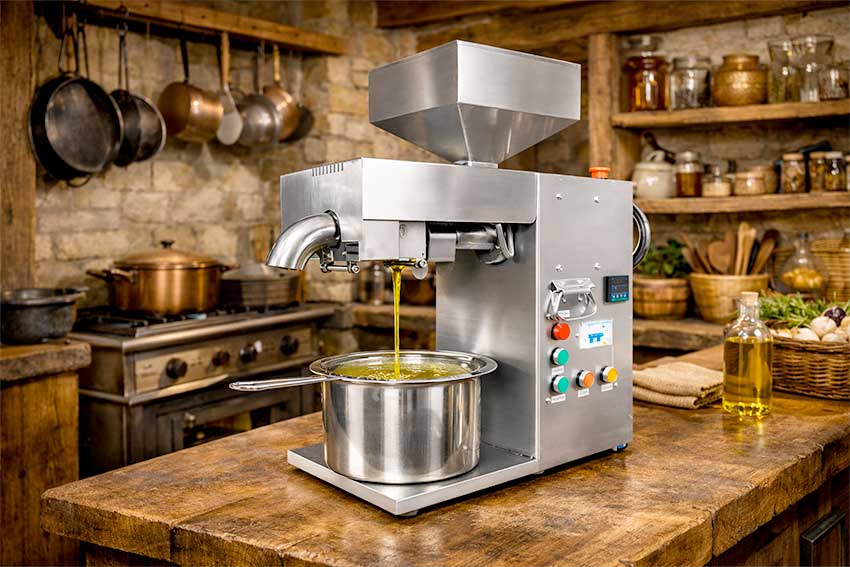
Oils pressed on-site fit perfectly into this narrative. They can become an element of brand storytelling, especially if the kitchen or back room location allows showing the pressing process to guests. A transparent wall separating the dining room from the production area where the press stands is a solution increasingly popular in open kitchen concepts. Guests can observe how golden oil is created from seeds, which will soon be on their plate.
Authenticity and Customer Engagement
Marketing based on freshness requires authenticity. It is not enough to buy a press and place it in a visible spot. You need to actually use it, show the process, talk about it. It is worth considering organizing culinary workshops where guests themselves press oil and learn to use it. Such events build loyalty and generate valuable promotion on social media.
Shorter Shelf Life as an Advantage
The aspect of freshness also concerns oil durability. Cold-pressed, unrefined oil has a shorter shelf life than its industrial counterpart. This is not a disadvantage but a feature. In small gastronomy, where production occurs according to current needs, excessive stocks never arise. Oil pressed on Monday will be used by the end of the week, maintaining maximum properties throughout this time.
Home Production Versus Semi-Industrial Approach
Characteristics of Home Production
The boundary between home and semi-industrial production in the context of oil pressing is not sharp. For a small family restaurant or bistro, production may resemble home production - a few kilograms of seeds daily, pressing conducted ad hoc, according to needs. For a larger establishment, food truck serving dozens of customers daily, or manufacture also selling oils for takeaway, production already takes on a semi-industrial character.
The home approach is characterized by flexibility and small scale. The press can stand in the kitchen, next to other equipment. Pressing occurs when fresh oil is needed - for example, in the morning before service begins or in the evening, preparing the base for the next day. This type of production does not require a dedicated room or separate operator. Every member of the kitchen team can operate the press after brief training.
Specifics of Semi-Industrial Production
Semi-industrial production assumes greater systematicity. Oil is pressed according to schedule, in specific quantities, with consideration not only for current kitchen needs but also for potential retail sales. This requires better space organization - a dedicated pressing station, space for seed storage, and bottles for pouring finished oil. Production documentation is also necessary, especially if oil is to be sold separately.
Semi-Industrial Press LY-129 as the Optimal Solution
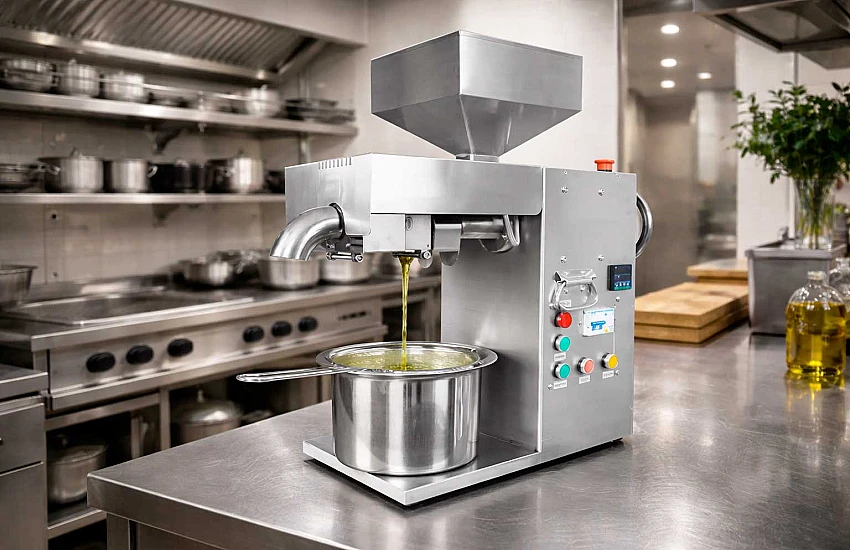
Regardless of production scale, the key factor is choosing appropriate equipment. A semi-industrial oil press, such as the LY-129 model, represents the optimal point between home devices and large production lines. The efficiency of fifteen to twenty kilograms of seeds per hour is precisely this golden mean - enough to satisfy the needs of even a busy restaurant, but not so much that the process takes all day. You can find this press at https://www.pureoilpress.com/en/product/semi-industrial-oil-press-15-20-kgh for approximately $2,700.
Quiet Operation and User Comfort
Equally important is the noise issue. A press working in the kitchen or back room cannot be a source of irritating sound for several hours daily. Modern constructions with a motor of about one and a half kilowatts ensure quiet operation that does not interfere with normal kitchen functioning. This is particularly important in open kitchen establishments, where guests sit almost in the middle of the production space.
Stability of Efficiency in Continuous Work
Stability of efficiency is another technical parameter that has key significance in gastronomy. The press cannot change its work pace mid-process or suddenly require interruption and cleaning. Professional devices ensure constant efficiency throughout the pressing session, regardless of whether we are processing rapeseed, sunflower, or flaxseed. This predictability allows precise production planning and avoiding situations where fresh oil runs out in the middle of service.
Multifunctionality in Gastronomic Practice
A restaurant or food truck is a place where diversity is an asset. The menu changes seasonally, sometimes even weekly. This flexibility must also be reflected in kitchen equipment. A press that can only press one type of seed quickly becomes a limitation. Therefore, the ability to work with different raw materials is an invaluable function.
Sunflower - Universal Base
Hulled sunflower is the basis for most restaurants. Sunflower oil is universal, relatively neutral in flavor, tolerates medium frying temperatures well. Pressing sunflower is not difficult - seeds have appropriate oil content and are easy to process. However, fresh sunflower oil has a completely different character than store-bought. It is more aromatic, with a distinct nutty note that pairs well with salads or dips.
Rapeseed for Fusion Cuisine
Rapeseed is another popular choice, especially in fusion cuisine combining European and Asian traditions. Rapeseed oil has higher oleic acid content than sunflower and is better suited for short-term frying at high temperatures. Its flavor profile is more delicate, making it a good base for flavored oils. A few leaves of fresh tarragon or rosemary macerated for a week in rapeseed give oil with unique character.
Flax - Intensity for the Demanding
Flax is a seed of exceptional nutritional value but also the most demanding organoleptically. Flaxseed oil has an intense, almost grassy taste with characteristic bitterness. Not everyone likes it, but in the right culinary context it becomes a real gem. Fresh flaxseed oil is an ideal base for salad dressings in Scandinavian or Central European style. A drop of flaxseed oil can completely change the character of a simple salad with young spinach and fresh vegetables.
Exotic Seeds and Blending
Exotic seeds are a category for those who want to experiment. Black cumin, pumpkin seeds, hemp seeds, grape seeds - each gives oil with unique character. Many chefs treat pressing as a form of culinary art, experimenting with different proportions and seed compositions. Such an oil blend, for example seventy percent sunflower with thirty percent pumpkin seeds, can become a restaurant's signature product.
Interchangeable Screws
The interchangeability of screws in the press is a function that enables such experiments. Different seeds have different structure, oil content, and hardness. A screw adapted to hard rapeseed will not be optimal for soft hulled sunflower. Having a set of screws allows maximizing efficiency regardless of the currently pressed raw material.
Practical Applications in Different Types of Establishments
Full-Service Restaurants
A full-service restaurant is the most obvious place for own oil pressing. A menu including cold and hot dishes, salads, appetizers, desserts - all these categories can benefit from fresh oils. In practice, this means pressing several types of oil at the beginning of the week and using them in different compositions. Sunflower oil for frying and baking, flaxseed for salad dressings, rapeseed as a base for flavoring.
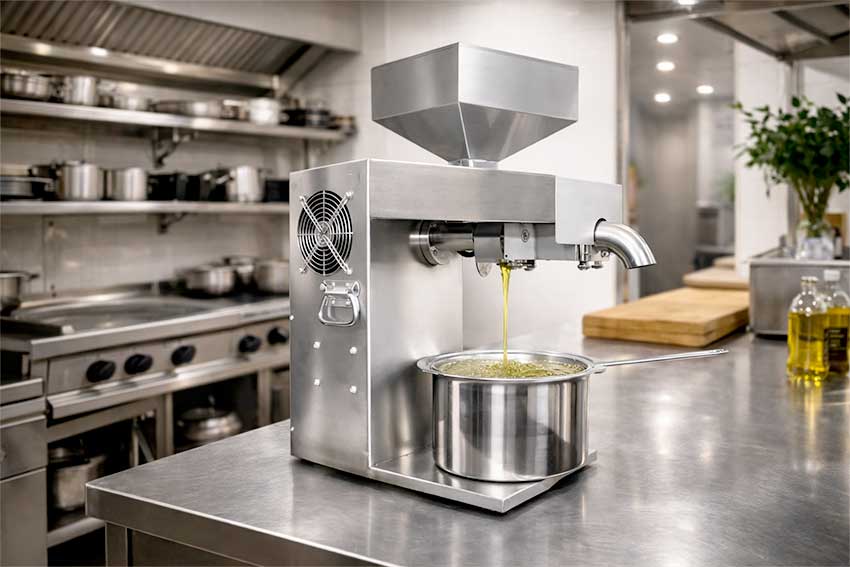
The key issue in a restaurant is space. Kitchens, especially in older buildings, often do not have an excess of square meters. A compact press measuring seventy by thirty by seventy-four centimeters takes up about as much space as a standard commercial dishwasher. It can stand on a counter, in a corner of the back room, or even in a visible place if the establishment's concept allows.
Food Trucks and Mobile Gastronomy
A food truck is an even more demanding environment space-wise. Every centimeter must be used functionally. Is there room for an oil press in such conditions? It turns out yes, with thoughtful organization. Food trucks specializing in healthy cuisine, salads, or vegan concepts can make own pressing the central element of their offering. A press installed on the vehicle's external wall, visible to customers waiting for orders, becomes living advertising.
In a food truck, device stability is crucial. A press weighing about fifty-three kilograms requires solid mounting so it does not shift during driving. At the same time, it must be possible to quickly disassemble if we regularly move the vehicle between different locations. A two hundred thirty volt power system is standard, which poses no problem when connecting to aggregates used by food trucks.
Food Manufactures
A food manufacture is a somewhat different category. Here oil production is not an addition to main activity but its essence. Manufactures often combine retail sales with gastronomic services - they have a small tasting point, sell oils in bottles, offer culinary workshops. In such a business model, the press works more intensively, often daily for several hours.
For a manufacture, maintaining constant product quality is key. Customers buying a bottle of oil one week expect the same taste and aroma a month later. This requires process standardization - the same seed suppliers, the same pressing temperature, the same sedimentation time. A professional press with precise parameter control is indispensable here.
Bistros and Cafés
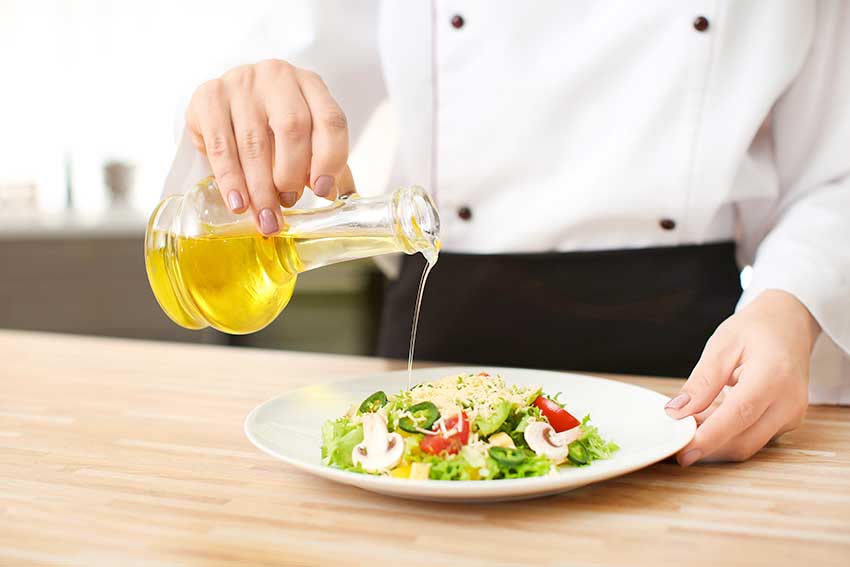
Bistros and cafés with extended gastronomic offerings are another niche. Fresh oil can be an element of a comprehensive healthy breakfast or lunch offering. A sandwich with whole grain bread, avocado, and a drop of fresh flaxseed oil sounds much more premium than the same sandwich with supermarket olive oil. In cafés, oils also find application in baking - fresh sunflower oil in cakes gives them moisture and delicacy impossible to achieve with mass products.
Economic Aspects and Return on Investment
Initial Investment Cost
The decision to purchase an oil press is an investment that requires economic analysis. The cost of a semi-industrial device is approximately $2,700. This includes seeds, bottles if we plan retail sales, and possibly labels. Is such an investment profitable?
Savings from Own Production
The calculation is relatively simple. A liter of cold-pressed sunflower oil, high quality, costs retail from twenty to thirty dollars. The cost of producing the same liter in a private press is about seven to ten dollars, counting seeds, energy, and equipment depreciation. The margin is therefore clear, even if we do not sell oil separately but use it only in the kitchen.
For a restaurant using ten liters of oil weekly, the savings are from one hundred to one hundred fifty dollars. Per year, this gives about six thousand dollars. The simple return on investment is thus less than two years, which in the restaurant industry is an acceptable result. If we additionally sell oil in bottles for thirty dollars per liter, obtaining a margin of about twenty dollars per bottle, the return accelerates significantly.
Marketing Value and Possibility of Price Increases
Marketing value is harder to quantify but real. A restaurant offering fresh, pressed on-site oil can raise dish prices by a few percent without risk of losing customers. The argument of freshness and quality is strong enough that people accept a higher price. In practice, this means that a salad that cost twenty-eight dollars can cost thirty-two dollars if we emphasize in the menu that the oil is our own pressing.
Promotion on Social Media
Social media is a modern promotional tool whose power cannot be underestimated. A post showing the oil pressing process, with a caption about freshness and quality, generates more engagement than a photo of a finished dish. People want to know what happens behind the scenes. They want to see the process, meet the people who prepare their food. An oil press provides infinite possibilities for such authentic communication.
Cooperation with Local Producers
Cooperation with local seed producers is another economic and marketing aspect simultaneously. Instead of buying seeds from wholesalers, direct relationships with nearby farmers can be established. This lowers cost by eliminating intermediaries but also provides a great story to tell. Customers will appreciate information that the sunflower in their salad grows twenty kilometers away, from Mr. Smith, who has been farming organically for thirty years.
Technical Aspects of Equipment Selection for Small Gastronomy
Stainless Steel Construction
The technical parameters of a press are as important as its efficiency. Poorly chosen equipment can bring more frustration than benefits. Stainless steel construction is an absolute standard in gastronomy. Elements in contact with food must meet appropriate sanitary standards, guaranteed by steel types 304 and 420. These grades are corrosion-resistant, easy to clean, and do not chemically react with acids contained in oils.
Motor Power and Work Culture
Motor power determines not only efficiency but also work culture. A motor of about one and a half kilowatts is optimum - powerful enough to efficiently process seeds, but not so large as to generate excessive noise or consume much energy. In practice, this means the press can work in the background without interfering with kitchen functioning. Staff does not need to interrupt conversation or raise their voice when the device is on.
Heating System and Temperature Control
The heating system is an often underestimated element. A heater of five hundred watts ensures precise temperature control in the pressing chamber. This is crucial for maintaining cold-pressing parameters. Too high temperature destroys sensitive ingredients, too low decreases efficiency. Automatic regulation eliminates these problems, allowing setting the desired temperature and forgetting - the device itself maintains optimal conditions.
Hopper Capacity
Hopper capacity is a parameter determining how many seeds we can pour in at once. Four to five kilograms is a convenient working size - enough so we do not have to refill every few minutes, but not so much that it is difficult to mix different types of seeds or experiment with small batches. In practice, this means the possibility of working for half an hour without operator intervention.
Power Supply and Device Weight
Two hundred thirty volt power is a universal standard eliminating the need for three-phase power installation. This is especially important in older buildings, where bringing four hundred volts would be costly and complicated. An ordinary kitchen outlet suffices, giving flexibility in equipment placement.
A weight of about fifty-three kilograms is stable construction that does not vibrate during work but simultaneously does not require a reinforced base. It can be placed on a standard stainless steel counter. For comparison, a typical commercial dishwasher weighs similarly, so standard kitchen construction standards easily withstand this.
The Pressing Process and Work Organization
Seed Preparation
The pressing process itself is not complicated but requires understanding basics. Seeds should be clean and dry, with moisture below ten percent. Excess moisture leads to lower efficiency and can cause screw clogging. In practice, this means seeds should be stored in a dry room, in closed containers protecting against moisture.
Press Warming and Starting Pressing
Before starting pressing, the press requires warming. This is a few minutes during which the heater raises chamber temperature to working level. This time can be used to prepare seeds - measure the appropriate amount, possibly sift to remove impurities. After warming, we pour seeds into the hopper and start the screw.
Oil and Press Cake Collection
Oil flows in a stream from a special outlet and goes into a placed container. In the first minutes it may contain particles, so some operators drain the first half liter separately and filter it later. After this initial period, oil flows clean and transparent, ready for direct use or pouring into bottles.
Press cake, the residue after pressing, falls from the second outlet. This is not waste but a valuable byproduct. Press cake contains protein, fiber, and oil residues, making it an excellent ingredient for animal feed. Some restaurants cooperating with local farmers give press cake away for a symbolic dollar, creating a closed-loop economy model. Others use it in the kitchen - sunflower or pumpkin press cake can be ground and added to bread to increase nutritional value.
Cleaning and Maintenance
Press cleaning should occur daily after finishing pressing. This is simple - disassembling several elements, washing them with warm water and mild detergent, drying, and reassembling. The whole operation takes about fifteen minutes. Regular cleaning prevents residue accumulation, which could transfer taste between batches of oil from different seeds.
Seasonality and Production Planning
Demand Fluctuations Throughout the Year
Gastronomy is a seasonal business, which directly affects press use. In summer, when the menu abounds in salads and light dishes, demand for fresh oils grows. A restaurant may press several dozen liters weekly. In winter, when guests prefer warm, fatty dishes, consumption drops. Production flexibility is one of the advantages of own pressing - we adjust quantity to actual needs.
Seed Availability and Storage
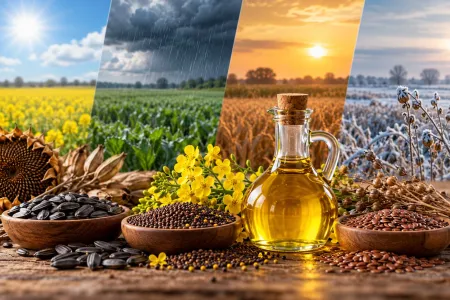
Seasonality also concerns seed availability. Rapeseed is harvested in spring, sunflower in late summer. Planning seed purchases therefore requires foresight and appropriate storage. Seeds in appropriate conditions - dry, cool, dark - retain properties for a year or longer. Some restaurants buy an annual seed supply directly from local farmers right after harvest when prices are lowest.
Seasonal Menu and Storytelling
The seasonal menu is a trend increasingly present in gastronomy. Fresh oils fit perfectly into it. Spring rapeseed oil for salads with young vegetables. Summer sunflower oil for grilled dishes. Autumn pumpkin oil for creamy soups. Winter flaxseed oil for roasted root vegetables. Such cyclicity not only makes culinary sense but also provides marketing structure - each season is a new story to tell.
Press Sharing Between Establishments
Cooperation with other establishments is a rarely considered but noteworthy possibility. Restaurants located close to each other can jointly use a press, sharing purchase and operating costs. Such a model requires good organization and trust but can significantly lower the entry threshold for those unsure if own oil production will work.
Marketing and Customer Communication
Communication in the Menu
Fresh oil is a product but also a story. How we talk about it determines whether it becomes a differentiator or just a curiosity. The menu is the first place of communication. Instead of simply writing "salad with sunflower oil," we write "salad with sunflower oil pressed this morning in our kitchen." These few extra words make an enormous difference in perception.
Information on Tables and at the Station
Table cards are another channel. A small stand with information that oils used in the restaurant are our own pressing, with the current production date. Guests will appreciate this, especially those nutritionally conscious. Some establishments go further and place a board at the pressing station showing what seeds were used that week.
Culinary Workshops
Culinary workshops with press participation are an event combining education with promotion. Participants learn not only how to press oil but also how to use it in cooking. Such workshops can be organized once a month, on less busy days of the week, increasing restaurant space utilization. Participation fees often cover seed costs and still provide a profit margin.
Cooperation with Local Media
Local media willingly write about restaurants doing something unusual. Own oil pressing is a topic for an article in the local newspaper, radio interview, regional television report. Such promotion is free and very effective because it builds credibility. Readers trust journalists more than advertisements.
Social Media Strategy
Social media requires regularity. A post showing the pressing process weekly may seem monotonous, but in practice each process is slightly different. Different seed type, different season visible through the window, different team member at the press. This diversity within one theme builds a coherent brand narrative.
Common Challenges and How to Solve Them
Problem of Time Underestimation
Every technology has its challenges, oil pressing is no exception. The most common problem is underestimating the time needed for the entire process. Pressing itself is one thing, but there is also seed preparation, press warming, cleaning after finishing work. Altogether, this may take three to four hours. That is why it is so important to plan production at times of least kitchen load.
Seed Quality
Seed quality can be unpredictable. Different batches from the same supplier may differ in moisture or cleanliness. This affects efficiency and oil quality. The solution is testing a small sample before processing the entire batch. If seeds require drying, this can be done in a gastronomic dryer overnight.
Sedimentation and Filtration
Oil sedimentation is a natural process but requires patience. Freshly pressed oil contains suspended fine particles that settle to the bottom within twenty-four to forty-eight hours. Some restaurants filter oil immediately using paper filters, speeding up the process. Others let it naturally clarify, which gives even better quality but requires advance planning.
Oil Storage
Oil storage requires appropriate conditions. Cold-pressed oil is sensitive to light and high temperature. Dark bottles of opaque glass or stainless steel, stored in a cool place, are minimum. Some restaurants invest in a small refrigerator dedicated only to oils, extending their durability.
Production Documentation
Production documentation is necessary if we sell oil retail. A register of pressing dates, used seeds, amount of produced oil must be maintained. In case of health inspection, this documentation is the first thing inspectors ask about. Even if we do not sell oil separately, keeping a simple production journal helps in inventory management.
The Future of Own Pressing in Gastronomy
Growing Trend of Own Production
The trend of own ingredient production in gastronomy will intensify. Consumers increasingly demand transparency, want to know what they eat and where it comes from. Restaurants that can answer these questions with concrete actions will gain competitive advantage.
Technology Development
Press technology will develop toward even greater automation and precision. Already now models with digital control of all parameters, cloud data recording, automatic alarm in case of irregularities are appearing. In a few years, a press will be able to send a message to the seed supplier itself when stock runs low.
Organic Certification
Organic certification is another development direction. More and more farms offer seeds with organic certification, and customers are willing to pay more for oil from such seeds. Own pressing gives control over the entire production chain, facilitating obtaining such certification.
Deepening Cooperation with Agriculture
Cooperation between gastronomy and agriculture will deepen. A model where a restaurant contracts a specific farmer to grow certain seeds will become more common. This gives the restaurant certainty of supplies and quality, and the farmer a stable income source. Such partnerships often translate into joint marketing activities beneficial to both parties.
Consumer Education
Consumer education is an area where restaurants can play an important role. Most people do not know how cold-pressed oil differs from refined. They do not understand why freshness matters. Restaurants showing the process, talking about it, educating through their own example, build awareness that later translates into changing purchasing habits of entire local communities.
Is It Worth Pressing Your Own Oil in Small Gastronomy?
The answer is: yes, if you are ready to treat it seriously. This is not a gadget or temporary trend. This is an investment in quality that requires commitment, planning, and consistency. But if these conditions are met, benefits significantly exceed costs.
A semi-industrial oil press, such as the LY-129 model available at https://www.pureoilpress.com/en/product/semi-industrial-oil-press-15-20-kgh, eliminates most entry barriers. It is sufficiently efficient for business but not so large as to require a dedicated production room. Quiet operation allows installation in the kitchen or back room without disrupting normal functioning. The ability to press different seeds gives menu flexibility and allows culinary experiments. This is equipment combining professionalism with practicality, which in the world of gastronomy is a rare and valuable trait.
Does every restaurant need its own press? No. But every restaurant, food truck, or manufacture that wants to stand out with quality, authenticity, and freshness should at least consider this possibility. In a world full of mass production and standardization, the ability to say "this oil was pressed here, this morning, especially for you" is something no mass producer can offer.
How to Start Pressing Cold Oil in Your Gastronomic Kitchen?
Step One - Analysis and Planning
The first step is research and planning. You need to understand how much oil we actually use, what types, in what culinary applications. This will allow determining whether investment in a press makes economic sense. For an establishment using five liters of oil weekly, return may be long; for one using twenty liters, it will be very fast.
Step Two - Choosing a Seed Supplier
The second step is choosing a seed supplier. You can start with wholesalers offering oilseeds for the food industry, but it is also worth looking for local farmers. Direct cooperation often gives better quality and lower price, plus has invaluable marketing value.
Step Three - Team Training
The third step is team training. Press operation is not complicated but requires basic process knowledge. Every kitchen member should know how to start the press, clean it, what to do in case of problems. This cannot be just one person's knowledge because if that person happens not to be on shift, production stops.
Step Four - Communication with Guests
The fourth step is communication. From the first day of pressing, guests should be informed about what we are doing. In the menu, on the website, on social media. Producing fresh oil is not enough - people need to know about it and understand why it matters.
Step Five - Process Optimization
The fifth step is monitoring and optimization. The first months are a period of testing and learning. Which seeds work, which do not. How often to press to use oil before it loses freshness. How to integrate the pressing process with kitchen work rhythm. These answers come with practice, so you need to give yourself time to learn.
Why Fresh Oils Are the Future of Small Gastronomy?
Gastronomy is changing toward locality, transparency, and authenticity. Large restaurant chains cannot compete in these areas - their business model is based on standardization and centralization. Small gastronomy has an advantage precisely in what is unique, local, fresh.
Own oil pressing fits perfectly into this trend. This is something fast food will never be able to offer. This is a visible, authentic process, possible to show and explain. In times when consumers are increasingly aware and demanding, such attributes become decisive.
Economics is also on the side of small producers. The margin on fresh oil is large, production costs relatively low, and the entry barrier - thanks to availability of compact semi-industrial presses - significantly lower than just a few years ago. This is a rare situation when market trend, consumer preferences, and business economics align in a favorable arrangement.
FAQ
How much time daily does oil pressing take in a restaurant?
The actual press working time depends on the needed amount of oil. For a typical restaurant producing ten to fifteen liters of oil weekly, one pressing session lasting about three hours suffices. During this time, we process about fifteen kilograms of seeds, which gives us precisely this amount of oil, depending on seed type. Preparation and cleaning time must be added, so altogether we plan about four hours once a week. It is best to do this on a day when the kitchen is least loaded, for example Monday morning before opening. In practice, this means one team member dedicates half a day weekly to oil production, which does not disrupt normal restaurant functioning.
Is own oil pressing economically profitable for a small gastronomic establishment?
Profitability depends on oil consumption scale and ability to utilize marketing value. If a restaurant uses at least ten liters of oil weekly, savings on product cost alone amount to about one hundred twenty dollars weekly, or over six thousand annually. This gives return on press investment within two years. If we additionally sell oil in bottles with a twenty dollar margin per bottle, with sales of just ten bottles weekly we add another ten thousand profit annually. But true value lies in the ability to raise dish prices by a few percent thanks to freshness and quality arguments. For an establishment with fifty thousand monthly revenue, even three percent price increase is fifteen hundred additional monthly income, or eighteen thousand annually.
What seeds work best in gastronomy for daily pressing?
Hulled sunflower is the absolute basis - universal, easy to press, giving oil with neutral taste fitting most dishes. Rapeseed is the second must-have, especially if the menu includes dishes fried at higher temperatures. Flax is more niche due to intense taste but invaluable in salads and cold dishes. For restaurants beginning adventure with own pressing, the best strategy is focusing on these three basic seeds and only after mastering their handling experimenting with more exotic options like black cumin, pumpkin, or hemp. Each of these seeds requires slightly different pressing parameters, so it is better to master basics before moving to advanced techniques. It is also worth remembering that different seeds have different seasonal availability and prices, which should influence purchase planning.
How long does cold-pressed oil maintain freshness in gastronomic conditions?
Freshness of cold-pressed oil depends on storage conditions and seed type. Sunflower oil in a dark bottle, at room temperature, maintains full properties for about four weeks. In a refrigerator, this time extends to eight weeks. Flaxseed oil is more delicate and should be used within two to three weeks, preferably stored in a refrigerator. Rapeseed oil falls in between - about six weeks in a cool place. In gastronomic practice, the best strategy is pressing once a week such quantity that will be used before the next production session. This guarantees oil is always maximally fresh. For larger restaurants, it is worth having two bottles of each oil type - one in active use in the kitchen, another in reserve in the refrigerator. Proper bottle labeling with production date is also key so the team knows which oil to use first.
Does an oil press require special permits for operation or maintenance?
An oil press is a relatively simple device to operate and does not require any special certificates or permits. Anyone after brief training, usually lasting an hour or two, can safely operate the press. Basic principles are understanding the process of pouring seeds, controlling temperature, and collecting oil and press cake. Maintenance comes down to daily cleaning after finishing work, taking about fifteen minutes, and periodic replacement of wearing elements like screws or seals, which happens once every few months of intensive use. Most manufacturers offer technical support and provide detailed operating instructions in English. However, it is worth choosing a press from a manufacturer or distributor offering service in your region so that in case of technical problems you can quickly get help. Regular technical inspections are not legally required but recommended once a year to maintain optimal efficiency.
How to organize space in a small kitchen to fit an oil press?
A semi-industrial press measuring about seventy by thirty by seventy-four centimeters takes up about as much space as a standard commercial dishwasher or smaller planetary mixer. The best solution is placing it at a permanent station on a work counter, preferably near a power source. The press does not have to stand in the central kitchen place - it can be in a corner, in the back room, or even in an adjacent room if available. It is important to ensure about half a meter of space around the device for comfortable operation - space to place containers for oil and press cake, and access to the hopper. Some restaurants install the press on a wheeled cart, allowing it to be moved to less used places during normal kitchen work and taken out only for pressing time. In open kitchen concepts, it is worth considering placing the press in a visible spot behind a transparent wall or counter so guests can observe the process. This solution combines functionality with marketing. Planning space for seed storage is also key - ideally in sealed containers in a cooler room than the main kitchen.
What are the most common beginner mistakes when pressing oil in gastronomy?
The most common mistake is underestimating the importance of seed quality and preparation. Seeds that are too moist, contaminated, or old give poorer quality oil and can damage the press. The second widespread problem is impatience - forcing the press to higher efficiency than the manufacturer provides, leading to overheating and oil quality deterioration. The third mistake is neglecting daily press cleaning, resulting in residue accumulation, taste transfer between different seed types, and ultimately technical problems. Fourth is poor oil storage - in transparent bottles, in bright and warm places, drastically shortening its durability. Fifth is lack of systematicity - random pressing when the mood strikes instead of a regular schedule leads to situations when oil suddenly runs out in the middle of peak time. Sixth mistake is poor team communication - if only one person knows how to operate the press, their absence blocks production. The last common problem is underestimating the marketing value of own pressing and ineffective communication to guests, wasting enormous potential for market differentiation.